Craig Camp Craig Camp

Micah and Nate: Selling and Making Biodynamic Wine

I am excited to share new podcast episodes that share the stories of how two people arrived in the winery trade by very different paths. I find that most passionate wine professionals had a rainbow of visions for their future before wine became that future. 

While wine may be made in the vineyard, it is also made by people. It is also sold by people. Too often, we separate the two, but the combination of plants and people makes our world at Troon Vineyard. In our Troon Talk Conversations, we tell those stories. 

Nate Winters arrived at Troon after a stint in the U.S. Army, where he spent his time jumping out of perfectly good airplanes. Afterward, a brief interlude waiting on tables led him to a tasting room job at Troon, where he moved up the ranks, becoming tasting room manager. Then he spent a year working in our Biodynamic cellar and vineyard before taking over as director of sales. In addition, he achieved the rank of Certified Sommelier from the Court of Master Sommeliers. He still spends a lot of time in airplanes, but no longer has to jump out of them. 

Assistant winemaker Micah Wagner started down the culinary route before detouring into an academic wine business program. Fortunately for us, she entered the wormhole that teleports otherwise rational people into a life in the wine cellar – she took a job as a harvest intern. Micah brings an unusually broad range of experience to her work at Troon, having worked on other Biodynamic vineyards, hopped around the globe as a harvest intern, and even managed a custom crush winery in California. It is hard to imagine a better winemaking school than running a custom crush, where you have to deal with many different winemakers, all with different visions. 

Their paths into wine are worth hearing. Each offers a unique insight into the world of Biodynamic winemaking and how to bring those wines to market.

Nate Winters: Selling Biodynamic Wine with a Certified Sommelier Paratrooper

Micah Wagner: Champagne and a Winemaker’s Voyage

Read More
Craig Camp Craig Camp

Winegrowing in Oregon's Applegate Valley, a Conversation with Master Viticulturist Jason Cole

To paraphrase Dr. Suess, 

From there to here, from here to there,

gambling things are everywhere

Gambling seems to have overtaken the world, and it’s hard to find something you can’t bet on. Every sports event is awash in ads for gambling apps. Casinos are now everywhere and you can even bet on if the pitcher was going to throw a curve or a fastball. Some even made money on betting if we were going to war or not. By all accounts, the easy availability of gambling is causing all sorts of social ills. 

None of these opportunities tempts me to risk my money, as my job involves gambling. I’m not a dealer or a croupier—I work in agriculture. In farming, like in casinos, the house, or, in our case, Mother Nature always wins. 

Like all gamblers, our mission is to improve our odds against the house. As a Biodynamic winery, we strive to work in harmony with nature rather than against it. Industrial chemical farming cheats to beat the house. That’s a good way to end up, in Godfather speak, sleeping with the fishes. Instead of sleeping with the fishes, we apply them to our soils. 

The only legitimate way to improve your odds in farming is to be a good farmer. In our case, our good farmers are director of agriculture, Garett Long, and our master viticulturist, Jason Cole.

In this episode of our podcast, we have an in-depth conversation with viticulturist Jason Cole, following his deep academic foundation in viticulture, how that has evolved as he has practiced in the real world, and how introducing him to Biodynamics has influenced his farming. We also look at the unique aspects of growing wine grapes in Oregon’s Applegate Valley and why that makes our wines so distinctive. 

So, instead of that gambling app, open your podcast app and listen to this new episode of The Wine Camp Podcast: Winegrowing in Oregon’s Applegate Valley, a conversation with Master Viticulturist Jason Cole. 

Read More
Craig Camp Craig Camp

The Farm at the Table

The farm-to-table concept is in vogue in the restaurant world. We go beyond that at Troon Vineyard & Farm, where the farm and the table are just minutes apart. During last Sunday’s Garden to Guest lunch, Chef Carl realized he needed more daikon for his Cover Crop Salad on the menu. He walked out the back door of the kitchen and picked some, and five minutes later, he was slicing the daikon fresh out of the ground. At Troon, the farm and the table are inseparable. 

Farm-to-table and food-and-wine matching are fashionable and promoted by restaurants, but at Troon, everything we grow arrives at the table together, reflecting our Biodynamic® and Regenerative Organic Gold Certified® farming, winemaking, and cooking. Our wines intertwine with the food we grow when you dine at Troon. The Biodynamic ideal of the whole farm as an organism arrive to our guests as they experience The Troon Table.

Troon’s chef-in-residence, Carl Krause, is in daily contact with our farmer and vinegar maker, Jennifer Teisl, as they seek to express the seasons of the produce we grow at Troon. Jennifer, Carl, and Troon’s director of agriculture, Garett Long, plan our garden from the beginning to the end of last harvest to supply a range of produce to inspire Chef Carl’s creativity as we harvest the bounty of our farm throughout the year. 

It’s an amazing privilege for us as winemakers to enjoy the wines we craft in harmony with the food we grow. This biodiversity not only improves the health of our farm and the quality of everything we grow, but also expands our vision and appreciation for the wines we grow. It makes us better farmers and winemakers. 

In this episode, Chef Carl Krause and farmer Jennifer Teisl tell the story of how they take Troon beyond farm-to-table to become The Troon Table.

Read More
Craig Camp Craig Camp

A Conversation with Garett Long: Biodynamic Soil Scientist

Garett Long has a superpower. He is a true believer. The energy he draws from that inspiration directly translates into the quality and nutrition of the crops he grows. 

Garett’s true beliefs encompass two systems that many assume are mutually exclusive – Biodynamics and science. The intertwining of Biodynamics and science is the core of our daily agricultural practice at Troon Vineyard & Farm.

Almost every week, I run across another article that brings modern agricultural science closer to the concepts behind Biodynamics. The vocabulary may be different, but the problems they address are the same. One major difference is that commercial agricultural science is focused on patenting products to sell for profit. Other than investing your own time and labor, the Biodynamic preparations are free if you grow and harvest them yourself. It’s tough to get big companies behind products without an ROI.

Mycorrhizal fungi, soil and plant microbiome, silica for cell wall strength and pest resistance, the influence of the Moon’s reflected sunlight, and bio-stimulant products are slowly becoming common concepts and products used on conventional farms. Slowly but surely, more farmers are rediscovering that it’s easier to work with nature rather than trying and failing to conquer it. 

In this episode of our podcast, Garett weaves these two practices together as he tells both his personal story and the story of our farm. After listening to this episode, Garett said he regretted forgetting to mention one of his mentors — nature. I think you will agree that nature is never forgotten in this episode.

Read More
Craig Camp Craig Camp

A Harvest 2025 Retrospective

It takes a few months after harvest to assimilate everything that happened and to begin to look towards the next vintage. We analyze the effectiveness of our vineyard strategies and formulate our farming in our constant quest for improvement. The wines themselves are just beginning to reveal their personalities as they slowly complete malolactic fermentation. It is only now, months after we picked the last grape, that we can more completely understand what our partnership with nature has created. 

In this episode of our podcast,  Troon Vineyard winemaker Nate Wall and assistant winemaker Micah Wagner discuss the known and unknown aspects of being Biodynamic winemakers. Biodynamic wines are created in nature’s continuum, in which humans are only here to support, not control. This discussion will give you an inside look at how differently Biodynamic winemakers think about their craft.

Read More
Craig Camp Craig Camp

Nature's Hide and Seek

Harvest Night at Troon Vineyard

“The power of Biodynamics is the power of observation. Long before lab reports and soil panels, a farmer’s most reliable instrument was attention — to the moon, the constellations, the textures of their soils.”

In Ten Keys to Reality, Nobel Prize-winning physicist Frank Wilczek discusses the concept of complementarity. Complementarity, as described by Wilczek, underscores the intricate and interconnected nature of the quantum world, where seemingly contradictory properties can coexist and enrich our understanding of the universe. In the dance of quantum mechanics, we find that the more we try to pin down certain properties of particles, the more elusive others become. It’s as if reality is playing hide-and-seek with us, revealing itself in glimpses of complementary truths.

This, of course, made me think of wine. 

There are a lot of people in the world confident they know all the answers; they are the same people who are wrong quite a bit of the time. Somehow, this does not deter them. They need to connect with complementarity. 

A popular pastime for these people is trashing Biodynamics. They don’t realize that Nature is playing hide and seek with us. They deny the unknown, while Biodynamic farmers join in the game.

At Troon Vineyard & Farm, we are avid users of lab analysis and almost everything we grow is analyzed multiple times, both during the growing season and after harvest. These lab reports clearly lay out a myriad of results, many with colorful graphs denoting high, low, and normal ranges for your crop. The amount of data we assemble is amazing, and we track the trends year after year. This data is valuable and a great asset as we work to improve our farm’s health. 

The rub comes when what is indicated as a remedy, as laid out by conventional agricultural experts, does not always work. This is when the game of hide and seek begins, and a biodynamic farmer has an edge in this game.

Our understanding of soil health is far from complete, and while science has made significant progress, Nature is still winning the game. There is one reality that we can be sure of – Nature always wins.

The focus of Biodynamics is on soil health and working with the natural systems that Nature has evolved. Conventional agriculture destroys the soil’s natural system and then tries to replace what is lost with chemicals. This forces plants to live in an environment foreign to them. The resulting struggle means they demand more and more chemicals. The plants become addicts and the farmers pushers. 

The conventional people see Biodynamics as spiritual silliness. They have a reason to see Biodynamics in this light, as a segment of the Biodynamic community comes to the practice from a belief in Anthroposophy, a spiritual science created by Rudolf Steiner. But many farmers simply come to Biodynamics seeking a better way. Winegrowing is home to many of the latter types. You can be a Biodynamic farmer without following Anthroposophy. Spirituality is a personal experience, and any farmer who spends years working the land develops their own, individual spiritual connection to that land. Eventually, you connect to those energies that create life, the microbiome of the soil, and what i required to sustain it. You can make those connections without even knowing who Steiner was. 

The power of Biodynamics is the power of observation. Long before lab reports and soil panels, a farmer’s most reliable instrument was attention — to the moon, the constellations, the textures of their soils. They noticed where and when things went right or wrong and passed what they learned down through countless generations, refined by people who had no choice but to notice. Today, we are privileged to blend that knowledge with the revelations of modern science. The proof shows up in our soils — in the dramatic increase of organic matter we’ve measured year after year. I believe this is the superpower of Biodynamics. We just need to be as open to the powers of observation as the farmers who went before us.

Nature still has much to teach us. We just need to learn how to learn again.

Read More
Craig Camp Craig Camp

Harvest 2025

Harvest 2025 at Troon Vineyard

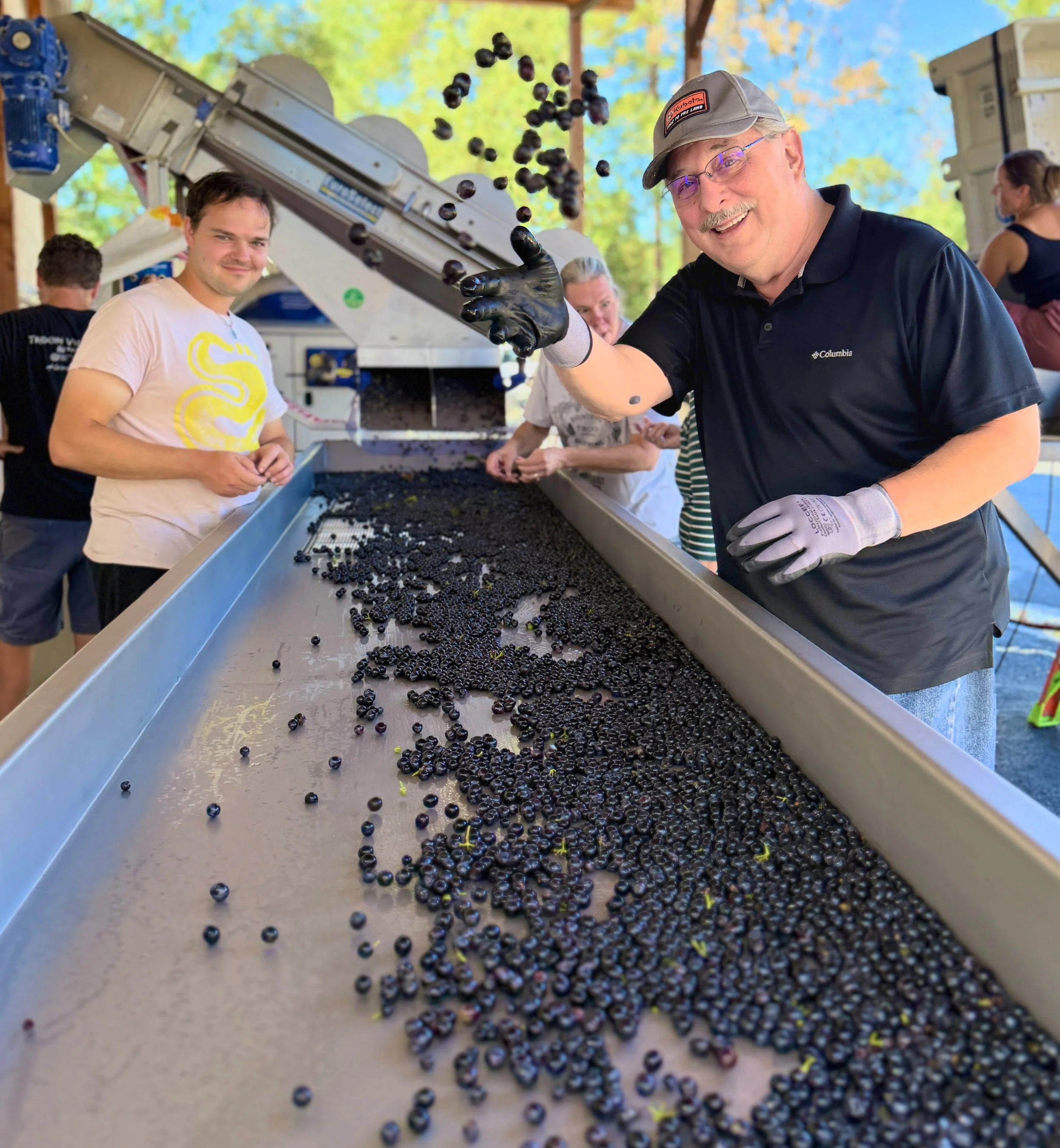
That’s me sorting Syrah

I keep finding earwigs in my hair – and everywhere else for that matter. My right hand looks like a red balloon from a Yellowjacket sting. My feet hurt and I'm sticky everywhere. It must be harvest season again. I love it. 

Dawn breaks with the snip, snip, snip sound of picking crews starting to hand-harvest our grapes. It has been a Goldilocks-type vintage, not too hot – just right. While each vintage is always a learning experience, this is particularly amplified for us at Troon, as our youngest blocks are producing their first crop – our first lesson – while our other blocks mature and continue to educate us about their individuality. While stressful and exhausting, each harvest shares our hopes and vision for the wines we will create.

Making wine is a unique combination of farming and an almost industrial production method. Processing grapes can be like working on an assembly line. Half-ton bins of grapes arrive one after another, hour after hour. However, the experience is defined by the wines you aspire to make. Creativity and intention transform the experience of harvest from grind to a joy.

I’ve seen many harvests. They have ranged from semi-trucks, working like dump trucks, disgorging their tons of machine-harvested grapes into augers, washed in with fire hoses, to vintages with optical sorters that only spit out perfect “blueberries” after blowing away everything else. The first way of making wine is soulless; the other sorts the soul out. One doesn’t care what goes in; as you adjust with additives later, the other delivers cold, unnatural perfection. 

Nature strives for balance until we rudely interrupt it. Somewhere between industrial production and sterile perfection, a soulful winemaking tradition still exists. That’s the wine world we aspire to live in at Troon Vineyard

The soul of a wine grows in the vineyard, and from how you farm it. While the pruned, long rows of vines in a vineyard are not what nature intended, we can strive to work in harmony with evolution to make our vines feel truly at home in our soils. The first step is understanding that the soul we want to achieve in our wines is the soul of each vine. Our farming should encourage each to express their individuality. That diversity gives birth to complexity in your wines. It is what makes your vineyard unique. 

We are unique too. It shows in the wines. Winegrowing for us is farm and farmers in harmony. Both are expressed in our wines. Everyone is tired and nerves a bit frayed, but there remains a foundation of joy in everyone’s work. It is a joyful thing to be part of nature’s process. 

Last January, we took a two-day retreat to evaluate the previous vintage and envision the next. As well as the wines from the 2024 vintage have been received — we knew that our vineyard could give us far more as long as we kept our end of the bargin and gave far more back to our vines. Every bunch of grapes we take is filled with nutrition that has been gifted by the sun and taken from our soils. While we can depend on the sun to return for the next vintage, what we have taken from our soils must be replenished. That is the work that nature has selected for the farmer — we are a link in that system.

The question for the farmer is to feed the soil or the plant. Feeding the soil is investing in the future of your farm; feeding plants directly is an attempt to repair the damage done. That’s a short-term fix. Vines evolved to live in symbiosis with mycorrhizal fungi. The vines take the energy harvested from the sun and share it with the fungi in the soil. In return, the fungi transform nutrients in the soil into a form the vines can use. Chemical and tillage-heavy agriculture destroys the fungi in the soil, leaving plants to rely on direct chemical applications to survive. A healthy, harmonious neighborhood is replaced by drug addicts waiting for a fix. 

At Troon, we are a part of the harvest, a step in a natural system. We are not on an industrial assembly line manufacturing a product, but a partner in the ancient process of winemaking. Making wine does not have to be like making widgets. Both wine and beer are just another crop that farmers have grown for millennia. It is an honor to be part of nature’s continuum. 

So, despite the bugs, bruises, tired muscles and spirit, harvest continues to generate both excitement and exuberance for everyone at Troon. We’re lucky to be a part of something that connects us to generations past and to nature itself. The joy we have in making our wines will be shared in the joy our wines give to the people we can share them with. 

We are all in this together.

Read More
Craig Camp Craig Camp

An Honor

I am honored and humbled by wine writer Jeff Kralik's take on my Wine Enthusiast Wine Star Nomination!

Craig Camp: Champion of Sustainable Winemaking Posted on September 24, 2025 by the drunken cyclist In a world that seemingly has decided to focus on the negative, I tend to relish every bit of good news that comes across one of my various screens. A handful of days ago, however, I did not have to search far as some great news was waiting for me in my in-box.

Craig Camp has been nominated for a Wine Enthusiast Wine Star Award, for Environmental Advocate of the Year. While surely I would be considered by some as relatively “new” to the wine world, I can say without equivocation that I know of no more deserving person than Craig Camp.

Here is the link to his article. 

Read More
Craig Camp Craig Camp

Wine Enthusiast Wine Star Environmental Advocate of the Year Award

Environmental Advocate of the Year

Craig Camp

Troon Vineyard | Grants Pass, OR

In 2016, Craig Camp left his job in the Napa Valley and moved north to Oregon’s Applegate Valley, a quiet area near the California border. Under the Regenerative Organic Alliance’s mantra “farm like the world depends on it,” Camp cares for cider apples, hay fields, honey bees, sheep, chickens, dogs, and grape vines. Camp and the Troon Vineyard team are reviving old, overworked vineyards to make an example out of what responsible agriculture can produce, work that has earned Troon the title of the world’s only Demeter Biodynamic and Regenerative Organic Certified Gold winery. Camp’s deep commitment to fighting climate change extends to advocacy—he’s a member of the board of directors at the Biodynamic Demeter Alliance.
— The Wine Enthusiast

I could not be more honored to be nominated for the new Wine Enthusiast Wine Star Environmental Advocate of the Year Award. It is a privilege to be mentioned alongside a list of such exceptional advocates for our planet and the generations that will follow us.

Our story at Troon Vineyard & Farm is a unique confluence of place, time, and people that have a shared vision. Each member of the team shares an equal commitment to quality and the health of the Earth, believing these concepts are inseparable.

The work at Troon Vineyard & Farm is driven by our team’s dedication to both the quality of the wines we make and the produce we grow, but also to our commitment to make the Earth a better place for the generations that follow us. Just as we have planted vines that will grow grapes that will be made into wines by people we will never meet, we want our work to preserve the climate that enables them to make great wines that will allow our grandchildren and their grandchildren to enjoy them.

I applaud The Wine Enthusiast for introducing the Environmental Advocate of the Year to their prestigious Wine Star Awards. This will build international awareness of how essential it is to work in harmony with the Earth to produce meaningful wines that add to our quality of life not only at our dinner table, but to all life on our planet.

While I am more than honored by The Wine Enthusiast nominating me as a Wine Star Environmental Advocate of the Year, I must honestly share this nomination with our exceptional team. Our winemakers, Nate Wall and Micah Wagner, have a deep belief in minimalist winemaking that expresses the character of our vineyard. Our farmers, Garett Long, Jennifer Teisl, and viticulturist Jason Cole nurture everything growing on our farm to maximize flavors and nutrition. Owners Dr. Bryan and Denise White have made the investments that have fueled all that has been accomplished at Troon. Biodynamic consultant Andrew Beedy has guided us from the beginning. In our tasting rooms, Meg Ordaz, Allison Thomas, and Jen Wahlstrom and their teams convey our vision to our guests, while Nate Winters hits the road to tell our story across the country. The essence of Biodynamic agriculture is the concept of the whole farm as an interwoven organism. Our farm is made whole by this extraordinary team.

Our certifications provide an important foundation for our work. We are proud to have achieved both Demeter Biodynamic® and Regenerative Organic Gold® certifications, and we are the only winery in the world to currently hold both. These certifications communicate to consumers who share our values that we are farming with them in mind. Hopefully, they will also convince other farms that is worthwhile to follow this path.

Dedication to the environment and quality are one and the same. The strategies that create wines with the most distinct personalities are the same that save our planet. All living things evolved under the influence of natural selection. These natural systems created the abundance of life that covers the Earth. In the last century, humans decided we knew better. We need to lose that arrogance.

The so-called Green Revolution created an explosion of quantity and an implosion of quality – more calories, but less nutrition. We need a new green revolution that can still produce quantity while returning both flavor and nutrition to our foods. We cannot continue to separate quality and quantity.

We are proud of what we have achieved on our one hundred acres, but it is not enough to change the world. We want to show that you can not only survive but also thrive by farming for the planet. With no margin, there is no mission. We strive to achieve both.

Farm like the world depends on it, because it does.

Read More
Craig Camp Craig Camp

Ranger to Ranger: The Rhône Rangers

I belong to many wine trade organizations including the Applegate Valley Vintners Association, the Rogue Valley Vintners, and the Oregon Winegrowers Association. I had a similarly long list when I worked in the Napa Valley. Each of these organizations are defined by a place.

Then there are the Rhône Rangers. The Rangers diverge from these place-based organizations as the Rhône Rangers are defined by the varieties they grow. To be a Rhône Ranger wine, 75% of the wine’s content must include one or more of the twenty-two traditional Rhône grape varieties as approved by the French government for the wines of the Côtes du Rhône, with Petite Sirah tacked on because of its early contributions in the American wine industry.

So the Rhône Rangers are not defined by a place, but by an ideal—a belief in the unique characteristics of these classic Southern French varieties as expressed in American vineyards. The members of the Rhône Rangers span the continent, not an AVA.

In this episode of the Wine Camp Podcast, we’re talking ranger to ranger with a panel all of whom have served as president of the organization. Joining us are Jason Hass from Tablas Creek in Paso Robles, Tony Quealy, with Thacher Winery in Paso Robles, Larry Schaffer of Tercero Winery in Santa Barbara, and me here at Troon Vineyard in Oregon’s Applegate Valley.

As you will find in the discussion, the Rhône Rangers as an organization are dedicated to the idea of mutually assured success. It does not matter if you are growing in California, Texas, Oregon, or Virginia; you’ll always find a helping hand and a willingness to share knowledge. The old saying that a rising tide lifts all boats perfectly describes the Rhône Rangers’ philosophy.

Please visit the Rhône Rangers website for information on upcoming tastings. With twenty-two varieties, DEI is alive and well at our tastings!

Read More
Craig Camp Craig Camp

Certified: A Biodynamic Deep Dive with Evrett Lunquist

The foundations for Biodynamic farming combine intentionality with the concept of your farm as a unique integrated organism. That includes the farmers. A guiding principle is to bring as few inputs as possible that are not produced on your farm. That’s our goal.

In January, the Troon Vineyard team spent two days planning—only planning. The entire farm team focused on being better farmers and stewards of our land. Last Friday, the team took time to review progress. In our hands during all these planning sessions were our Biodynamic calendars. Our planning was focused on both making and applying the Biodynamic preparations. Informed by our calendars, we made our plans.

I have practiced Biodynamic farming since 2018 and aspired to it for years before that. Few types of agriculture are more misunderstood, and, to a large extent, that's the fault of the Biodynamic community. Community is not the right word, as Biodynamic practitioners are a diverse group ranging from full-on spiritual anthroposophists to those who have moved forward beyond Rudolf Steiner’s original agriculture lectures and believe there is more science than spirit in how Biodynamic works. Apparently, none of us is doing a good job of communication.

I cringe when reading articles about Biodynamic farming. One oft-repeated misunderstanding is that we bury cow horns throughout the vineyard. We don’t. It is difficult to explain a way of thinking, which is what Biodynamics is in daily practice. Biodynamic farming is both a philosophy and a discipline. The breakdown between the two depends on the farmer.

The discipline is following a plan to achieve your goals. That means working within the Biodynamic calendar as much as Mother Nature allows. Set your schedules for making and applying the Biodynamic Preparations. You always have to be ahead of any problems as there are no quick fix chemicals to correct your mistakes. You have to plan, plan, and plan some more and then be ready to change course as conditions change.

The philosophy connects with life on your farm. From the birds in the skies to the red wigglers in the soil and all the microbiology in between, there is much they have to teach us. It is our job to learn how to listen. Humans are not good listeners. We want to do something — take command. Instead of observing and learning how natural systems work, like our ancestors, we want to impose our will on nature. This has not been a good strategy and we are losing the battle.

In the May 2nd episode of Science Friday, astrophysicist Kelsey Johnson discusses, “Are There Things That We Know We Can’t Know.” Anyone who has farmed Biodynamically would readily agree. At Troon Vineyard, we are committed to science. We do soil studies, analyze our plants and wines using the most modern techniques and finest laboratories. But all that data cannot answer all our questions. Sometimes the farmer’s best tool is their own eyes — as someone said, the best fertilizer for a vineyard is the farmer’s footsteps. Biodynamic farming weaves science, intention, and observation into a system that complements nature rather than trying to dominate it.

Humans have the illusion that they control nature when we are simply part of it. Our goal as Biodynamic farmers is to honor and learn from what we don’t know and what we do. Then, as we learn, we grow our practice of Biodynamics. Steiner was a lens that refocused past wisdom as an antidote to the explosion in the use of agricultural chemicals after the First World War. Farmers were getting sick and turned to Steiner to explore a more natural connection with nature. His last instruction in the Agriculture Course he presented in 1924 was that this was just the beginning, and we were to take his ideas, research them, and build on them. Biodynamics was never meant to be dogma.

Part of the discipline required is certification. The rigors of the certification process sharpen your practice of Biodynamics. Becoming certified requires thought, planning, and discipline on the part of the farmer. Demeter certification guarantees to the consumer that what they are buying is authentic and in alignment with their own beliefs and desires.

In this episode of Troon Talk, we dig deeply into Demeter Biodynamic Certification with Demeter’s director of certification Evrett Lunquist. Evrett speaks eloquently, based on deep reflection, on what it means to be a Biodynamic farmer and the importance of becoming certified. I have talked with few people more adept at explaining the least understood aspects of Biodynamic practices. His views on how they can be woven together with modern agricultural science to make Biodynamics more valuable than ever, both for the farmer and the Earth.

Read More
Craig Camp Craig Camp

Wine Words

Episode One, Two and Three: A Deep Dive into Winemaking - 1: White Wines, 2: Red Wines, 3: Troon Wines

There are a lot of adjectives used to describe winemaking these days. While much emotion is used in debating them, all are inadequate in one way or the other. Some of the most common are:

  • Industrial
    • Designed wines that use all the tools and additives available to create a product to satisfy a specific group of consumers. They are constructed like any mass consumer brand, like soft drinks, snacks, and all ultra-processed food products, and made by committees, marketers, and accountants more than winemakers. The wine shelves in your grocery store are full of them. These wines are interchangeable and better categorized as beverage alcohol rather than wine as they have the same relationship to grapes that Doritos have to corn.
  • Conventional
    • Often wrongly confused with industrial wines, which some certainly are, these are the wines many medium and small wineries produce. Most of these winemakers strive to make a wine with integrity and character. Many also succeed but often make wines that may be technically clean but taste more or less like their compatriots due to the homogenizing impacts of selected yeasts, other additives, and new oak barrels. While these wines can lack individuality, some exceptional examples are among the finest wines made in the world. While many wines in this category are made without passion, many are made with the same commitment to quality and personality as the Biodynamic winemakers discussed next.
  • Certified Biodynamic/Organic
    • Certified winemakers must adhere to a strict discipline and a certification process that guarantees to consumers that their wines are produced according to rigid standards. While not a guarantee of wine quality, they are wines of a place. These certifications are primarily agricultural in scope but require cellar practices that prohibit using almost all additives. While sulfite additions are permitted, the levels are strictly controlled, and producers must submit proof. Unfortunately, while their vineyards may be pristine, their cellars may not be, and these wines can suffer many of the same faults as the natural wines below. At the very least, you know that farming and winemaking and farming were as natural as possible. Some of the world’s greatest, most expensive wines are Biodynamic certified. Some producers claim to use biodynamic methods, but these claims should be viewed cautiously without certification.
  • Natural
    • A popularized winemaking term that has no actual definition or formal requirements except for a small certification in France. All too often, so-called natural wines are marred by faults that overwhelm any sense of vineyard, variety, or vineyard. Many wines that call themselves “natural” are produced from purchased grapes and are more focused on winemaking techniques (or lack thereof) instead of the sense of place. Often, the main requirement for these wines is that they do not add any sulfites to their wine. While they claim to use organic grapes, it is not an actual requirement, and they are often not using certified grapes.

These categories overlap, but these terms are used in the wine media today. So, while great, sound, dull, and terrible conventional, Biodynamic, and natural wines are made, only boring industrial wines are produced.

Back in 2022 I tried to “explain” natural wines, “Natural wines are an expression of the winemaker. Biodynamic wines are expressions of the land. Some wines are both natural and biodynamic, and some are not. You can make biodynamic wines that would not be considered natural winemaking — but why would you? Some wines claim to be naturally made with uncertified fruit, and it’s hard to make a case that they can genuinely be considered natural. Not using sulfur in the winemaking process is not a get-out-of-jail-free card if a vineyard is blasted with it — and other non-organic products.”

Like most things, there is no right or wrong way to make wine. It depends on what goal you are trying to achieve. The wine chemists who construct industrial wine are amazingly talented. It is an astounding technical achievement to produce millions of cases of identical beverages from grapes year after year. Conventional winemakers range from uninspired to the most inspired, each with wines that match their intentions. Biodynamic winemakers see their farm and their wines as one in the same. For better or, sometimes, for worse, their goal is to express each vineyard, variety, and vintage. Natural winemakers focus on what they don’t do rather than where the grapes come from. Sulfite additions seem to be the primary requirement.

As it should be the consumer who gets to choose what they prefer. Fortunately for the wine industry, their tastes run the gamut.

So, for this episode of our podcast, we decided to talk about all of this. You may not be surprised that the discussion did fit into one episode. So this is a marathon of podcasts covering three episodes:

  • Episode 1: General winemaking and making white white
  • Episode 2: Red winemaking
  • Episode 3: Biodynamic winemaking at Troon Vineyard

Please join our winemaking team of winemaker Nate Wall and assistant winemaker Micah Wagner as they take you through the labyrinth of modern winemaking.

Read More
Craig Camp Craig Camp

Farm Life

The foundation of Biodynamic farming is that the farm itself is a living organism. Every living element of the farm intertwines to become one. We tend to focus on plants, wildlife, and soil, but the humans who work the farm are part of the energy that makes each farm distinct.

Work on a Biodynamic farm flows with the seasons. During the cold and damp of winter, we repair and prepare for the growing season. Then, as the weather warms and the buds burst, the labor required also explodes. More help is needed, not just simple labor, but strong backs willing to work with the intentionality that connects Biodynamic farming to the power of nature itself.

That is why we have an intern program at Troon Vineyard & Farm. Now, interns will join the farm team during the summer months. We have had wine harvest interns for many years, as it is part of an aspiring winemaker’s education to work harvests at many wineries as they hone their skills. We are excited to offer a similar program to aspiring Biodynamic Regenerative Organic farmers.

This year, with the expansion of our gardens and orchards, we have expanded our internships to include our farm team. In this episode of Troon Talk, director of agriculture Garett Long and farmer and garden manager Jennifer Teisl share their vision for our farm internship.

Troon Vineyard & Farm is currently the world’s only Demeter Biodynamic® and Regenerative Organic Gold Certified® certified vineyard, farm, and winery, and we offer one-of-a-kind experiences for those who aspire to learn these skills and philosophies. Our whole farm experience includes our interns. You are invited to join us.

For more information on our internships click here.

Read More
Craig Camp Craig Camp

Going Native

Troon Vineyard & Farm

Native gardens are spread throughout the farm

The native gardens at Troon Vineyard & Farm came to be as naturally as the plants in them. A bit of serendipity along with good karma introduced Troon winemaker Nate Wall to Suzie Savoie of Klamath-Siskiyou Native Seeds and our native garden project was born. What started as a small garden continues to expand to every corner of our farm, and integrating plants native to Southern Oregon is now an essential element of our farming philosophy.

Biodiversity is fundamental to biodynamic agriculture as it mirrors the systems that have evolved in nature. We are always seeking a natural balance in our work and from our farm’s produce. While biodiversity is required to be Demeter Biodynamic® Certified, we felt it was essential to go beyond the minimum requirements of certification to achieve our quality goals. It is not enough to simply be diverse. As you will learn in this podcast, to create a more native natural system, you must plant the right plants in the right place.

What started as a small project on one-third of an acre is now spreading throughout our farm – just as native plants should. What has grown from the seed of an idea conceived by Nate and Suzie has grown to include the entire Troon team – both physically and emotionally.

In this episode, the incredibly eloquent Suzie Savoie discusses native plants and seeds with Troon winemaker Nate Wall and director of agriculture Garett Long.

Read More