Certifiable

Cynics often claim wineries get certifications as a marketing ploy. They’re right, but not in the way they think. We are selling something — an idea. That idea is regenerative agriculture. Those that think it’s a slick wine marketing concept need to have a conversation with our accountants.
That’s not to say that biodynamics and regenerative agriculture can’t be profitable, indeed they can be, should be, and better be. As they say, you can’t farm green if you’re in the red. However, you may need to be patient for the profit — it’s worth the wait.
There are many reasons to get organic certifications — all of them good for the planet. You need a framework, a foundation to get started on a complex project based on long-term goals. Rigorous certifications like Demeter Biodynamic® and Regenerative Organic Certified™ (ROC) give a farm an outline of how to move forward. The process sets goals and milestones that help define the work that needs to be done and how to do it. This is critical when you are held to a high standard that demands you progress and improve.
There is no endpoint in the process — you never reach agricultural nirvana. Even if you improve every year, you’re only taking small steps forward for the next generation. There is no finish line, this is a race where the leaders are the ones not moving backward. Continual, gradual improvement is the mission. Building an additional one-percent organic matter in our soil may not sound like a lot to you, but for us, it’s a cause for celebration.
The certification process is a time of introspection and planning. We thoroughly reviewed what we accomplished and discussed what worked and where we fell short. We then plan out strategies for the next season and beyond. By the time the inspector arrives, we are prepared in a way you can never be without a formal process and demanding standards that must be achieved. The challenge is always planning how you will improve and move forward. Each year we add additional layers to our practice.
Your first certification, while an achievement, is only the beginning. It means you have finally arrived at the starting line. Ultimately, you have to build on the outline that the certifications have developed and discover the ideal framework for your farm. While the overall concepts of regenerative agriculture are the same everywhere, you need to sculpt them for your farm — an art that takes years, even generations, to develop fully.
There’s a lot of greenwashing out there. Many “sustainable” certifications sound good on paper but still allow far too many poisons and shortcuts in the field and cellar. While many sustainable certifications are focused on the needs and problems of the producer, Demeter and ROC are concentrated on providing the consumer with a logo on a label that can reliably mean something to them. While I cannot doubt the best intentions of most involved in the many sustainable certifications, their programs fall short of what is needed to save our planet and have been co-opted by big agriculture. These greenwashed logos on labels dilute the meaning of all similar logos on wine labels and only confuse the consumer — which is often their intention. Why achieve a more demanding certification when you can slap a sustainable certificate on your brand without giving up Round-Up and so many other dangerous applications in your vineyard?
Every major grocery chain features organic vegetables, but those sections are dominated by big agriculture, and big organic ag is often not regenerative agriculture. This dilution of the term organic combined with corporate greenwashing of the term sustainable makes more meaningful certifications a necessity.
There are many uncertified, perfectly legitimate practitioners of regenerative agriculture who are just as dedicated to that vision as we are, but by not getting certified and putting those logos on their labels, they are not pushing the movement forward. Yes, they are improving their soils, and capturing carbon, and touching all the bases except one — evangelicalism. Our job is not to change just our farm, but to change all farms.
Putting your certifications on the label is a means of communication, and any brand messaging can be construed as marketing. But the Demeter and ROC logos are essential to communicate to consumers that are devoted to supporting producers who are committed to both the environment producing fruit, vegetables, and livestock that meets both their standards of quality and integrity. Connecting with those customers is an essential element for those that practice regenerative agriculture. With no margin, there is no mission. There are customers who share our values and want to support them. It is our job to connect with them and certification logos clearly carry our message and mission to them. Those consumers consider that a service, not a marketing hack.
Wine has advantages as we have labels to display logos and produce products that can sit on a shelf for extended periods, an advantage not open to many biodynamic farmers. Shipping perishables is challenging for small farmers. This puts winegrowers in a unique position to promote the idea of certifications beyond organic. Telling the story of how we farm is a responsibility, communicating to customers about why they should buy regeneratively farmed products is how we build demand for all ROC and Demeter products — and that’s a sure way to convince more farmers and retailers to change their ways.
Regenerative agriculture is not just about your farm — it’s about all farms.
Growing Forward: A Panel Discussion on Regenerative Agriculture
“Craig Camp, who has been heralded for turning around Troon Vineyards in Oregon’s Applegate Valley points out that in their replanted vineyards “biodynamics is the framework we integrated into our process. Regenerative organic is the next step.” Wine Industry Network.
Please join us for a panel discussion about regenerative agriculture with Paul Skinner, Paul Dolan and Jordon Lonborg and myself as we discus the future of winegrowing.
Dirt is Not Terroir

Mycorrhizal Fungi - Illustration by Michael Rothman - https://www.rothmanillustration.com
It was the early eighties, and I was yet again rereading several chapters of Edmund Penning-Rowsell’s tome The Wines of Bordeaux. I had just spent the day tasting in Graves and Sauternes from the tank and barrel with renowned French wine exporter Christopher Cannan. Now it was night, and I was getter ready for bed in a small, dimly lit guest room above the offices of his company Europvin in the city of Bordeaux. We were visiting the Chateaux he worked with throughout all the appellations of Bordeaux. Each night before sleep I would review the appellations we had visited that day and those we would visit the next. That week long visit to Bordeaux was followed by a week in Burgundy with Becky Wasserman and my nightly reading changed to Burgundy, then a brand-new book authored by Anthony Hanson.
The next year I made a similar trip to Italy. Setting off with famed Italian wine exporter Neil Empson, we visited almost every wine area of Italy to taste at nearly every estate in his extensive portfolio on a three-week tasting marathon. In my bag was a well-worn copy of Burton Anderson’s Vino, the Italian wine bible of the day. My reading pattern was the same as when I was in France, reviewing each night on where we had been and cramming on where we were headed the next day.
I have been lucky over my career to have made multiple such trips to France, Italy, Spain, Germany and Australia. Top that off with many, many trips through the wine regions of California, Oregon and Washington. On each trip I would devour the current wine literature of each region before, during and after each visit.
I was obsessed with wine books and literally would buy and read whatever came out each year and my bookshelves overflowed with dog-eared, wine-stained volumes. This was the era of my life when I was a wine importer and distributor based in Chicago. Then, two decades ago, I made the transition from wine distribution to wine production and my reading list began to change. Slowly but surely instead of reading books about wine, I began reading books about farming. I recently realized this when I noticed that the last five books I’ve read all have the word soil in the title.
Even though my reading materials have changed, I am still as obsessed by the concept of terroir as I was decades ago in that small room in Bordeaux. However, what that means to me has changed significantly.
Those books presented terroir as something magical. That each site is a unique expression of the soil where it was grown. Then you actually start to grow wine and a new reality presents itself.
Take Oregon and Burgundy for example. In the Willamette Valley the soils are volcanic or sedimentary acidic soils. Summers are almost desert-like with no rain for months. Burgundies are grown on alkaline limestone soils and there is rain throughout the growing season. There’s not much in common here except one thing — outstanding pinot noir. Time after time experienced professional tasters find it difficult to tell which wine is Willamette Valley and which is Burgundy.
Burgundy and the Willamette Valley are not alone in this for the same experts can confuse California and Washington Cabernet with Bordeaux and California Coast and Oregon Syrah with Rhône wines. Each of these areas are very different from each other. How it is possible that all can produce wines whose provenance confuses the experts?
The reason is we have always made the cornerstone of terroir the type of soil the vine grows in — limestone, volcanic, granitic, sedimentary and so on. But it turns out that it’s not the exact type of soil that matters as much as the life in the soil itself. It has been this realization that changed my reading from wine books to soil books.
Terroir is not an expression of inert dirt, it is the individual expression of living soil and how a healthy plant intertwines with that soil. Dirt is not always soil. Soil is a system teeming with life.
Obviously, there are distinct sites. Terroir is a combination of many things. Climate and mesoclimate are critical, then there is the human element — row spacing, trellising and picking the right variety for the right place. For example, planting cabernet in a cool climate and pinot in a warm climate is not a great idea. But it takes grapes grown on healthy vines on living soils to make an expressive wine with a distinct character.
What makes for a living soil? Here is where you find the reason that biodynamic wines have a unique liveliness that stands out. Sustainable agriculture is not enough. That only means that you are killing the life in your soils more slowly than industrial agriculture. It is only with regenerative agriculture that you can build soil that creates distinctive, individualistic wines.
Plants and the microbiology in the soil have a complex symbiotic relationship. The plant takes a large percentage of the carbohydrates it produces through photosynthesis and pushes this exudate out through its roots to attract the microbes it needs to extract nutrition from the soil. It can change the mix of exudates depending on its requirements at the moment. A healthy plant decides the microbiology in the soil by the mix of gourmet microbe treats it sends out through its roots. That microbiology then returns the favor by processing the nutrients in the soil into a form the plant can utilize. The healthier the plant, the healthier that microbiology becomes. The healthier that microbiology becomes, the healthier the plant becomes. Not a bad system.
Then we come in and screw it up. The application of pesticides, fungicides and fertilizers destroys nature’s well-tuned system. In that system is to be found what makes a vineyard unique. It is an essential element of what we call terroir. The grapes that make distinctive wines come from vines in vineyards where nature’s system is humming along. Our job as farmers is to assist the plant and soil in regenerating that balance year after year. This is vital when you have a perennial crop like vines that do not lend themselves to crop rotation.
Coming back to the Willamette Valley and Burgundy comparison, perhaps their shared qualities come more from the life in their soils than their geological provenance.
I still read before and after vineyard visits. However, these days they are not wine books, they are soil books. It is in the soil you find great wine.
Demeter Certification
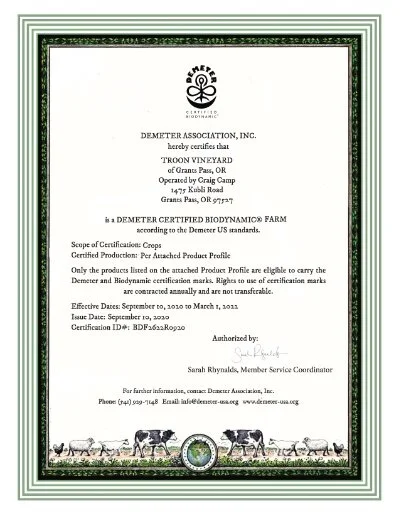
Troon Vineyard one of twelve Demeter Biodynamic® Certified wineries and vineyard in Oregon
It started in a grown over abandoned cow pasture three and a half years ago and ended with Champagne on the patio at Troon Vineyard last week.
The start was picking the site for the compost piles. The Champagne toast was to celebrate what we have achieved in these years in-between. Troon Vineyard is now one of only twelve wineries in Oregon to be certified Demeter Biodynamic® in both the winery and vineyard. To add a bit of icing to the cake, both the vineyard and winery are now also certified CCOF Organic.
Searching with me for a compost site in an abandoned and overgrown pasture over three years ago was biodynamic consultant Andrew Beedy. The new proprietors of Troon Vineyard, Dr. Bryan and Denise White had fully committed to the concept and investment required to transform Troon Vineyard from industrial agriculture to biodynamics. Now Andrew and I started the project forward. If you were standing there that day with Andrew and me and then came back to Troon Vineyard today, you would not recognize you were on the same farm. Only Grayback Mountain, still majestically towering over the Applegate Valley, would tell you that this spot was Troon Vineyard. The distressed, dilapidated and diseased vineyard that was Troon Vineyard in 2016 has been replaced by a living farm. Today, everywhere you look is activity and, most importantly, life.
While media tends to focus on buried cow horns and other photogenic aspects of biodynamics, the heart of biodynamics is the people who practice it. A farm is not a natural occurrence in nature. Mother Nature does not plant grapevines in nice neat rows. Our goal and I believe the goal of biodynamics, is to let the natural systems of nature function as normally as possible in the rather unnatural environment that is a farm.
It takes a village to achieve a goal like Demeter Biodynamic® Certification. Fortunately we built a dynamic team to accomplish this goal. Proprietors Bryan and Denise White have provided a solid foundation for us to build on. Biodynamic consultant Andrew Beedy and viticulturist Jason Cole provided the framework for our vineyard crew, led by ranch manager Adan Cortes, to transform not only the vineyard but the entire property. Our cellar team, winemaker Nate Wall and assistant winemaker Sarah Thompson fully embraced biodynamics and daily keep us moving forward as we expand and deepen our practice of regenerative farming and winemaking.

Troon Vineyard CCOF Organic Certification
For me, I will admit this is an emotional moment as I remember first seeing this vineyard in 2016. Today, when I stand in the same spot where I first surveyed this vineyard, surrounded by the majestic beauty of the Siskiyou Mountains, I can clearly recall feeling that this was a special place and a special vineyard. To see the possibilities I saw transformed into reality sometimes seems like almost a dream, but it is a dream come true.
Certification was a goal and now it is a goal achieved. It fact it just means that we have arrived at the starting line. So much of the work over the last three years has been repairing and restoring and we are far from done with those jobs. Now the goal is to more deeply understand this vineyard, this farm, and to make the practice of biodynamics our own. To achieve certification you are given a set of rules to follow. If you check off all the boxes you achieve certification. Now, as a jazz musician must master the scales before they can improvise, that we have learned to work within the framework of biodynamics, we must learn to go beyond that framework and discover the natural system of this farm. That will be our ultimate goal. Our job is to learn what this farm needs and then do our best to provide for those needs. The next years will be focused on building biodiversity. We will be welcoming some new members to our biodynamic team as next spring a flock of sheep, more chickens, and the requisite guard dogs (Pyrénées of course!) became part of our farm.
We celebrated our certifications with a Champagne toast. We toasted not only to what we accomplished, but what we will accomplish in the future. Becoming one of the few Demeter Biodynamic® Certified wineries and vineyards is a true milestone. Now, on to the next one.
Planting New Vineyards at Troon - It Only Looks Like the Beginning
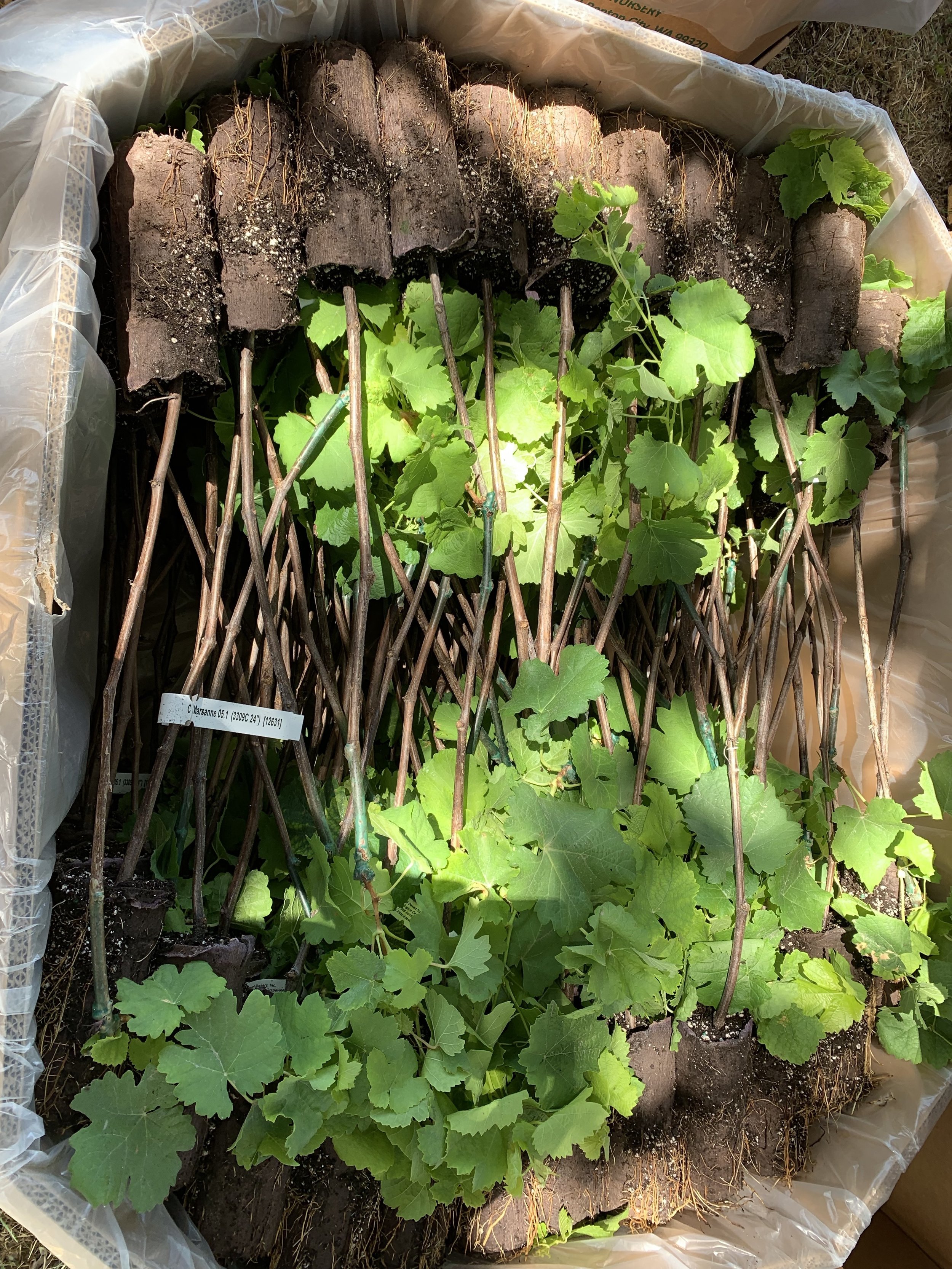
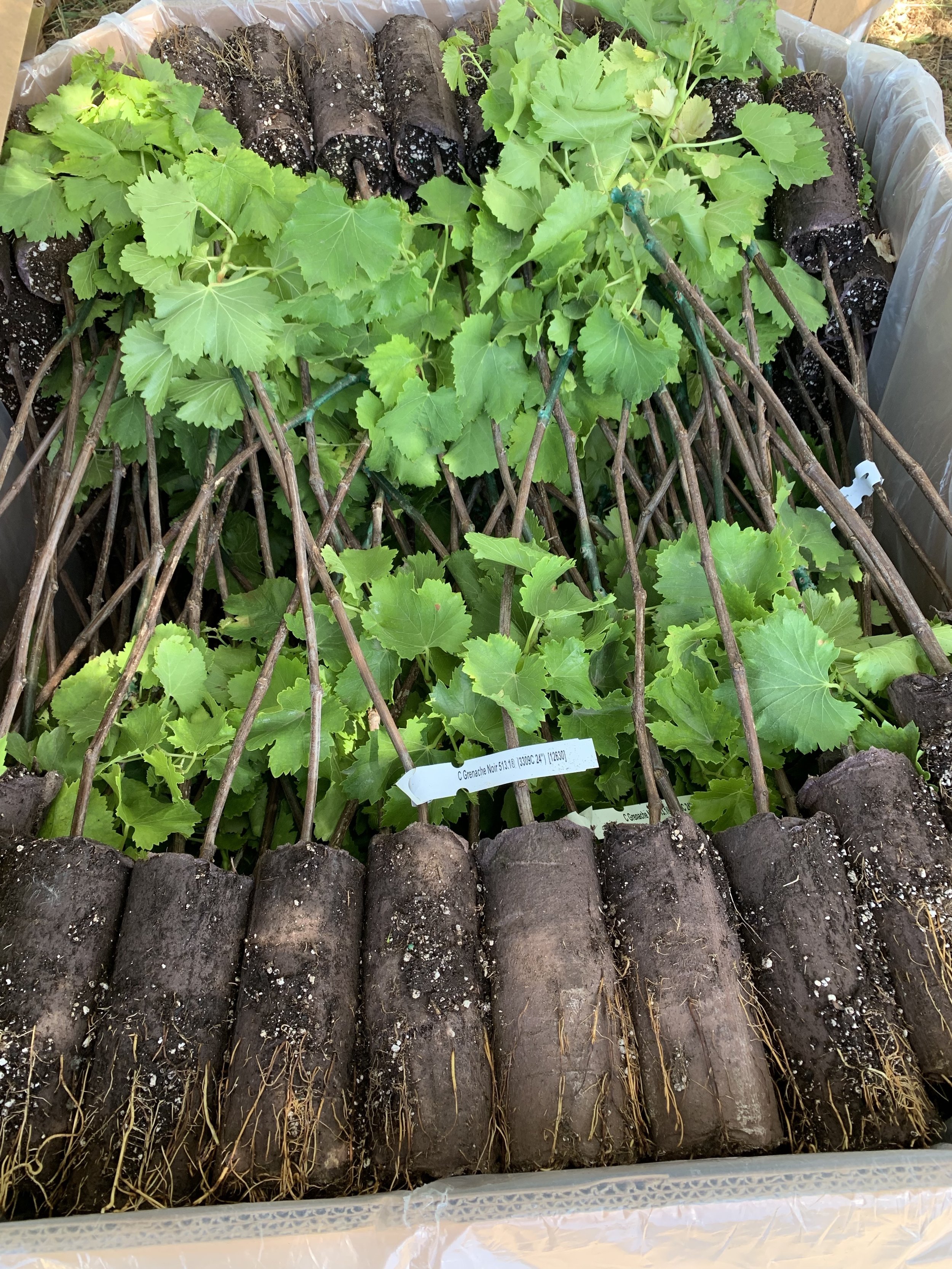
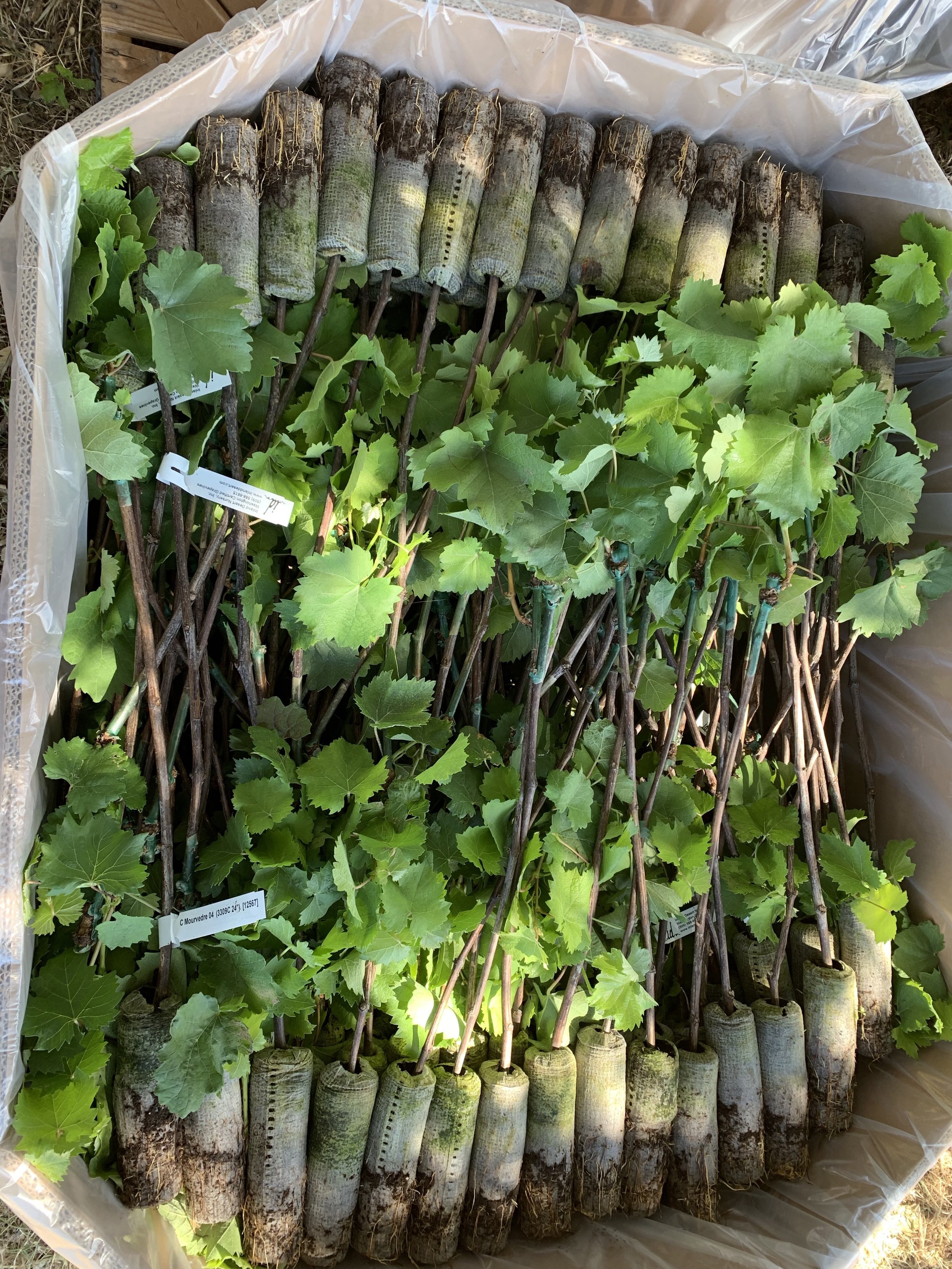
New vines arrived at Troon Vineyard yesterday from Inland Desert Nursery in Washington - mourvèdre, grenache noir and marsanne all neatly packed into shipping boxes. Next week more classic southern French varieties will arrive and within the next ten days, we’ll have planted over 14,000 vines to create ten new acres of vineyard.
Stacked in their shipping boxes they look like the beginning of a project, but it only looks that way. This project started a year and a half ago and the arrival of the vines themselves is closer to the end than the beginning of the project of planting a vineyard. The first step was extensive soil studies as Vineyard Soil Technologies dug more than seventy five-feet deep soil pits to create detailed soil profiles. Based on that data we selected ten acres as ideal for vineyard development. Combining the soil data and climate data with our experience we selected the varieties we felt would be best matched to each vineyard block to be developed. We then begin working with Inland Desert Nursery to obtain the clones of the varieties we chose to focus on. The varieties we were looking for are not the most popular so ordering from the nursery long in advance is required.
Planting does not begin with plants. First, there was the soil work and that filled most of the last year and a half. Once the blocks to be planted were identified the ground had to be prepared. That meant heavy equipment as a D8 ripped the ground to a depth of thirty-six inches. Prior to the ripping, we applied five tons per acre of organic compost along with other soil amendments that we discovered were required by our soil studies. This was followed by discing then yet another finishing discing. When the soil was prepared we seeded a specifically designed cover crop to add nutrition to the soil. As Biodynamic farmers, we also did our first application of Biodynamic Preparation 500.
Over the winter and spring, the cover crop prospered. This was then mowed, then disced into the soil as green manure. Then the vineyard begin to take form as we put in end posts, stakes for each vine (head-trained vines) and irrigation tubes for the soon to arrive young, and very thirsty vines. In addition, another application of Biodynamic preparation 500 was applied to both the blocks to be planted along with all existing vineyard blocks.
Only after all of this investment and work did we arrive at last Friday, when the first vines arrived. Their arrival was the culmination of all of this work, not the beginning. However, these vines mark the beginning of new wines that will come from the grapes they will yield. In that sense, they are truly a new beginning for Troon Vineyard.
As you see, the plan for planting these new acres at Troon was built upon scientific research, extensive viticultural experience, the principles of Biodynamic agriculture and on a vision to make wines with a unique character defined by our soils and the climate on the Kubli Bench in Oregon's Applegate Valley.
Over the next weeks, I will be documenting the process of planting these new vines at Troon Vineyard in words and images. I invite you to share that process with us as we build a foundation for a new generation of wines at Troon.
More Biodynamic Fake News...

Harvest 2018 at Troon Vineyard in Oregon’s Applegate Valley.
Tired old canards. When will the media get on board with modern biodynamics? While the article Weighing Up the Value of Biodynamic Wine by Vicki Denig addresses valid concerns, once again the sources for the article are either misinformed or have an ax to grind. Here is a link to the original article:
https://www.wine-searcher.com/m/2019/04/weighing-up-the-value-of-biodynamic-wine?rss=Y
“Couple that with calendar-specific workdays and strict following of the lunar cycle, and even the smallest of vineyards would face significant time restraints and financial challenges. So when a sizeable estate decides to go biodynamic, is it actually achievable?”
“However, not all winemakers are convinced. In Crete, Giannis Stilianou, winemaker and owner of Stilianou Wines, explains that with larger properties, cultivating with biodynamic principles is nearly impossible, mainly because farmers are only permitted to execute vineyard work on a small amount of very specific days”
The Demeter standard for wines states, “Observation of the Biodynamic calendar is encouraged.” It does not demand only “calendar-specific work days or that “farmers are only permitted to execute vineyard work...on very specific days.” The statements above are false and following the biodynamic calendar is not required for Demeter Certification.
The work of all the biodynamic farmers I know is focused on regenerative agriculture. Their goal is to build the health of their soils and plants. In trying to follow the biodynamic calendar we are reaching for the very peak of quality. That extra edge that pushes our wines beyond just being delicious to becoming truly alive in the glass. If you can’t prune or pick on the ideal day due to weather and practical considerations you know that all of the other work you’ve done will still make exceptional wine. What we reach for by trying to do our work on certain days, by paying attention to the natural cycle of the Moon, is to go beyond simply delicious and make a wine that sings of the vineyard itself. A wine that is transparent and living.
“And for others, size isn't even the biggest issue. Stu Smith, partner and enologist at St. Helena-based Smith-Madrone Vineyards dug deep into the world of biodynamics – and still wasn't convinced. "I discovered that Rudolf Steiner had never been a farmer," he says, noting that Steiner went from student to agricultural theorist, without any experience in the field. Smith explains that when he'd challenge biodynamic farmers on their lack of trials and published results, their response was always that it's a belief system.”
Mr. Smith “discovered” that Rudolf Steiner had never been a farmer. Digging deep? An amazing discovery? I think not. Rudolf Steiner is famous for being a philosopher and founding the Waldorf schools, not for being a farmer, as a quick look at Wikipedia will show you. What we today call biodynamics was only outlined by Steiner in a series of lectures in 1924. He did not go from “student to agricultural theorist”, but gave the lectures at the end of his life at the request of a group of farmers. The modern practice of biodynamics has been built after his death on the experience and experiments of several generations of biodynamic farmers. None of the biodynamic wine growers I personally know consider biodynamic farming a “belief system”, but see it as a framework to build on with a goal of taking their farming to a new level. Contrary to what Mr. Smith may believe, Nicolas Joly is not your typical biodynamic winegrower.
“Smith also takes issue with what he deems to be close-mindedness amongst biodynamic farmers, from both large and small estates. "They are the only group out there that says 'our way is the only way, and everyone else is doing it wrong'. Organic and sustainable farmers don't do that, but biodynamic farmers do."
This, simply, is total bullshit.
“And when it comes down to it, Smith sees it all as a fast-track to making money. "There are so many wineries that need to find their place in the sun," he says, calling out the appeal of biodynamics to Millennial consumers. "In my opinion, it's a marketing ploy – do you see biodynamic carrots? Lettuce? Peaches? No. They're doing it in wine in America as a marketing concept so they sell their product easier and get a higher price for it."
Yes, Mr. Smith, you do see biodynamic carrots, lettuce, and peaches, just not enough of them. The reason you see few of these biodynamically certified fruits vegetables and wines is that practicing biodynamics is hard work and unlikely to reward with you with enough additional profit to justify the effort. You choose biodynamics because of a commitment to reach for something special. Demeter USA currently has certification protocols for Fruit and Vegetables; Nuts, Seeds and Kernels; Bread, Cakes and Pastries; Grain, Cereal, Tofu and Pasta; Herbs and Spices; Meat; Dairy; Oils and Fats; Sweetening Agents, Confectionary, Ice Cream, Chocolate; Cosmetics and Body Care; Textiles; Wine; Beer; Spirits; Cider and Fruit Wines; Infant Formula. It seems he is shopping in the wrong markets, perhaps he should give Google a try?
Then there is his “marketing ploy” statement, which any accountant for a biodynamic winery would get a big laugh over.
“Others think that many biodynamic practices are, frankly, bullshit.”
I'll tell you the real bullshit. It’s farming with chemicals that destroy the environment and cause cancer. It’s making boring industrial wine. If a little voodoo will save the planet, count me in. Voodoo is just what people call something they don’t understand.
A New Culture at Troon (and poop jokes)


Assistant Winemaker Nate Wall fills horns.
It seems everyone either ridicules or worships the cow horns and the processes of biodynamics. Then there’s biodynamic cycles of the moon that are mistakenly confused with astrology - no, not related. You can’t blame the press for focusing on these aspects of biodynamics as they make for great photos and headlines. However, as wine writer Monty Walden recently noted, “Biodynamics is not farming by the moon.”
Biodynamics is farming by the earth.
At Troon Vineyard we recently completed one of the milestones for any biodynamic farmer. We buried our first cow horns on the estate to produce our own biodynamic preparation 500. The images of burying the cow horns may have become cliché, but for those of us who participated, it felt like a right-of-passage as we joined other biodynamic farmers around the world in what feels like a celebration to those involved. It is hard to imagine, but stuffing cow horns with fresh manure is a meaningful experience. After the horn’s ingredients ferment in our soils over the winter, we’ll take the newly created BD 500 and apply it to our vineyard soils to help build the natural microbiome that plants require to take their nutrition naturally from the soils. By letting the soil and the plants do the work we will end up with fruit that carries the energy and personality of our vineyard into our wines. Farming by the earth is the essence of terroir.
Biodynamics changes the soils, the vines, but equally importantly it changes the people who practice this discipline. Biodynamics is a structure and gives you a framework, which at the beginning you work within, but as you grow as a farmer you also go beyond. While everyone loves to focus on cow horns and moon cycles, and these are important aspects of biodynamics, these famous elements of this discipline are not the biggest changes at an estate that transforms into biodynamic agriculture. Perhaps the biggest changes happen to the people who take up this mission. Biodynamics not only transforms your soils, but your culture as a winery.
A big part of that change is that farming biodynamically is fun. You feel empowered by what you are doing and each day is a new adventure. Even though it’s much harder work than conventional farming, the risks and the efforts reward you with not only better grapes, but a better you. Filling our horns was a group effort and laced with happy banter and camaraderie. Poop jokes were as abundant as the actual poop at this celebration. Everyone including the horns were full of it. Conventional farming makes sterile soils and wines. There is nothing sterile about the world of biodynamics.
We’ll be stuffing horns again next fall. If you don't mind dirty hands and some rather unsophisticated humor come join our celebration!
In biodynamic agriculture, we bury cow horns filled with fresh cow manure each fall. These ferment over the winter and next season will be applied to our soils to help build the microbiome. of our vineyard. In this video, Banele (harvest intern from South Africa), Lindsay (harvest intern from Ireland) assistant winemaker Nate Wall and biodynamic consultant Andrew Beedy fill our horns at Troon Vineyard.
The Smell of Biodynamics

Troon vineyard foreman Adan Cortes applies biodynamic preparation 507 Valerian to our first compost pile. In the back, Levon, the son of our biodynamic consultant Andrew Beedy lends moral support. Photo by Andrew Beedy.
I remember the smells well and they always take me back to my childhood. That warm, earthy pungent smell can only come from one thing. I grew up in a small rural town in northern Illinois on the Wisconsin border . My grandfather and grandmother, Chester and Goldie Camp, were small dairy farmers, a type of farmer that rarely exists anymore. They were organic farmers, but did not know it.

My grandparents, Chester and Goldie Camp
I stayed with them often as a child, rising with my grandfather before dawn for the morning milking. I can remember looking up at him while he shaved as he lathered up with a brush swirled on a bar in a cup - yes, he shaved before milking. Then out to the barn for what, in those days, was the very hard physical job of milking. You carried the pails of milk to the tank one-by-one. I would wander among the cows while the men worked - avoiding their back-ends and hoofs due to the stern admonitions of my grandfather. The rich, warm aromas of the animals, the feed and, of course, the manure filled the barn while the twang of country music pushed by 50,000 watts from WJJD in Chicago tinnily played from an old and very dirty radio. After the morning’s work, my grandmother would have a huge country breakfast waiting with, of course, a glass of fresh milk, cream and all, straight from the milk tank.
These memories came flowing back to me as Troon’s vineyard foreman, Adan Cortes, dumped the first load of cow manure onto our new biodynamic compost pile. Soon more will follow. We are lucky to have the Noble Family Organic Dairy as a next-door neighbor - an unlimited supply of organic manure from the thousands of happy, healthy cows they milk three times a day.
Compost is the cornerstone of a biodynamic program. While organic regulations may be focused on what you can’t use, the Demeter Biodynamic Certification follows all the USDA Organic rules, but the discipline of biodynamics takes things further with the biodynamic preparations and the concept of the whole farm. Biodynamic compost is the main vehicle that brings health to your soils and therefor your vines. Strong vines can fight off threats while weak vines require chemicals to survive. Of the nine biodynamic preparations, only three are applied to directly to the vineyard - 500, 501, 508 - while the other six - 502 to 507 - are applied to the compost piles. We began our biodynamic compost program in earnest last week starting with manure from our neighbor organic farmer, Noble Dairy. The Noble family has been farming organically since 2004. We layered this rich manure with organic hay from another neighbor and the remains from last harvest’s grape pressings to create a pile about 150 feet long and five feet high. Then our vineyard foreman Adan Cortes applied the biodynamic preparations to the new pile. It was an exciting and emotional experience for all of us at Troon. Next week we are building a second pile and this fall will be creating four more based on our grape pomace from this year’s harvest. From now on nature’s circle will be unbroken with each vintage producing the compost to feed our vineyard soils for another year.
My grandparents were organic farmers and didn’t even know it. My grandmother prepared and canned organic vegetables from her organic garden. On Sundays, they ate free-range, organic chicken - that my grandfather killed the day before. Note my grandfather could only kill the chickens my grandmother had not named. They fed their dairy cattle organic hay in the winter and they grazed on organic grass in the summer. They were either blissfully unaware of the latest chemicals or could not afford them, or both. Michael Pollan wrote in his excellent book, In Defense of Food, don’t eat anything that your grandparents would not recognize as food. Certainly, good advice in my case.
When you grow grapes for wine you are growing food and Pollan’s recommendation can easily be rewritten to don’t drink wine that your grandparents would not recognize as wine - not that my grandparents ever had a sip of wine as far as I know. Pabst was my grandfather’s drink of choice.
The direct connection of memories of my grandparents to our building our first compost pile was a warm, emotional experience for me. Agriculture is a seasonal and circular experience, if you are not emotionally connected to the past you will always struggle. Emotions and good feelings very much describe the process of converting to biodynamics. You feel good about what you are doing. While we have practiced sustainable agriculture for years, this is different and you can feel it.
It feels right. Chester and Goldie would approve.
Turn, Turn, Turn

January at Troon in Oregon's Applegate Valley
For everything, there is a season. There is a flow to the year that is defined by what is being harvested. Moments defined by what we eat and drink. As these seasonal treats start arriving at the farmers market, they mark your place in the year. Peas and asparagus in spring, summer brings peaches and tomatoes, fall brings squash and, for those of us who make wine, grapes. Each of them gives you a sense of time and place.
The wines I drink dance across the calendar along with the foods I find at the market. Cold weather brings stews, risotto, pasta, root vegetables and bolder wines - Barolo, St. Joseph, Bandol, and Tannat appear on my table. The arrival of summer brings vegetables and simple grills into staring roles and white wines - vermentino, roussanne, Sancerre, Muscadet, Soave along with wines of wildly varying shades of pink often become my wines of choice. For reds, pinot noir, Valpolicella, grenache and, most of all, Beaujolais - all wines that love a light chill - bring perfect pleasure.
Things that grow react to the season and wine is no exception. Obviously, drinking a Barolo on a hot day in August is not the same sin as insisting on buying tomatoes in January. Yet, I think the full pleasures of a Barolo are more likely to show themselves with Osso Bucco on a crisp fall evening than with a caprese on a hot summer afternoon.
Wine is food, and it is more enjoyable when served in the same way. We are drawn to certain foods at different times of the year and should apply that same common sense to wines.
I’m always mystified when people tell me they don’t like white wine or they only like big reds - the wine world’s equivalent of picky eaters. To me wine is wine, and the color is decided by the food, the season and, of course, my mood. There is no arguing with taste, but I’ll argue those picky eaters and drinkers aren’t tasting at all. They’ve already made up their minds.
The more you pay attention to what you taste the more diversity of experience you crave. That terrifying question I’ve been asked many times, “If you could only drink one wine for the rest...” - is more nightmare than fantasy. The other question I’m often asked is, “what’s your favorite wine you make” or, perhaps even worse, “what’s the best wine you make” leave me speechless. They are questions without an answer.
Each wine we make at Troon has its moment, its meal, its season. What’s my favorite wine? The one in my glass.
Becoming One with Wine
The world feels somehow different today at Troon Vineyard. I guess you can’t reinvent a vineyard without reinventing yourself. Reinventing and reinvigorating people and a vineyard at the same time is about the simplest way I can explain our transition to biodynamic farming. Everything just feels more alive.
Over the last week what was all planning, items on a Trello board, started to become real. New equipment, new ways of thinking and a new spirit all converged at Troon Vineyard this week. The first step was just a simple piece of string

Twine ties in a block of our vermentino
After years of plastic ties in the vineyard, many of a particularly noxious green color, we have replaced them with hand-knotted pieces of twine. The contrast between the bilious green of the old ties and the warm, earth tones of the twine ties running down the rows tying the canes to the wires could not be more obvious or meaningful. A simple change that tells of significant changes to come, we are becoming entwined in nature.
A somewhat physically more prominent change was the arrival of our Clemens radius weeder or “weed knife”. While a big financial investment, an efficient tool to control weeds is necessary if you are going to forgo chemicals like the seemingly ever-present Roundup. Many may debate about the evils of glyphosate, and all too many sustainable certifications allow it, but common sense tells us that chemicals like these are just not part of nature’s plan. It’s hard to describe how well the Clemens does its job as it fluidly dances the blade around each vine almost in slow motion - we actually it is in slow motion as the tractor can only go two and a half miles an hour while doing this work.
Other new mechanical arrivals include the Clemens multi-clean undervine brush, which, as the name implies, literally whisks away suckers and weeds around the base of the vine. Then there is a tank-like Domries disc and a Domries tri-till cultivator. We now have the tools to do the job right.

Creating a vortex while stirring BD 500
Then there was the really good shit, literally, which arrived this week. Now living in Southern Oregon, that phrase tends to refer to other local agricultural products, in our case, it was actually shit. This was the famed BD 500, the cow manure aged in buried cow horns. For this first application we had to purchase some finished BD 500, but by next spring we’ll have buried and fermented our own. The finished preparation does not remind of the original state or aromatics of the raw materials as it looks and smells more like very rich potting soil. To prepare 500 for application requires stirring it a very particular way. Troon winemaker Steve Hall selected one of our oldest barrels (for the history of place it had experienced) then after adding the 500 to around forty gallons of water we begin the stirring process. Steve and I alternated during the hour long process. First you stir in one direction until you build a deep vortex then suddenly reverse direction going violently from order to disorder. You repeat this process over-and-over for the full hour. This was a uniquely satisfying experience as you bond with the preparation that will become one with your soil. A very different experience than wearing haz-mat gear demanded by standard vineyard applications. Once prepared we poured the BD 500 into the sprayer and as the week came to a close our entire property had received this application.
Just knowing that the first biodynamic preparation is in our soils gives me both a sense of peace and accomplishment. We are on an entirely new voyage with a new mission. Just as the vines are reborn each spring, this spring Troon Vineyard is reborn along with them. Soon the buds will break into a whole new world of winegrowing.
Biodynamics will reinvigorate our soils and our vines, but it is also reinvigorating us. It is those combined energies that will be expressed in our wines. Wines full of energy are exciting wines and we could not be more excited about making them. Our desire to make special wines from what we know is a vineyard, a terroir, with exceptional potential is what started us on this voyage to begin with.
We are at the starting line of a long struggle to achieve our goals. Now that we have taken our first steps we feel like a sprinter whose energy has just been released by the starting gun.
The vines, the soil, the place, the wines and the people are all becoming one.

Alberto spraying BD 500 in a block of zinfandel
Get Set, Go!

Biodynamic consultant Andrew Beedy and Troon winemaker Steve Hall on the spot selected for our compost program.
This is the spot that will become the most important place of the vineyard. We’ve chosen the spot for the compost piles.
There is a day that dreams, plans and goals become a reality. On your mark, get set, go! As we crossed the starting line this week, we were firmly aware that we were starting a marathon, not a dash. This week we took our first steps to converting Troon Vineyard to organic and biodynamic agriculture. We have our eye on 2020 to achieve our first organic and biodynamic certification, but that will not be the finish line. In agriculture, there is no finish line.
We had already taken some steps forward as we had received our L.I.V.E. and Salmon Safe sustainable certifications, but we have now committed to biodynamics as our vision for the future of Troon. Our first big step was to secure the services of Andrew Beedy ([https://www.andrewbeedy.com]). Andrew's speciality is designing a complete plan that looks at your property as a whole, not just as a vineyard. Andrew has spent his entire life immersed in biodynamics as he was born on a biodynamic dairy farm in Pennsylvania. He attended a Steiner elementary school that was attached to a biodynamic farm. As a teenager, he worked on an organic farm in England. After university, he moved to California, where he worked with his mentor, the famed biodynamic consultant Alan York, who also was the biodynamic consultant for our neighbor, Cowhorn Winery, here in the Applegate Valley. Today, Andrew’s clients span the entire nation coast-to-coast.
After walking for hours with Andrew through our vineyards and our entire farm property, you can feel your perceptions began to change as you start to look at your farm as a whole rather than as simple blocks of vineyards. This extends beyond our property lines as you understand that the Applegate Valley itself is included in a whole farm, holistic plan for farming.
With conventional agriculture you identify problems and then apply various applications. Many, many of these applications are nasty indeed. While they may solve one problem, the collateral damage they cause slowly, but surely kills your soils. Soil is the plant’s foundation, and dead soils cannot produce great wines. When you farm biodynamically you eschew these chemicals, which means you have to deal with the threats to your plants before they appear. In other words, biodynamics is all about prevention. A healthy plant can better resist diseases and pests than one living in dead soils relying on chemical fixes to deal with each and every problem.
Our new compost piles will be the heart and soul of the vineyard as this is how we will be bringing our soils back to life. One way I like to explain biodynamics is that it is organic agriculture with probiotics. It is the bacteria and fungi surrounding a plants roots that allow it to take nutrition from the soil. Conventional agriculture destroys this natural system. The power of biodynamics is that it brings the microbiome of your farm back to life, which brings your soils and plants back to life.
I will be chronicling the process of bringing Troon’s soils back to life here on this blog. Over the next weeks, we are evaluating our soils and the microbiome of our vineyards, and we will be carefully monitoring and documenting the changes in our soils and vines as we practice biodynamic farming over the next years. It is a story I am very excited to be sharing. It is a process that will change our farm, our vines, our wines and us.
It will be a steep learning curve. Could anything be more exciting?
Here is a link to the Demeter Biodynamic Farm Standard for certification.