
And Now for Something Completely Different

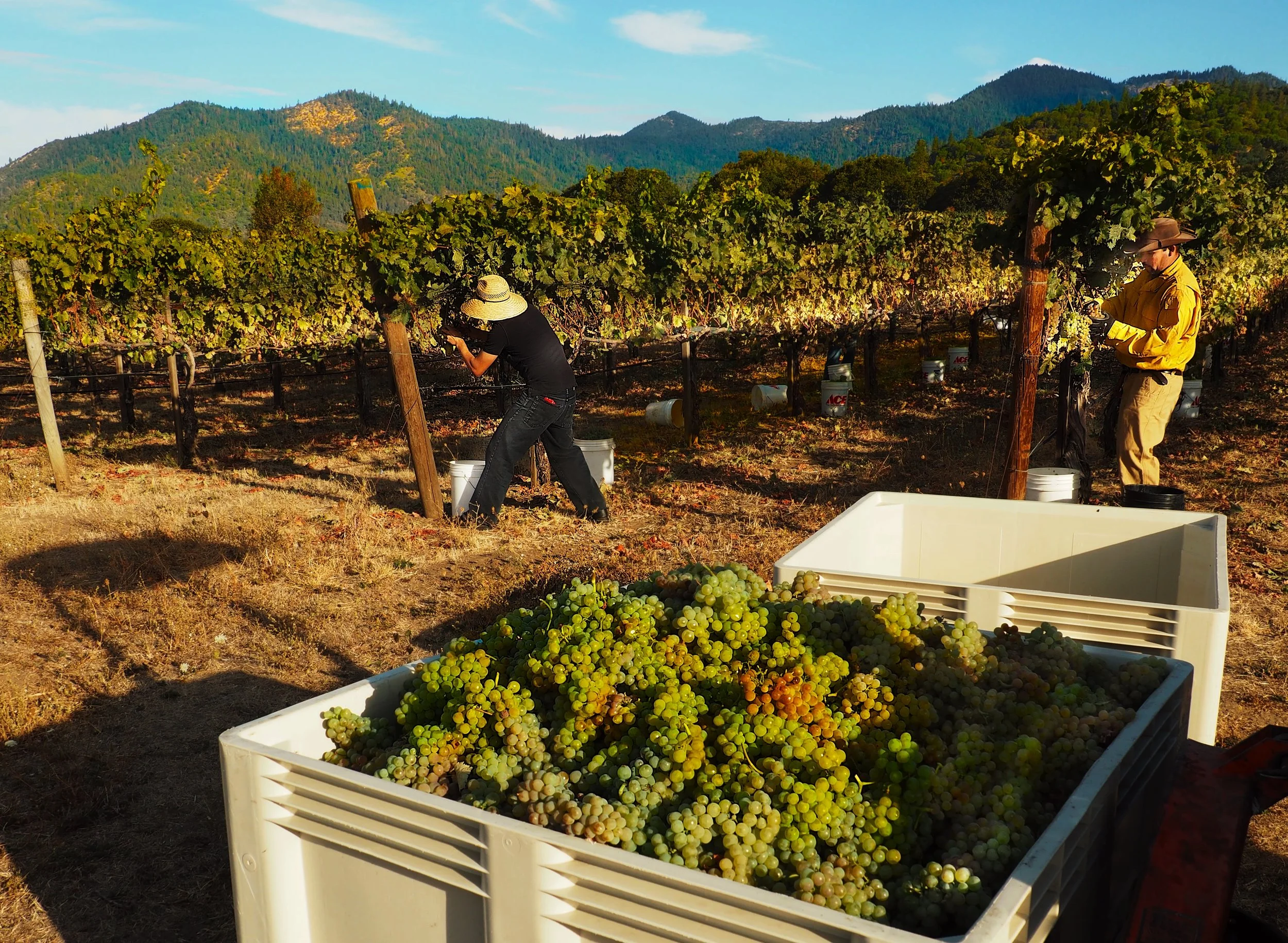
The last day of harvest 2020 at Troon Vineyard in Oregon’s Applegate Valley
Well, that was interesting. Goodbye 2020.
I was really looking forward to 2020. It was going to be a benchmark year as, after three years of intense effort we were going to receive our full Demeter Biodynamic® Certification. Finally, Troon Vineyard, always a vineyard with unfulfilled potential, was going to show what it could do.
Obviously, far, far more important, and more terrible, things happened.
In late February, I was on the Slow Wine Tour as we had achieved another Slow Wine award at Troon Vineyard. San Francisco, Seattle and Denver in four days. Then, during the first week of March, while I was in San Francisco for the Oregon Wine Trail tasting event, I was unnerved to see the desk clerk at my hotel was wearing a mask when she checked me in. Then, at the packed event, people made nervous, feeble jokes about not shaking hands, while making clumsy attempts at bumping elbows. COVID had arrived.
Then everything imploded.
Our tasting rooms and our restaurant customers were closed down, sales events were canceled and the world came to a stop. Or so it seemed at first.
While everything else closed, the farming just kept going. Farms can’t stop for pandemics. The winery became an eerie place. Most days I was alone in the offices and vineyard crew was spread out over the entire farm. It is easy to social distance on one-hundred acres. The cellar team would alternate days so only one person at a time was in the cellar. Despite the challenges, the work got done.
Actually, the work in the vineyard was a comforting thing. With the entire world in an uproar, the quiet and beauty of the vineyard and the surrounding mountains made it a calming and safe place.
Selling wine was not a safe and calming place. A major segment of our customers simply vanished overnight as restaurants and wine bars were shuttered. For a small biodynamic winery producing wines from varieties that are not mainstream commercial pop hits, this was not a good thing.
But then something very special happened.
Our regular customers, wine club members and locals, stepped up to support their local businesses when they needed it most. Our walk-in and online orders took off. Then there were our retail store customers who could have settled for the big, well-known commercial brands, but stuck with small producers like us. It is a favor we will do our best to repay forever.
Then, thankfully, good weather arrived.
In summer things felt lighter as we could have outdoor tastings at our tasting rooms and the energy that our guests brought to Troon revitalized our team. We are lucky to have a large patio and lawn at the winery and a courtyard at our Carlton tasting room. Outdoor tastings were not going to be an issue, as even in normal summers everyone prefers to be tasting outside. Social distance was not a problem as we easily spread out tables across the lawn. During the long, warm sunny days of summer in the Applegate Valley we were busy as outdoor wine tasting felt like a safe option.
Then the fires arrived.
The winds were predicted, but their actual arrival was unnerving as everyone was aware of the danger — a danger that was more than realized. Our neighbors in the towns of Talent and Phoenix saw their communities destroyed. Simple Machine Winery in Talent lost everything. Many winery and vineyard workers lost their homes. The first day of the fires, the skies were blue at Troon, but then the smoke settled in for a few weeks. Once again, we had been luckier than many. The main problem we experienced was that the smoke curtailed our outdoor tastings. Certainly a minor inconvenience compared to what so many suffered. The wine community came together with the Rogue Valley Wine Country Cares fundraiser to raise $57,000 to support housing costs for those that lost their homes. The wine industry is filled with good people.
Then it was time for harvest.
There is never a day filled with such unbridled optimism at a winery than the first day of harvest. We all did our best to maintain that facade. As dawn broke on that first day, we started picking in particularly heavy smoke. I wore both a N95 and a surgical mask and the pickers struggled to work in their masks and the smoke making an already difficult job that much harder. The cellar crew all wore N95 masks, now to ward off both smoke and COVID. Not one person complained. While we could not see each other’s smiles, you could still could still hear the jokes and laughter.
When we briefly removed our masks as Troon Vineyard winemaker Nate Wall made the traditional Champagne toast as the first grapes arrived, it was clear that neither the smoke or COVID could steal our optimism for this new vintage.
Finally, the smoke cleared and most of the vintage was completed under blue skies surrounded by beautiful vistas of the Siskiyou Mountains. Once again we were lucky as our wines were not affected by the smoke. The fires were too far away from Troon so we were not covered with the fresh smoke that can impact the wine.
It is always strangely quiet when the vintage is over.
Harvest interns always bring a lot of energy, fun and enthusiasm to the harvest crew and their departure marks the official end of harvest. It also makes the winery feel quieter and a bit empty. It is always a time for reflection and looking forward. Now that the smoke had cleared the late October weather was unusually warm, customers returned to our tasting rooms and their support once again buoyed our spirits.
Then in November everything imploded — again.
Just as other businesses had done, we had carefully planned how to keep our tasting rooms open for indoor tasting during the winter months. The social distance between tables had been carefully measured, firm mask requirements and disinfecting strategies had been put into action. Everyone on the team was committed to the safety of our guests and each other. I have been inspired by the commitment of everyone at Troon during this year. You could always see their deep respect for each other on their faces — because they were always masked.
Then, as COVID dramatically spiked we once again were limited to outdoor tastings. Winter outdoor wine tastings are not an inviting prospect in the mountains of Southern Oregon.
But then something very special happened — again.
Yet again the Troon team pivoted and recreated our outdoor patios with heaters, blankets and windbreaks to make guests as comfortable as possible. Once again our customers have come through for us braving the elements to taste and buy our wines. You can never look at these people that supported you during this difficult year the same way again. We are very lucky.
All of us are looking forward to 2021.
As you look to the next vintage you are always filled with optimism. I know 2021 will be a special vintage. We learned many things this year. We know more about each other and more about our customers. We are better than we were at the start of 2020. Both more efficient and more empathetic. Smarter and more creative. Tougher and more humble.
Most of all we have to treasure our good fortune in 2020. We were able to hold our own while so many others had the business that they had dreamed of and sweated over for years devastated. We were able to make exciting wines in challenging situations. More than anything we did not lose anyone to this terrible disease, although some of our team lost extended family members. The lessons of vintage 2020 are to count your blessings.
We practice regenerative agriculture at Troon Vineyard. Regenerative means to put in more than you take out. In 2020, that did not only apply to the vineyard.
Well, this will be interesting. Hello 2021.
Rebirth, Regeneration, Rediscovery

Troon Vineyard, Applegate Valley, Oregon
“Troon Vineyard is a story of rebirth, regeneration, and rediscovery,” reads the lede in the Oregon Wine Press article “Troon Renaissance” in their July issue about the transformation of Troon Vineyard. The author, Barbara Barrielle, could not have better captured the spirit of what has been accomplished at this small vineyard in the Applegate Valley of Southern Oregon.
When I first visited Troon Vineyard in 2016, I felt a connection to the vineyard from the first day because I could feel the potential of this site. I can still clearly remember that day as I stared at the vineyard with the dramatic backdrop of Grayback Mountain and the Siskiyou Range. I felt that this was not only a site with potential, but with soul. The serene beauty of the Applegate Valley is unmatched by other American wine regions and, while the site and the valley were beautiful, the condition of the vineyard was not. This was a vineyard that needed to be born again.
In 2016, the rebirth of Troon Vineyard began. This was no easy task as the owner at that time did not share my vision of the potential of the vineyard and the wines. For years, Troon had been focused on what I would call “gimmick” marketing. Funny labels and contrived marketing spin were the strategies. Also, key staff members had been driven off by, shall we say, less than enlightened management practices. I still cringe when I think of the loss of one, particularly talented staff member due to insensitive treatment. Fortunately, at least, she moved on to another winery in the Applegate Valley and remains a friend to this day. I had been brought in to put the business in order so that it could be sold. I saw it as a short-term project, and I was getting ready to move on when Denise and Bryan White arrived and decided to purchase Troon. In the meantime, I'd fallen in love with this vineyard. Thankfully, they did too. For it would demand a labor of love to not only restore the vineyard but to restore honor to a tarnished brand.
Troon Vineyard had been in a dark period for some time. To say the brand was tarnished would be an understatement. I was brought in to put a bandaid on it and then to move on once first-aid was applied. That’s all the owner at that time wanted, and I just wanted to get out of Napa and have some time to find a compelling vineyard in the Willamette Valley. It did not take me long to realize I had found that vineyard, but it was in the Applegate Valley. Without an owner that is connected to the vineyard and the soil, there is no hope. The vineyard convinced me to hope anyway.
What is now Troon Vineyard was divided at that time. The west ranch was being farmed using the nuclear option by the family that had purchased it in a sale that had broken the property apart. Knowing little about farming, they pushed the vines to their limit using every chemical trick and allowing the vines to overproduce and exhaust themselves. I’ll always remember reading their spray list and seeing a product called Venom. Any product with such a name needed to be checked out. The first thing I saw on the product label was that it killed bees - all of them. These poor plants would never completely recover from this abuse, but, hopefully, the soils and the bees could. Fortunately, the east ranch was still under our control, and there I pulled the plug on chemicals in the vineyard and the cellar. It was not an easy task as the winemaking and vineyard team at the time had never been asked to aspire to make great wines, so they had not.
We had to not only regenerate the site, but the people that worked it.
In 2017, the regeneration of Troon Vineyard began. The essential step was the purchase of the Troon Winery and the west ranch by the Whites. They had already purchased the half of the original property that had been sold off and then they purchased the Troon Winery site to reunite the entire estate. The other big step was the arrival of biodynamic consultant Andrew Beedy. A huge leap forward was made as, now that both vineyard blocks were under our control, we were able to move immediately and totally to organic and biodynamic agriculture on the entire estate. Then plans were initiated for a range of research projects to dig into every aspect of the vineyard. There was a lot to learn.
This year also was the start of our compost program, which required us to produce over two hundred tons of biodynamic compost a year. That’s a lot of manure. Fortunately for us, our neighbor here in the Applegate Valley is the Noble Organic Dairy with thousands of cows eager to contribute to our cause.
Regenerative agriculture became the foundation of everything we did, and biodynamics provided the framework to build on. We were searching for the soul of this vineyard. It had been there all along, but we had to rediscover it.
In 2018, the rediscovery of Troon Vineyard began. Vineyard Soil Technologies from Napa Valley arrived and dug over seventy five-feet deep soil pits. A team of soil scientists spent a week in the pits researching every aspect of the vineyard. At the same time, we began our project with Biome Makers, as they created an annual database on the bacteria, fungi, and yeasts that made our soils unique. Master viticulturist Jason Cole came on board to manage the redevelopment of the vineyard. We wanted to understand how every aspect of the vineyard changed as we implemented biodynamics. We needed all the data we could obtain to help us make the right decisions.
There were a lot of decisions to be made as we had decided to replant the entire vineyard. The existing vines were simply beyond saving. The biggest issue was extensive red blotch virus infection, but the vines had also been weakened by the years of conventional farming. Weak vines are easy targets for other vine diseases, and these vines had become an encyclopedia of afflictions. As devastating and expensive it was to have to replant the entire vineyard, there was a silver lining as we could now choose the right varieties for this site and plant them the right way. Instead of having to deal with a hodgepodge of varieties, some less than ideal for the site, we could replant with a plan. That plan would be to focus on the varieties of southern France. Those varieties would include syrah, grenache, mourvèdre, cinsault, counoise, tannat, malbec, negrette, bourboulenc, marsanne, roussanne, viognier, clairette blanche, bourboulenc, vermentino (rolle) and picpoul. Many of these varieties will not appear as single-variety wines but will be part of blends.
Blends are to become the heart of Troon Vineyard as we create the new Troon.
In 2019 we recreated Troon Vineyard as the replanting project began as we planted ten new acres of vines. Some of these were new areas, never before planted, and others were replanting of vineyards we had removed the year before. It is always a sad experience to remove vines - even sick ones. Planting new vines is the flip-side of that emotion as there is nothing that fuels the spirit of optimism more than putting vines in the ground. We are planting not only for ourselves but for future generations. There are few things that “pay it forward” more than planting a vineyard. These vines will produce wines we’ll never taste, made by people we’ll never meet.
The work that began in 2016 was recognized in 2019 as we were awarded our first Demeter Biodynamic® and CCOF Organic certifications. There are separate certifications for the winery and vineyard. Therefore, we received our full certifications for the winery, but our “in-transition” certifications for the vineyard. We’ll get the final Demeter Biodynamic® certification for the vineyard in 2020 as it takes three full years of biodynamic farming, and in 2019 we were a few months short of that goal.
The older vines were now really showing the impact of our biodynamic regenerative agriculture program. They were healthier and producing better fruit. Our good friends in the Applegate Valley, Barbara and Bill Steele, at Cowhorn Vineyard, had graciously agreed to sell us some of their biodynamic syrah, grenache, marsanne, roussanne, and viognier to get us through the shortfalls of our own production as we replanted. So we had grapes from our own estate that were dramatically improved in quality combined with excellent fruit from Cowhorn to work with, but, as with a great violin, you need a virtuoso to play it to show what it can do. That talent arrived as this vintage was made under the guidance of new Troon Vineyard winemaker Nate Wall. Nate is an incredibly sensitive and passionate winemaker whose love for the site equals the Whites and my own. His background in science (B.S. in Biology and M.S. in Environmental Engineering) was ideal for our philosophy of searching for the science in biodynamics. His extensive experience making pinot noir in the Willamette Valley provided the light, minimalist touch needed for wines from the Applegate Valley.
The confluence of a healthier vineyard, better fruit, and the right people made the 2019 vintage a milestone vintage for Troon Vineyard. The wines from this vintage finally give a glimpse of what this special vineyard is capable of producing. The first of our new generation of wines included wines released in 2020: Piquette, Pét tanNat (100% tannat pét nat), and Kubli Bench blends that included an Amber (orange wine) and a Rosé. Another orange wine, Amber Amphora Vermentino, has been aging on the skins and stems in three amphorae for the better part of a year and will be released this fall. While most of the 2019 red wines (which we are equally excited about) will not be released for a few years, we did produce a 100% carbonic maceration Grenache, which we are enjoying chilled this summer.
So in 2020, Troon Vineyard has been reborn, we have regenerated the vineyard and the wines and created a team that has rediscovered the soul of a vineyard. Joining that team in 2020 is the energetic and creative assistant winemaker Sarah Thompson. This will be the year we receive our full Demeter Biodynamic® certification that will recognize years of hard work and investment. But these achievements only mean that we have arrived at the starting line of a race that never finishes. There is no such thing as a finish line in winemaking.
Regeneration is a constant. Every year it begins again only building on the work of the preceding years. Agriculture is a relay race. We can only do our best for the land, the plants, and our wines and then, finally, pass the baton on to the next runner. Hopefully, they’ll run the race with the same intensity that we ran our leg.
Planting New Vineyards at Troon - Getting to Know You

Troon assistant winemaker Cary Willeford applies Biodynamic Preparation 508 to newly arrived vines
Standing there looking at the now real Troon Vineyard block 9, newly planted with mourvèdre, was an emotional experience. So much planning, work and investment transformed from an idea into a vineyard. There in front of me, I could finally feel the wine that would come from these vines. Putting a plant in the ground that hopefully will be producing wines long after I’m gone is a very different experience than planting a crop that will be replaced after one season. But it was the day before that we got to know each of these vines.
The process of preparing these vines for their new home begins the day before planting. Troon winemaker Nate Wall and assistant winemaker Cary Willeford and I spent the day preparing and applying a series of Biodynamic Preparations to the new plants. First was Biodynamic Barrel Compost, which we dynamized for twenty minutes by hand before applying to the roots of each plant to give their microbiome a head start. Meanwhile, we had been preparing a tea of Biodynamic Preparation 508 (equisetum or horsetail). Which was also dynamized by hand then sprayed on the leaves and graft junctions. This preparation helps the plant ward off fungal diseases like powdery mildew. The time, care and intention that went into this process I believe are integral to what makes Biodynamics such a powerful agricultural system. The culture we built by providing care and attention to each plant changes our relationship to them and to each other.
Biodynamics achieves many goals. Your soils are healthier, your plants are healthier, your fruit tastes better, your wine is better and, obviously, its better for the environment. It is a lot of work, but it is also a lot of fun. You feel good about what you’re doing everyone feels pride in a shared worthwhile endeavor.
Yesterday afternoon all of our existing vineyards were also treated with Biodynamic Barrel Compost, we did not want them to feel left out. After all, plants do talk to each other you know.

Troon assistant winemaker Cary Willeford and winemaker Nate Wall apply Biodynamic Barrel Compost to the roots of the new vines.
Taking the Parking Lot Back to Paradise

Brassica and sweet peas bloom as part of the cover crop regenerating soils at Troon Vineyard
Hey farmer farmer
Put away that D.D.T. now
Give me spots on my apples
But leave me the birds and the bees
Please
Don't it always seem to go
That you don't know what you've got
'Till it's gone
They paved paradise
And put up a parking lot
- Joni Mitchell, Big Yellow Taxi
I felt like I was walking on blacktop. Hard, hot and lifeless it looked like a place where a parking attendant would work, not a farmer. But this was a vineyard. Each vine looked like it was a weed growing out of cracks in the blacktop on some worn parking lot.
Living soil gives life. In this vineyard the soil was dead and the vines were dying. Yet, it was a beautiful site and the vines were giving some good wines even as they struggled to survive. They deserved better.
There seemed only one route back to health that could provide the opportunity to make the wines I believed we had the potential to produce. That path was biodynamics, which is the best existing framework for regenerative agriculture. To craft the wines we aspired to make, our soils, indeed our entire farm needed regeneration. It is never just the soil that needs regeneration, but also the spirit. At Troon, not only our soils were abused.
How was a vineyard transformed into a parking lot? Only through the abuses of industrial, thoughtless farming can soil be so decimated. Sick soils make sick plants and these poor vines were overcome with viruses and fungal diseases that stronger plants could have resisted. It became our mission to bring them back to health so they could live out their remaining years doing what Mother Nature intended them to do with their lives - ripen grapes.
Then there is intention, perhaps the key to regenerative agriculture. Previously their intent was to extract all they could from the land and extract they did. Today our mission is to give back more than we take. To be a good farmer you must work for the farmers who will farm the land in the future with the same fervor you work for yourself.
The path from parking lot to vineyard started with science. We did extensive soil studies with Vineyard Soil Technologies and worked with Biomemakers to establish a complete cross-section of our vineyard microbiome through genetic sequencing. To know where you need to go, you first have to know where you are.
Then came the proactive part - biodynamics. The essence of biodynamics is building healthy soils. The main tool in the biodynamic toolbox is compost. Over the last years we have been applying tons of biodynamic compost to our vineyards. In addition to the compost, now that chemicals were eradicated and weed control was returned to manual methods our soils began to change, the microbiome bloomed. Today you can walk into our vineyard and easily dig your hands into healthy arable soil.
That parking lot has been replaced by paradise - a vineyard.
Harvest 2018 Photo Album - Troon Vineyard in Oregon's Applegate Valley
Mother Nature was very kind to us in 2018. Rain and cool weather are things you expect during harvest in Oregon, but not this year! All during harvest we were given warm, dry weather under beautiful blue skies. This perfect weather meant we could harvest each variety at the ideal moment. There was no pressure from the weather so our pace was almost leisurely compared to a normal vintage. It was a harvest to remember as will the wines!

Picking tinta roriz, this is our last vintage of this variety as these vines will be pulled and replanted next year.

Picking starts at dawn with the vines still in the shade of the Siskiyou Mountains, which are already brightly illuminated.
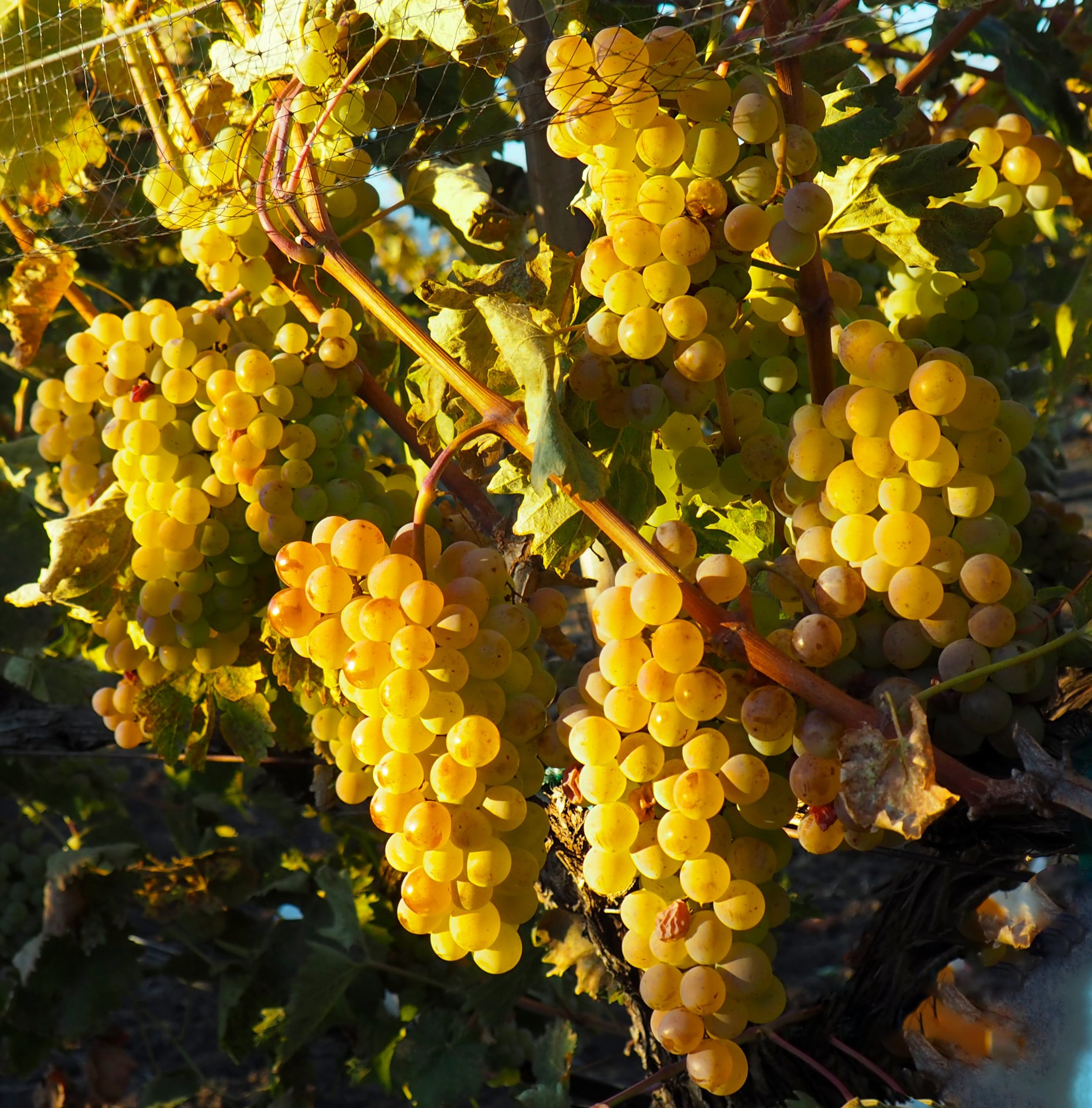
Some picure-perfect vermentino.

Banele and Jesus picking malbec as dawn breaks.
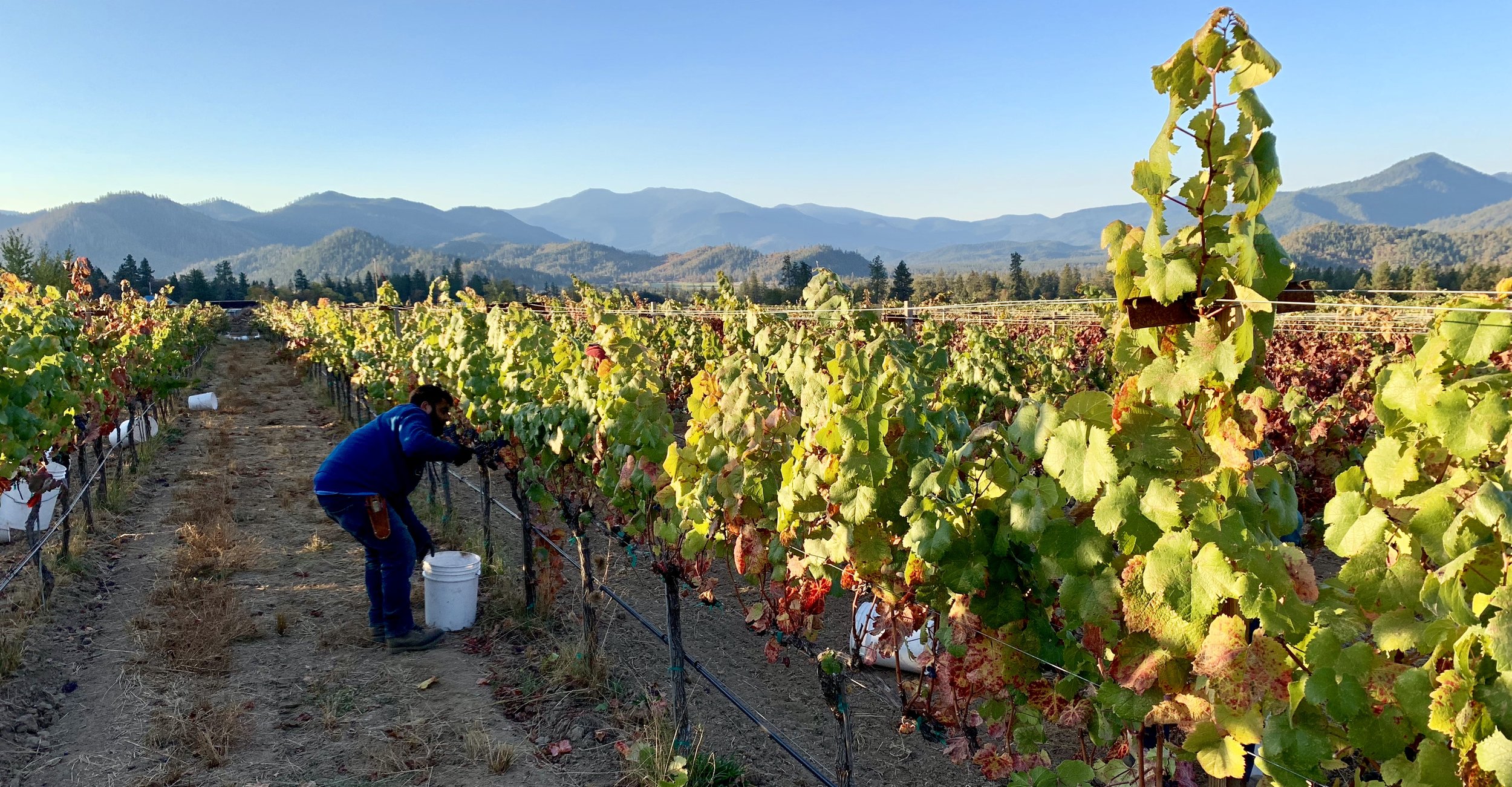
The Applegate Valley during harvest.

In a biodynamic vineyard, the leaves are fully turned color and falling off when it is time to pick the fruit. This is the natural cycle of a vine.

Vineyard manager Adan Cortes bundled up against the morning cold as he harvests vermentino.

Associate winemaker and biodynamic team leader Nate Wall fills cow horns to make biodynamic preparation 500. They will buried until next spring. Making BD 500 is something you do during harvest in the fall.

Banele, our harvest intern from South Africa, places the filled cow horns in pit to be buried until next spring. The BD 500 they will produce will be sprayed on our vineyards.

Grape pomace, fresh from the press, is added to our compost pile. All the leftovers from harvest are added to our biodynamic compost piles and returned to the vineyard.
Electromagnetic Soil Scanner
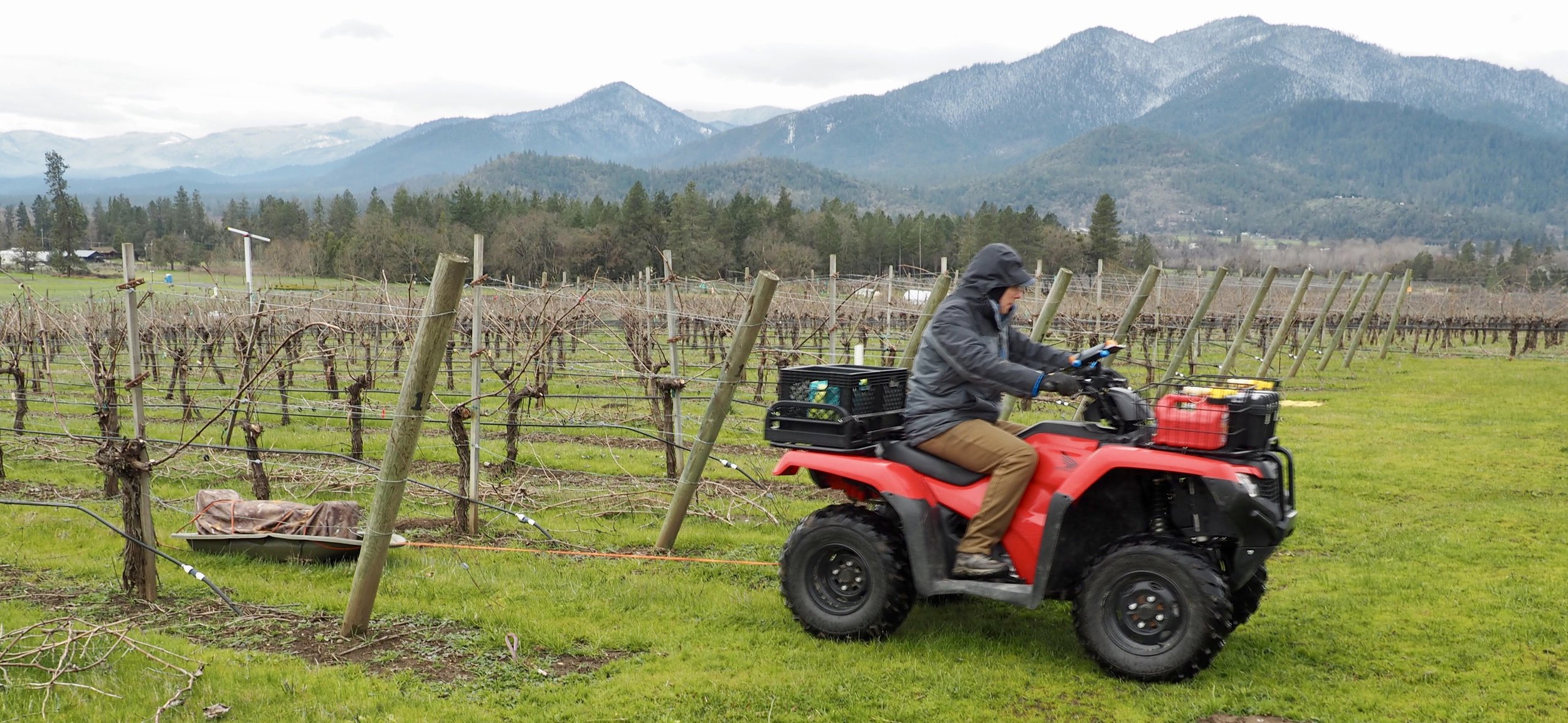
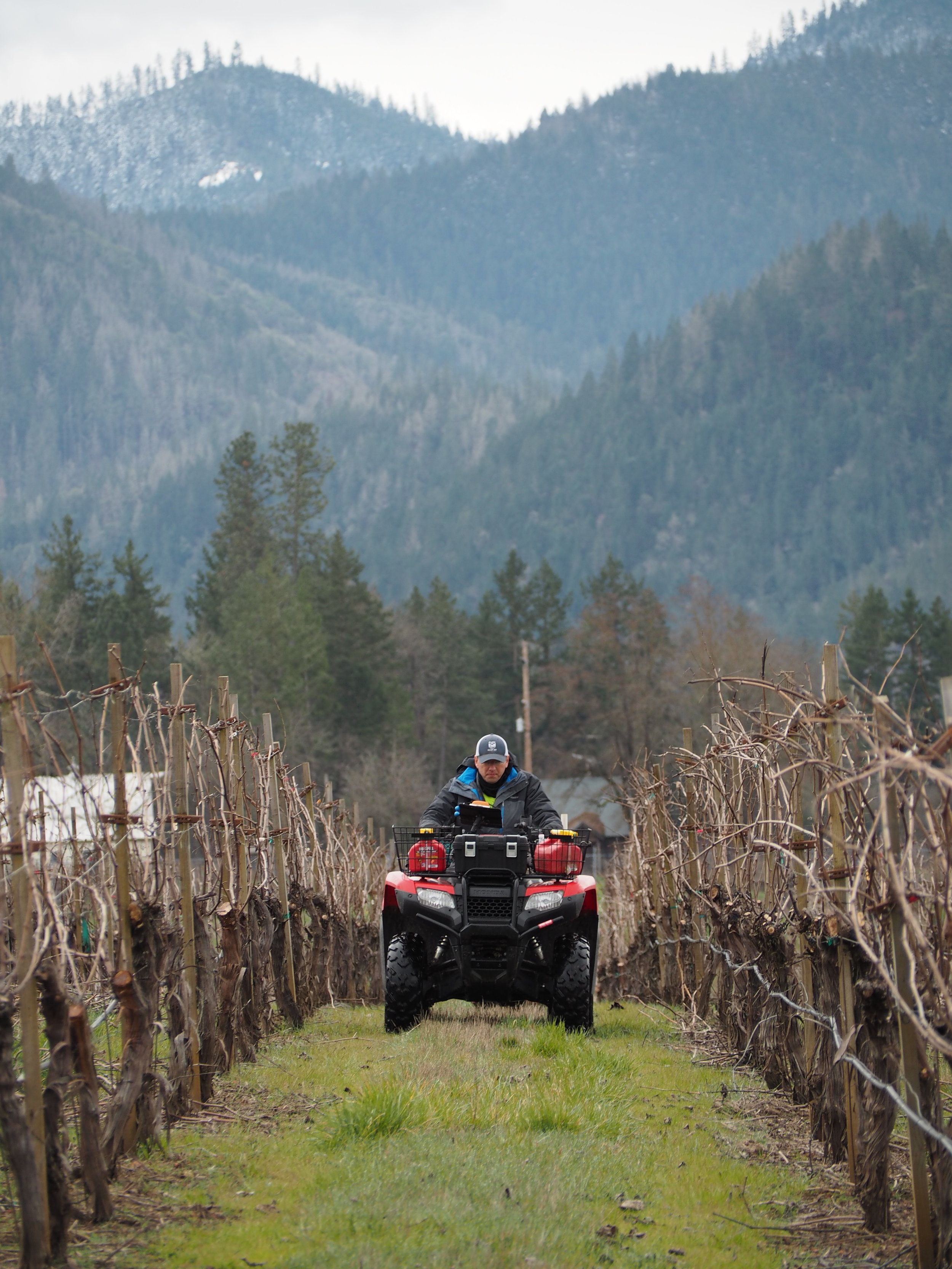
Our soil studies at Troon Vineyard started today with Nick Madden here for the day to do a complete electromagnetic soil scan of our vineyard blocks. We've retained Dr. Paul Anamosa and company to do a complete analysis of our vineyard blocks. Armed with this scan data we will be selecting locations for about eighty 5 feet deep pits to fully map our soil types. This data will help us select the proper varieties as we add new vineyard blocks and replant old ones. The scanner is on the sled behind the ATV. Here is some information on exactly what Nick is doing https://d.pr/dtaYMK
”Electromagnetic induction (EMI) has been used to characterize the spatial variability of soil properties since the late 1970s. Initially used to assess soil salinity, the use of EMI in soil studies has expanded to include: mapping soil types; characterizing soil water content and flow patterns; assessing variations in soil texture, compaction, or- ganic matter content, and pH; and determining the depth to subsurface horizons, stratigraphic layers or bedrock, among other uses. In all cases the soil property being investigated must influence soil apparent electrical conduc- tivity (ECa) either directly or indirectly for EMI techniques to be effective. An increasing number and diversity of EMI sensors have been developed in response to users' needs and the availability of allied technologies, which have greatly improved the functionality of these tools. EMI investigations provide several benefits for soil studies. The large amount of georeferenced data that can be rapidly and inexpensively collected with EMI provides more complete characterization of the spatial variations in soil properties than traditional sampling techniques. In addition, compared to traditional soil survey methods, EMI can more effectively characterize diffuse soil bound- aries and identify areas of dissimilar soils within mapped soil units, giving soil scientists greater confidence when collecting spatial soil information. EMI techniques do have limitations; results are site-specific and can vary depending on the complex interactions among multiple and variable soil properties. Despite this, EMI techniques are increasingly being used to investigate the spatial variability of soil properties at field and landscape scales.”
Rainy Oregon Harvest Dawn
Rain clouds roll over the Siskiyou Mountains with the Applegate River in the distance. In front are Troon Estate Vineyard Tempranillo vines. There's not enough rain to be causing us any real problems and harvest continues on schedule.

Double-click to edit...
Oregon Troon Vineyard Applegate Valley Harvest 2016 Estate Vermentino
Picking Troon Vineyard Estate Vermentino just after dawn in the Applegate Valley of Southern Oregon

Double-click to edit...

Double-click to edit...

Double-click to edit...
Double-click to edit...
Oregon Applegate Valley 2016 Harvest
Perfectly ripe Troon Vineyard Estate Vermentino ready to be harvested tomorrow morning.

Double-click to edit...

Double-click to edit...
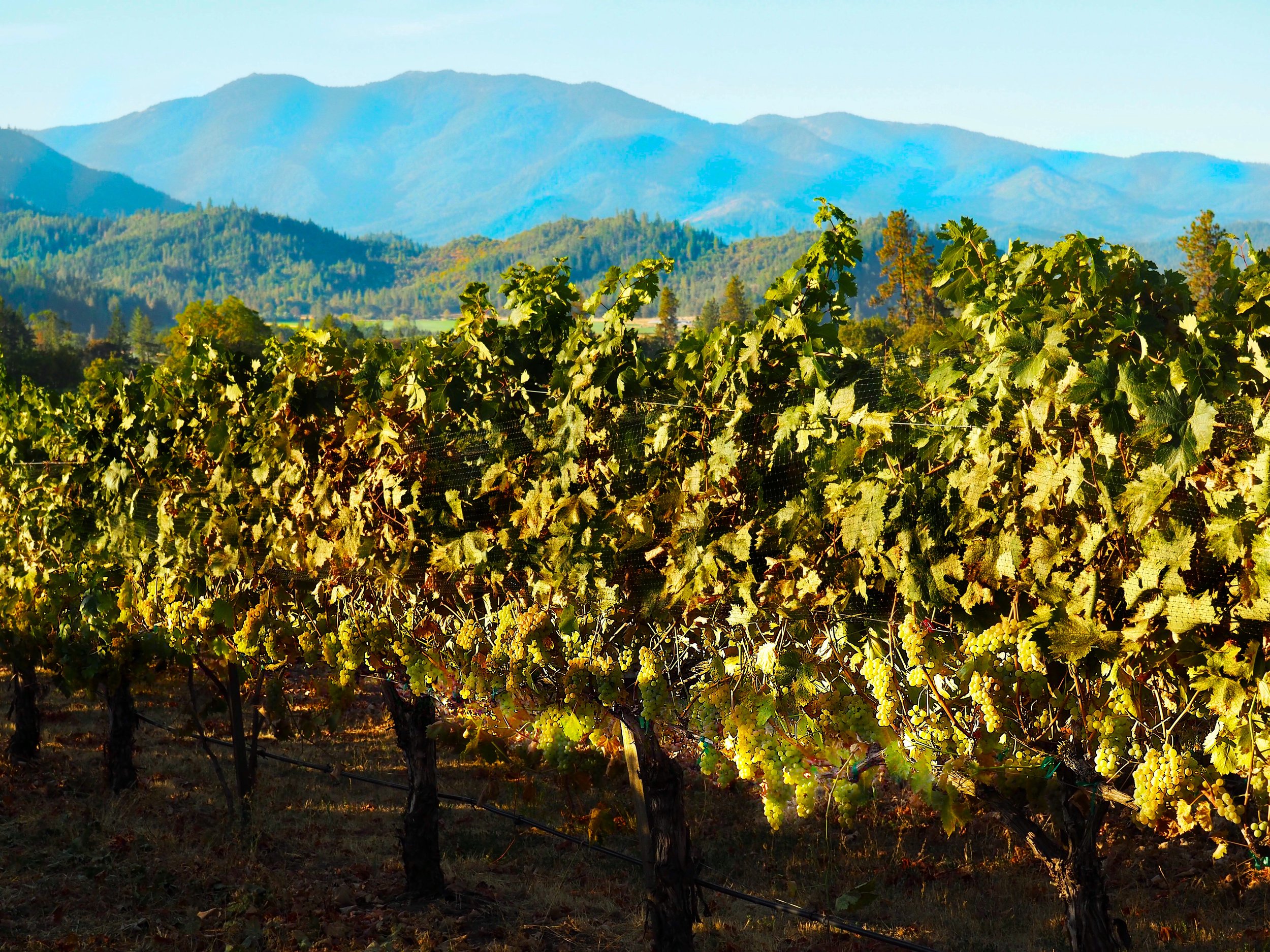
Troon Estate Vermentino framed by the Siskiyou Mountains
Double-click to edit...
Varietal Vigilantes
In the United States we tend to think of wines being driven by a single variety. That there is somehow something purer about being made from one type of vine. The varietal vigilantes are always asking, “is this 100%?” Due to the heavy emphasis on varietal labeling they don’t realize is that historically wines made from a single variety were the exception, not the rule.
Some of the greatest names in the world of wine: Bordeaux, Châteauneuf du Pape, Côte Rôtie, Chianti, Rioja, Porto and Champagne are, and have always been blends of varieties. There are classic marriages like: cabernet sauvignon, cabernet franc and merlot; marsanne and roussanne, syrah and viognier that have defined their wine regions. Without a doubt there are great mono-variety wines like Burgundy and Barolo, but many a classic wine region discovered over the centuries that blending produced not only the best wines for them, but a more consistently good wine vintage-to-vintage.
I believe that the Applegate Valley is one of those regions where blending creates the most complete and complex wines. In almost all of our wines at Troon Vineyard you’ll find more than one variety in the blend. We think deeply in making these choices looking for varieties that together create wines with greater nuance and personality than they could on their own. My goal in blending is to make the wines come alive and to craft wines that could only come from the Applegate Valley as making a wine of place is at the center of everything for me.
Blending is one thing, but I believe you need to go farther and actually co-ferment the varieties that you believe make will make your best blends. When you blend finished wines you can make wonderful wines, but when you can ferment the different varieties together they meld in a new an magical way that simple blending cannot reproduced. When fermenting together Mother Nature’s natural chemistry is amplified and a whole new wine emerges from the fermenter. When co-ferments are combined with natural yeasts and natural malolactic fermentations a unique purity of place and variety is expressed in your wine.
One of the better examples of this magic is our Troon Vineyard Longue Carabine, conceived by winemaker Steve Hall, which is created by blending several different co-fermented lots. The characteristics of each variety in the 2014 blend (38.5% vermentino, 33% viognier, 33% marsanne, 1.5% roussanne) shows their distinctive highlights in the expansive aromatics and rich texture. Longue Carabine is a one-of-a-kind wine totally unique to the Applegate Valley, Troon Vineyard and Oregon.
Being able to create wines like this is one of the inspirations that led me from Napa to the Applegate Valley in southern Oregon. The freedom to constantly experiment and push your wines forward is truly exciting - and truly fun!
2014 Troon Blue Label Longue Carabine, Applegate Valley