Investing in a Stranger’s Future
Agriculture is cyclical. Season flows into season. Vines flower then a hundred or so days later you harvest their fruit. Animals and farmers live their life cycles together on land that sustains them both. Nature wraps us in the cycle of life.
In January we begin to think of pruning and worrying about frost. What happened last vintage is behind us and only the potential of the next fills your minds. After all, the wines in the cellar are committed to their course and it is only our role to shepherd them home. That vintage is over.
There are few things other than agriculture where you so firmly press the reset button on the first of January. Of course, we build on the experience bestowed upon us by Mother Nature each year, but that’s all nuance compared to the cycles of Nature, which make all the most important choices.
We are facing a lot of new hurdles at Troon Vineyard as we begin a ranch-wide replant designed both to correct the viticultural sins of the past and to proactively move forward by selecting better varieties and then planting them in better sites. To move forward you must be willing to break ties to the past. At Troon we’ve decided to race towards the future.
New plantings will be decidedly focused on the varieties made famous by the Rhône Valley, Languedoc and Provence. These vines have proven their proclivity for our Kubli Bench terroir. Now it’s our turn to take what we’ve learned and focus on creating some truly special wines - some of which may be a decade or more away.
To some it may seem odd to embark on a voyage knowing you will not arrive at the destination, but that is farming and winegrowing. There is never any end to the cycle of seasons and you are only part of a chain that passes the baton ever-forward in a never-ending relay race. Nothing fires my passion more than knowing that I can make a perfect baton pass to the next generation. If they can make great wines from the vines we plant, I will have done more than my job. That is my goal.
For the time remaining to me, I will become a small part of the life of this vineyard and hope that I am still around to taste at least the potential of the vines we plant over the next years. We each get our vintages and it is our responsibility to enjoy every one and to hope that our work today will be rewarded with wines we will never taste made by people we never knew. They may not know us, but the vines we plant today will speak for us in the wines they make.
Every glass of wine we drink from an old vineyard carries the voices of those that planted and worked it over the decades. Listen to us, we deserve your attention.
Harvest 2018 Photo Album - Troon Vineyard in Oregon's Applegate Valley
Mother Nature was very kind to us in 2018. Rain and cool weather are things you expect during harvest in Oregon, but not this year! All during harvest we were given warm, dry weather under beautiful blue skies. This perfect weather meant we could harvest each variety at the ideal moment. There was no pressure from the weather so our pace was almost leisurely compared to a normal vintage. It was a harvest to remember as will the wines!

Picking tinta roriz, this is our last vintage of this variety as these vines will be pulled and replanted next year.

Picking starts at dawn with the vines still in the shade of the Siskiyou Mountains, which are already brightly illuminated.
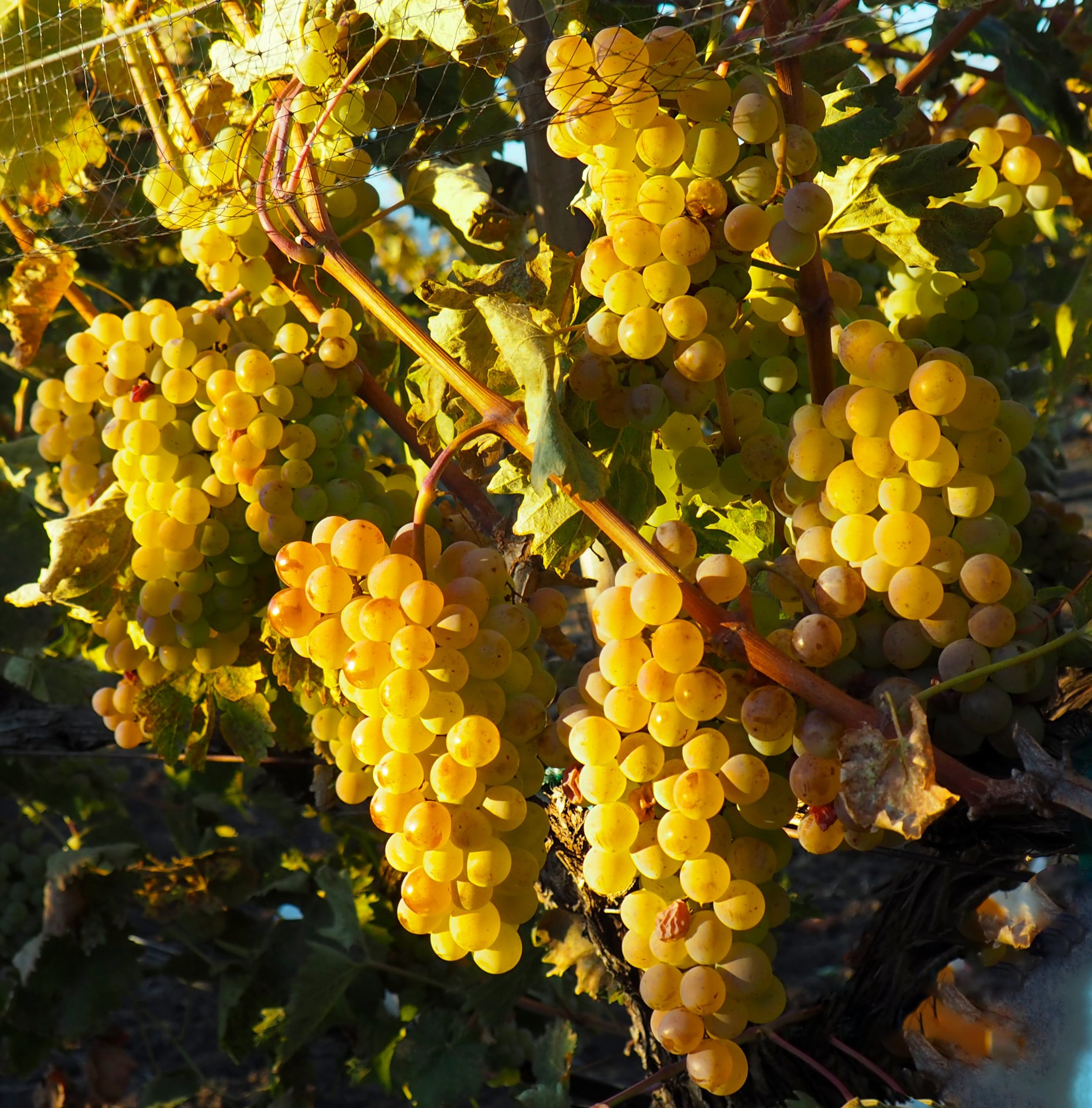
Some picure-perfect vermentino.

Banele and Jesus picking malbec as dawn breaks.
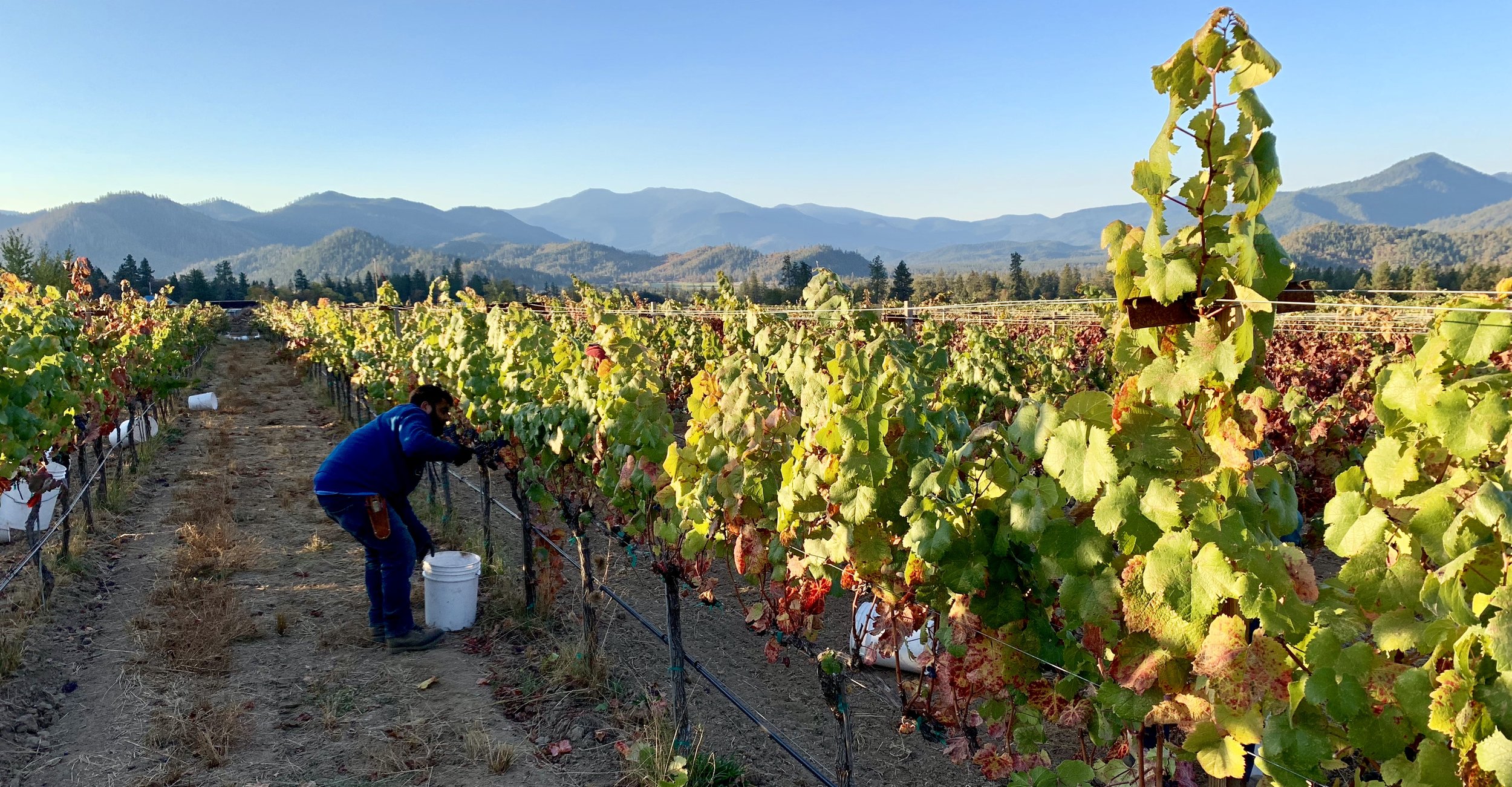
The Applegate Valley during harvest.

In a biodynamic vineyard, the leaves are fully turned color and falling off when it is time to pick the fruit. This is the natural cycle of a vine.

Vineyard manager Adan Cortes bundled up against the morning cold as he harvests vermentino.

Associate winemaker and biodynamic team leader Nate Wall fills cow horns to make biodynamic preparation 500. They will buried until next spring. Making BD 500 is something you do during harvest in the fall.

Banele, our harvest intern from South Africa, places the filled cow horns in pit to be buried until next spring. The BD 500 they will produce will be sprayed on our vineyards.

Grape pomace, fresh from the press, is added to our compost pile. All the leftovers from harvest are added to our biodynamic compost piles and returned to the vineyard.
The Smell of Biodynamics

Troon vineyard foreman Adan Cortes applies biodynamic preparation 507 Valerian to our first compost pile. In the back, Levon, the son of our biodynamic consultant Andrew Beedy lends moral support. Photo by Andrew Beedy.
I remember the smells well and they always take me back to my childhood. That warm, earthy pungent smell can only come from one thing. I grew up in a small rural town in northern Illinois on the Wisconsin border . My grandfather and grandmother, Chester and Goldie Camp, were small dairy farmers, a type of farmer that rarely exists anymore. They were organic farmers, but did not know it.

My grandparents, Chester and Goldie Camp
I stayed with them often as a child, rising with my grandfather before dawn for the morning milking. I can remember looking up at him while he shaved as he lathered up with a brush swirled on a bar in a cup - yes, he shaved before milking. Then out to the barn for what, in those days, was the very hard physical job of milking. You carried the pails of milk to the tank one-by-one. I would wander among the cows while the men worked - avoiding their back-ends and hoofs due to the stern admonitions of my grandfather. The rich, warm aromas of the animals, the feed and, of course, the manure filled the barn while the twang of country music pushed by 50,000 watts from WJJD in Chicago tinnily played from an old and very dirty radio. After the morning’s work, my grandmother would have a huge country breakfast waiting with, of course, a glass of fresh milk, cream and all, straight from the milk tank.
These memories came flowing back to me as Troon’s vineyard foreman, Adan Cortes, dumped the first load of cow manure onto our new biodynamic compost pile. Soon more will follow. We are lucky to have the Noble Family Organic Dairy as a next-door neighbor - an unlimited supply of organic manure from the thousands of happy, healthy cows they milk three times a day.
Compost is the cornerstone of a biodynamic program. While organic regulations may be focused on what you can’t use, the Demeter Biodynamic Certification follows all the USDA Organic rules, but the discipline of biodynamics takes things further with the biodynamic preparations and the concept of the whole farm. Biodynamic compost is the main vehicle that brings health to your soils and therefor your vines. Strong vines can fight off threats while weak vines require chemicals to survive. Of the nine biodynamic preparations, only three are applied to directly to the vineyard - 500, 501, 508 - while the other six - 502 to 507 - are applied to the compost piles. We began our biodynamic compost program in earnest last week starting with manure from our neighbor organic farmer, Noble Dairy. The Noble family has been farming organically since 2004. We layered this rich manure with organic hay from another neighbor and the remains from last harvest’s grape pressings to create a pile about 150 feet long and five feet high. Then our vineyard foreman Adan Cortes applied the biodynamic preparations to the new pile. It was an exciting and emotional experience for all of us at Troon. Next week we are building a second pile and this fall will be creating four more based on our grape pomace from this year’s harvest. From now on nature’s circle will be unbroken with each vintage producing the compost to feed our vineyard soils for another year.
My grandparents were organic farmers and didn’t even know it. My grandmother prepared and canned organic vegetables from her organic garden. On Sundays, they ate free-range, organic chicken - that my grandfather killed the day before. Note my grandfather could only kill the chickens my grandmother had not named. They fed their dairy cattle organic hay in the winter and they grazed on organic grass in the summer. They were either blissfully unaware of the latest chemicals or could not afford them, or both. Michael Pollan wrote in his excellent book, In Defense of Food, don’t eat anything that your grandparents would not recognize as food. Certainly, good advice in my case.
When you grow grapes for wine you are growing food and Pollan’s recommendation can easily be rewritten to don’t drink wine that your grandparents would not recognize as wine - not that my grandparents ever had a sip of wine as far as I know. Pabst was my grandfather’s drink of choice.
The direct connection of memories of my grandparents to our building our first compost pile was a warm, emotional experience for me. Agriculture is a seasonal and circular experience, if you are not emotionally connected to the past you will always struggle. Emotions and good feelings very much describe the process of converting to biodynamics. You feel good about what you are doing. While we have practiced sustainable agriculture for years, this is different and you can feel it.
It feels right. Chester and Goldie would approve.
Becoming One with Wine
The world feels somehow different today at Troon Vineyard. I guess you can’t reinvent a vineyard without reinventing yourself. Reinventing and reinvigorating people and a vineyard at the same time is about the simplest way I can explain our transition to biodynamic farming. Everything just feels more alive.
Over the last week what was all planning, items on a Trello board, started to become real. New equipment, new ways of thinking and a new spirit all converged at Troon Vineyard this week. The first step was just a simple piece of string

Twine ties in a block of our vermentino
After years of plastic ties in the vineyard, many of a particularly noxious green color, we have replaced them with hand-knotted pieces of twine. The contrast between the bilious green of the old ties and the warm, earth tones of the twine ties running down the rows tying the canes to the wires could not be more obvious or meaningful. A simple change that tells of significant changes to come, we are becoming entwined in nature.
A somewhat physically more prominent change was the arrival of our Clemens radius weeder or “weed knife”. While a big financial investment, an efficient tool to control weeds is necessary if you are going to forgo chemicals like the seemingly ever-present Roundup. Many may debate about the evils of glyphosate, and all too many sustainable certifications allow it, but common sense tells us that chemicals like these are just not part of nature’s plan. It’s hard to describe how well the Clemens does its job as it fluidly dances the blade around each vine almost in slow motion - we actually it is in slow motion as the tractor can only go two and a half miles an hour while doing this work.
Other new mechanical arrivals include the Clemens multi-clean undervine brush, which, as the name implies, literally whisks away suckers and weeds around the base of the vine. Then there is a tank-like Domries disc and a Domries tri-till cultivator. We now have the tools to do the job right.

Creating a vortex while stirring BD 500
Then there was the really good shit, literally, which arrived this week. Now living in Southern Oregon, that phrase tends to refer to other local agricultural products, in our case, it was actually shit. This was the famed BD 500, the cow manure aged in buried cow horns. For this first application we had to purchase some finished BD 500, but by next spring we’ll have buried and fermented our own. The finished preparation does not remind of the original state or aromatics of the raw materials as it looks and smells more like very rich potting soil. To prepare 500 for application requires stirring it a very particular way. Troon winemaker Steve Hall selected one of our oldest barrels (for the history of place it had experienced) then after adding the 500 to around forty gallons of water we begin the stirring process. Steve and I alternated during the hour long process. First you stir in one direction until you build a deep vortex then suddenly reverse direction going violently from order to disorder. You repeat this process over-and-over for the full hour. This was a uniquely satisfying experience as you bond with the preparation that will become one with your soil. A very different experience than wearing haz-mat gear demanded by standard vineyard applications. Once prepared we poured the BD 500 into the sprayer and as the week came to a close our entire property had received this application.
Just knowing that the first biodynamic preparation is in our soils gives me both a sense of peace and accomplishment. We are on an entirely new voyage with a new mission. Just as the vines are reborn each spring, this spring Troon Vineyard is reborn along with them. Soon the buds will break into a whole new world of winegrowing.
Biodynamics will reinvigorate our soils and our vines, but it is also reinvigorating us. It is those combined energies that will be expressed in our wines. Wines full of energy are exciting wines and we could not be more excited about making them. Our desire to make special wines from what we know is a vineyard, a terroir, with exceptional potential is what started us on this voyage to begin with.
We are at the starting line of a long struggle to achieve our goals. Now that we have taken our first steps we feel like a sprinter whose energy has just been released by the starting gun.
The vines, the soil, the place, the wines and the people are all becoming one.

Alberto spraying BD 500 in a block of zinfandel
Get Set, Go!

Biodynamic consultant Andrew Beedy and Troon winemaker Steve Hall on the spot selected for our compost program.
This is the spot that will become the most important place of the vineyard. We’ve chosen the spot for the compost piles.
There is a day that dreams, plans and goals become a reality. On your mark, get set, go! As we crossed the starting line this week, we were firmly aware that we were starting a marathon, not a dash. This week we took our first steps to converting Troon Vineyard to organic and biodynamic agriculture. We have our eye on 2020 to achieve our first organic and biodynamic certification, but that will not be the finish line. In agriculture, there is no finish line.
We had already taken some steps forward as we had received our L.I.V.E. and Salmon Safe sustainable certifications, but we have now committed to biodynamics as our vision for the future of Troon. Our first big step was to secure the services of Andrew Beedy ([https://www.andrewbeedy.com]). Andrew's speciality is designing a complete plan that looks at your property as a whole, not just as a vineyard. Andrew has spent his entire life immersed in biodynamics as he was born on a biodynamic dairy farm in Pennsylvania. He attended a Steiner elementary school that was attached to a biodynamic farm. As a teenager, he worked on an organic farm in England. After university, he moved to California, where he worked with his mentor, the famed biodynamic consultant Alan York, who also was the biodynamic consultant for our neighbor, Cowhorn Winery, here in the Applegate Valley. Today, Andrew’s clients span the entire nation coast-to-coast.
After walking for hours with Andrew through our vineyards and our entire farm property, you can feel your perceptions began to change as you start to look at your farm as a whole rather than as simple blocks of vineyards. This extends beyond our property lines as you understand that the Applegate Valley itself is included in a whole farm, holistic plan for farming.
With conventional agriculture you identify problems and then apply various applications. Many, many of these applications are nasty indeed. While they may solve one problem, the collateral damage they cause slowly, but surely kills your soils. Soil is the plant’s foundation, and dead soils cannot produce great wines. When you farm biodynamically you eschew these chemicals, which means you have to deal with the threats to your plants before they appear. In other words, biodynamics is all about prevention. A healthy plant can better resist diseases and pests than one living in dead soils relying on chemical fixes to deal with each and every problem.
Our new compost piles will be the heart and soul of the vineyard as this is how we will be bringing our soils back to life. One way I like to explain biodynamics is that it is organic agriculture with probiotics. It is the bacteria and fungi surrounding a plants roots that allow it to take nutrition from the soil. Conventional agriculture destroys this natural system. The power of biodynamics is that it brings the microbiome of your farm back to life, which brings your soils and plants back to life.
I will be chronicling the process of bringing Troon’s soils back to life here on this blog. Over the next weeks, we are evaluating our soils and the microbiome of our vineyards, and we will be carefully monitoring and documenting the changes in our soils and vines as we practice biodynamic farming over the next years. It is a story I am very excited to be sharing. It is a process that will change our farm, our vines, our wines and us.
It will be a steep learning curve. Could anything be more exciting?
Here is a link to the Demeter Biodynamic Farm Standard for certification.