Neutral Oak

Troon winemaker Nate Wall loads our first amphora to arrive at Troon in 2019. We now have five.
The wine was a technical perfection. It was made with beautiful, ripe fruit by a talented, technically proficient winemaker. The color was gorgeous, but there was one big problem. I could not bear to drink it.
The wine tasted like a big California pinot — not, as they said on Seinfeld, that there’s anything wrong with that. The problem was that this wine was from Burgundy.
New oak and I have parted ways. The heavy use of new oak in this wine made it simply undrinkable — for me. I tried over three days, the whole weekend, returning to taste the wine each night, but the result was always the same, and the majority of the bottle ended up going down the drain. Everything I wanted to taste in this wine, the flavors I could tell were there, were now forever lost under a heavy layer of oak. Few things can destroy terroir more than new oak barrels. This was a wine that had lost any sense of place.
I realize this falls under the “personal preference” category, but sometimes I wonder if that is true. When I Iooked up the winemaking information on this wine, I found they used 70% new oak on this pinot noir. Is that an authentic choice? Drinking a very oaky wine is like trying to listen to a conversation at a rock concert. You miss a lot of what is being said.
The best wines let you look inside of them and have beautiful transparency. Once you succumb to the pleasures of more delicate wines, tasting wines with characteristics like prominent new oak flavors make you feel like these wines are screaming at you — perhaps a Screaming Eagle, if you will.
My transition happened over the years, as, when we tasted through the barrels each vintage, my favorite wines were from older barrels. The wines in the new barrels were essentially undrinkable, and we would rationalize how they would add complexity to the final blend. All they added was overt oaky flavors that overwhelmed the elegant nuances of the wines in the older barrels.
As you delve into the complexities of more delicately styled wines, you soon make a discovery — there is no such thing as “neutral oak”.
Drinking wines without significant new oak used in their aging is kind of like going to a spa for a palate purge. Once your system is flushed out, everything feels different and, in this case, tastes different. Soon, as Steve Jobs said, you start to “think different.”
Once your palate is open to the experience, you soon understand the term “neutral oak” is a misnomer. Now, when you taste wines out of those three-year-old barrels you thought of as neutral, you can taste the oak flavors they still impart to the wine. The same goes for even older barrels. For white wines, their impact is even more pronounced.
What do we want from barrels at Troon Vineyard? Obviously, not to leak, but most importantly that they do no harm. They must not overwhelm the flavors of the variety and the vineyard. Besides simply holding the wine, the role of a barrel is to provide a controlled rate of oxygen to the wine. This is why different shapes and sizes of barrels have come into use in various wine regions due to trial and error over the centuries. Those reasons were not always about wine quality, but for ease of transportation in regions like Bordeaux, where export markets were established long ago. From huge botti in Barolo to puncheons in Cornas to the slight differences between Bourguigone (228 l.) and Bordelaise (225 l.) barriques, there were many reasons these sizes were selected, but those reasons were always commercial, efficient storage and, although they might not have known it, for the controlled introduction of oxygen into the aging wine. The idea of heavy use of new oak is a very modern one, and in the past, even if they had liked the flavors of new oak, new barrels would have been an expensive luxury few could afford.
The magic in barrels is that they let the wine breathe, but they are not alone as other very old wine storage methods also allow oxygen into the wine at ideal rates for developing young wines. We already have five amphorae and concrete tanks are also very exciting and both last a bit longer than your average barrel. Both are investments I am hoping to expand in the near future.
The use of high percentages of new oak and the rise of cult wines are intertwined — the more dollars than sense school of winemaking and wine buying. Now the key to making a mediocre wine seem expensive to the average consumer is the heavy use of “oak alternatives”, which is simply adding wood chips to wines in stainless steel tanks to add the sweet flavors of oak to a wine. You get the flavor, but no oxygen, but no problem; they can just add that too. Winemaking is transformed into beverage alcohol production.
There is nothing wrong with liking heavily oaked wines. If you like that flavor, go for it; there is no arguing taste. But you are giving up something as those wines taste more-or-less the same, no matter where the grapes were grown. To handle all that new oak, you have to harvest super-mature grapes, and overripe fruit loses not only its unique taste of place, but the very nature of the variety itself. Suddenly pinot noir starts to taste more like hollow syrah. To make matters worse, you’ll end up paying more as all that oak is costly, and those that make these massive wines in massive bottles also have massive egos, which demand massive prices.
Quantity should not be confused with quality. The restaurants with the biggest portions do not have the best food. Wine quality should not be defined by the amount of flavor, but by the quality of the experience. To have that experience, you have to taste the wine itself, not the aging vessel. Even with the best speakers, if you turn the volume up enough, the music will be distorted.
When buying wine you should get what you paid for — wine.
The Pace of Knowing

“The pace of knowing on our part does not alter how creation works,” Michael Phillips in Mycorrhizal Planet
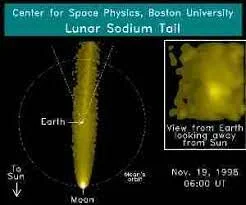
A recent article in the New York Times revealed that the Moon has a tail, much like a comet. “It almost seems like a magical thing,” said one of the astronomers. For a few days each month, like clockwork, a stream of sodium particles from the Moon wraps around the earth’s atmosphere. That tail is dusting the Earth with sodium.
“But even invisible, knowing the Earth has a meteor-fueled moonbeam is satisfying enough — a reminder of the Moon’s dynamism.” Says Dr. James O’Donoghue, a planetary scientist, “I think we definitely take it for granted.”
While we can’t sense the passage of this beam around the Earth, It does not mean that other beings on the planet cannot. There is much we still do not understand about the cycles of the natural world. Nature’s smallest beings sense many things that are invisible to us.
The more you pursue the science of regenerative agriculture, the more connections to biodynamic practices you discover. That is not to say the reasoning behind those practices are the same, but the practices themselves often closely align.
“As the second most abundant element in the Earth’s crust and the soil, silica has been largely ignored by agronomists. Silica is crucial, however, as it provides plant defense against pests and fungal/bacterial disease and reduces plant stress. It is a cell-strengthener and an activator for many plant functions,” says Nicole Masters in her thought-provoking book For the Love of Soil.
“Soil application of colloidal silicon increased plant-available Si, but only foliar application increased the total silicon concentrations in leaves, yield, and cluster weight. Moreover, the wine produced from the silica-treated grapes were ranked better in sensory evaluations,” states the Czech Academy of Agricultural Sciences in the article Effects of silicon amendments on grapevine, soil, and wine
One of the biodynamic preparations that raises most eyebrows (although all of them do for some) is BD 501 — the silica mentioned above. Silica is now routinely applied in many crops throughout the world. I’m sure most of the silica applied in agriculture is not buried in a cow horn first. Is the biodynamic method better than simply applying silica? I don’t know. However, I do know that silica prepared in the biodynamic way does make a difference in the vineyard. Our neighbors and good friends Barbara and Bill Steele at Cowhorn Vineyard have refined this practice over almost two decades of biodynamic farming. They use multiple precisely timed applications of BD 501 to encourage their Rhône varieties to reach higher brix levels in their cool Applegate Valley site. The proof is found in their exceptional wines.
While Rudolf Steiner got a lot of the “hows” and “whats” right in his lectures, the “whys” are clearly not always on the mark. Steiner saw cow horns as kinds of radio telescopes that captured cosmic energies and transferred them to their contents. He was clearly right about silica, but cosmic energies? I think terms like “energies” and “forces” are just names for things we don’t understand. There was a lot that was not understood about plant biology in the 1920s, when Steiner gave his lectures (he died a year after giving them), while we understand much more today, there is still much that is not known.
Having made our own BD 500 and BD 501 at Troon Vineyard for several years now we’ve had our own experience with burying cow horns to make these preparations. One thing is clear — the cow horns work in the sense that the final product is ideal for the job. Do they work because they are the perfect size and material or because of those cosmic forces? I admit there is a little bit of the “if it’s not broke don’t fix it” mentality here. Will other containers work just as well? I look forward to others doing that research and letting me know. I’d be happy to change, but I would prefer to not be the one experimenting as my immediate concerns are getting great fruit quality in the vintage at hand.
There is one cosmic energy that no one doubts — the Sun. Apparently, now the Moon can join that club. Not only does the Moon’s gravity gives us tides, but once a month the Earth is enveloped in its tail. Like a timepiece, the moon showers us not with mysterious cosmic energies, but a dusting of sodium. We can’t see it or feel it, but to the microbiology in the soil and plants, it may sound like Big Ben striking noon.
There are so many aspects of biodynamics that are now entering the mainstream of agricultural science. Composting at lower temperatures to increase fungal and bacterial populations. State-of-the-art compost tea brewers aerate compost tea overnight, which also builds those populations, as does the biodynamic practice of dynamizing. Even farming by the Moon may have to be reevaluated. It was obvious to many of us that biodynamics worked. All you had to do was to taste the wines. While we knew it worked, we were not very comfortable with the “whys” as presented by Steiner. Slowly, but surely those gaps are being filled by the new science of regenerative agriculture.
It is my hope that the new Regenerative Organic Alliance and Certification will bridge those gaps. It embraces both USDA Organic and Demeter Biodynamic Certification, but fully incorporates the rapidly advancing science and knowledge that is happening in agriculture today.
It’s not magical forces, but the Sun, soil, Moondust, mycorrhizal fungi, and manure that make agriculture work. As Michael Phillips wrote, “Nature does what needs to be done if we let her.”
Humble — something we should be when it comes to the natural systems. There is so much we do not know. Nature works, that’s truly magical.
Growing Forward: A Panel Discussion on Regenerative Agriculture
“Craig Camp, who has been heralded for turning around Troon Vineyards in Oregon’s Applegate Valley points out that in their replanted vineyards “biodynamics is the framework we integrated into our process. Regenerative organic is the next step.” Wine Industry Network.
Please join us for a panel discussion about regenerative agriculture with Paul Skinner, Paul Dolan and Jordon Lonborg and myself as we discus the future of winegrowing.
Inspiration
I have been more than fortunate to be literally immersed in a world filled with inspiring people during my whole career. People that lift you and make you reach for ever higher goals. To be called inspirational is obviously an honor, but, in fact, it is far more humbling. To be inspiring you have had to be inspired. You stand on the shoulders of so many.
Needless to say, I was more than flattered and honored to be named to the “Wine’s Most Inspirational People 2021” list in their article:
Craig Camp: Leading the Way for Vineyard Rejuvenation from Conventional to Biodynamic Farming
I have been deeply involved in fine wine, both the business and making of it, for almost four decades. The people that have inspired me are too many to count, but I will name a few anyway.
Mentors like Becky Wasserman, Christopher Cannan, Neil and Maria Empson, Barry and Audrey Sterling, and Angelo Gaja introduced me to the wines of the world. Don Clemens and Scott Larsen first showed me how special a wine could be as they shared their best bottles with me. Then there are those inspirational people I grew alongside, winemakers like Tony Soter, Cathy Corison, Richard Sanford, Josh Jensen, Cecil DeLoach, Fred Fisher, Joy Sterling, Dick Ward, and David Graves, Manuel Marchetti, Andrea Sottimano, Tino Colla, Andrea Constanti and Dominque Lafon. Sharing their voyage, even in a small way, continues to inspire me every day.
Inspiration also comes from younger, energetic people who are making a new future in wine, many of whom I have had the honor to work alongside. Winemakers like Thomas Houseman, Jeff Keene, Tony Rynders, Nate Wall, and James Cahill, viticulturists like Jason Cole, and marketing and salespeople like Kim McLeod, Nadia Kinkade, Meg Ordaz, Nate Winters, and Ashley Wells. Then there is Paul Mabray, the pioneer that takes all the arrows while driving winery marketing technology forward for the entire industry.
Inspiration is a continuum. One cannot inspire without being inspired. It is a debt that can only be repaid by paying it forward. The most inspiring people don't set out to be inspiring. They just show up every day and do the work. That's the most inspiring thing of all.
And Now for Something Completely Different

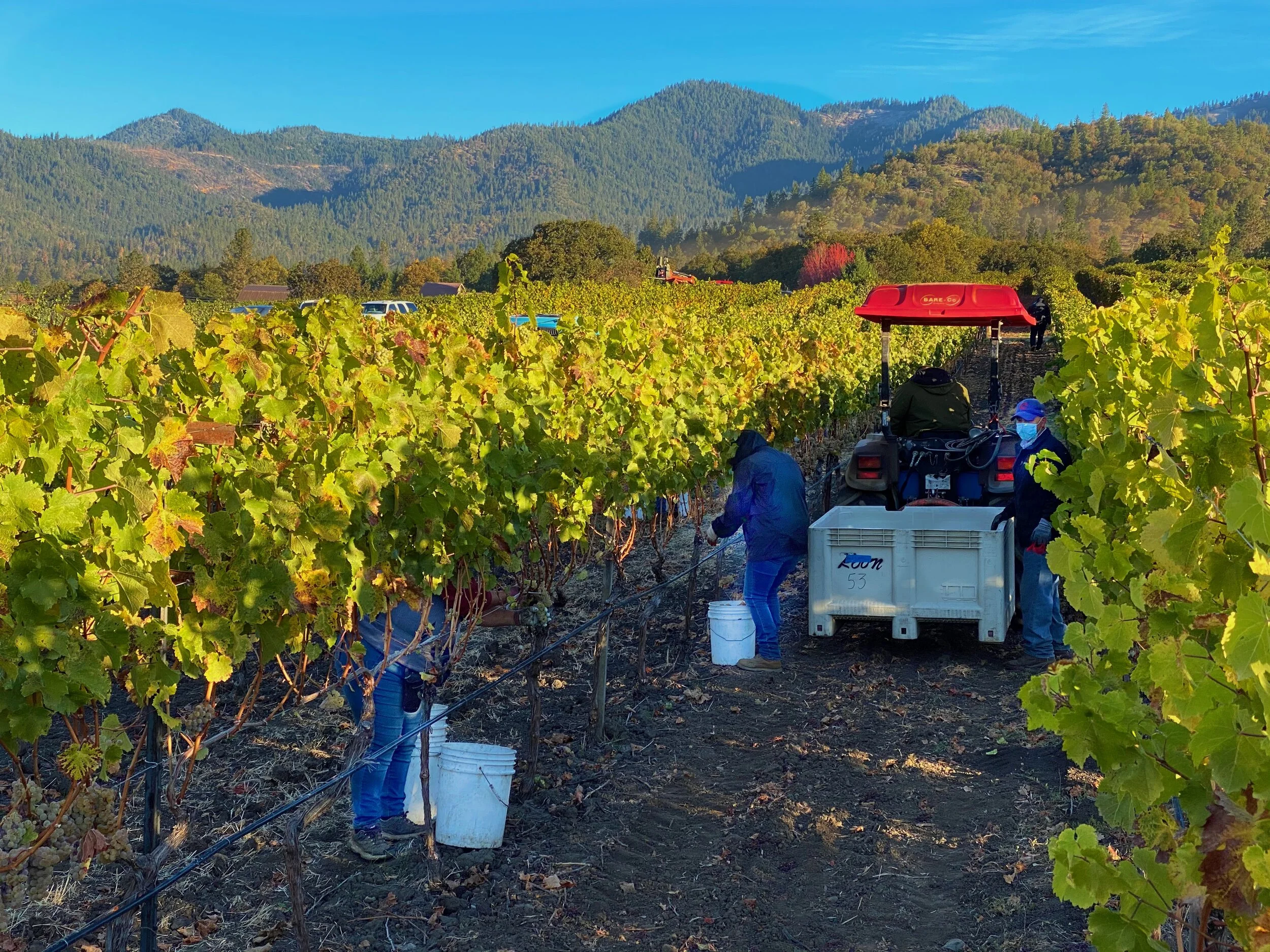
The last day of harvest 2020 at Troon Vineyard in Oregon’s Applegate Valley
Well, that was interesting. Goodbye 2020.
I was really looking forward to 2020. It was going to be a benchmark year as, after three years of intense effort we were going to receive our full Demeter Biodynamic® Certification. Finally, Troon Vineyard, always a vineyard with unfulfilled potential, was going to show what it could do.
Obviously, far, far more important, and more terrible, things happened.
In late February, I was on the Slow Wine Tour as we had achieved another Slow Wine award at Troon Vineyard. San Francisco, Seattle and Denver in four days. Then, during the first week of March, while I was in San Francisco for the Oregon Wine Trail tasting event, I was unnerved to see the desk clerk at my hotel was wearing a mask when she checked me in. Then, at the packed event, people made nervous, feeble jokes about not shaking hands, while making clumsy attempts at bumping elbows. COVID had arrived.
Then everything imploded.
Our tasting rooms and our restaurant customers were closed down, sales events were canceled and the world came to a stop. Or so it seemed at first.
While everything else closed, the farming just kept going. Farms can’t stop for pandemics. The winery became an eerie place. Most days I was alone in the offices and vineyard crew was spread out over the entire farm. It is easy to social distance on one-hundred acres. The cellar team would alternate days so only one person at a time was in the cellar. Despite the challenges, the work got done.
Actually, the work in the vineyard was a comforting thing. With the entire world in an uproar, the quiet and beauty of the vineyard and the surrounding mountains made it a calming and safe place.
Selling wine was not a safe and calming place. A major segment of our customers simply vanished overnight as restaurants and wine bars were shuttered. For a small biodynamic winery producing wines from varieties that are not mainstream commercial pop hits, this was not a good thing.
But then something very special happened.
Our regular customers, wine club members and locals, stepped up to support their local businesses when they needed it most. Our walk-in and online orders took off. Then there were our retail store customers who could have settled for the big, well-known commercial brands, but stuck with small producers like us. It is a favor we will do our best to repay forever.
Then, thankfully, good weather arrived.
In summer things felt lighter as we could have outdoor tastings at our tasting rooms and the energy that our guests brought to Troon revitalized our team. We are lucky to have a large patio and lawn at the winery and a courtyard at our Carlton tasting room. Outdoor tastings were not going to be an issue, as even in normal summers everyone prefers to be tasting outside. Social distance was not a problem as we easily spread out tables across the lawn. During the long, warm sunny days of summer in the Applegate Valley we were busy as outdoor wine tasting felt like a safe option.
Then the fires arrived.
The winds were predicted, but their actual arrival was unnerving as everyone was aware of the danger — a danger that was more than realized. Our neighbors in the towns of Talent and Phoenix saw their communities destroyed. Simple Machine Winery in Talent lost everything. Many winery and vineyard workers lost their homes. The first day of the fires, the skies were blue at Troon, but then the smoke settled in for a few weeks. Once again, we had been luckier than many. The main problem we experienced was that the smoke curtailed our outdoor tastings. Certainly a minor inconvenience compared to what so many suffered. The wine community came together with the Rogue Valley Wine Country Cares fundraiser to raise $57,000 to support housing costs for those that lost their homes. The wine industry is filled with good people.
Then it was time for harvest.
There is never a day filled with such unbridled optimism at a winery than the first day of harvest. We all did our best to maintain that facade. As dawn broke on that first day, we started picking in particularly heavy smoke. I wore both a N95 and a surgical mask and the pickers struggled to work in their masks and the smoke making an already difficult job that much harder. The cellar crew all wore N95 masks, now to ward off both smoke and COVID. Not one person complained. While we could not see each other’s smiles, you could still could still hear the jokes and laughter.
When we briefly removed our masks as Troon Vineyard winemaker Nate Wall made the traditional Champagne toast as the first grapes arrived, it was clear that neither the smoke or COVID could steal our optimism for this new vintage.
Finally, the smoke cleared and most of the vintage was completed under blue skies surrounded by beautiful vistas of the Siskiyou Mountains. Once again we were lucky as our wines were not affected by the smoke. The fires were too far away from Troon so we were not covered with the fresh smoke that can impact the wine.
It is always strangely quiet when the vintage is over.
Harvest interns always bring a lot of energy, fun and enthusiasm to the harvest crew and their departure marks the official end of harvest. It also makes the winery feel quieter and a bit empty. It is always a time for reflection and looking forward. Now that the smoke had cleared the late October weather was unusually warm, customers returned to our tasting rooms and their support once again buoyed our spirits.
Then in November everything imploded — again.
Just as other businesses had done, we had carefully planned how to keep our tasting rooms open for indoor tasting during the winter months. The social distance between tables had been carefully measured, firm mask requirements and disinfecting strategies had been put into action. Everyone on the team was committed to the safety of our guests and each other. I have been inspired by the commitment of everyone at Troon during this year. You could always see their deep respect for each other on their faces — because they were always masked.
Then, as COVID dramatically spiked we once again were limited to outdoor tastings. Winter outdoor wine tastings are not an inviting prospect in the mountains of Southern Oregon.
But then something very special happened — again.
Yet again the Troon team pivoted and recreated our outdoor patios with heaters, blankets and windbreaks to make guests as comfortable as possible. Once again our customers have come through for us braving the elements to taste and buy our wines. You can never look at these people that supported you during this difficult year the same way again. We are very lucky.
All of us are looking forward to 2021.
As you look to the next vintage you are always filled with optimism. I know 2021 will be a special vintage. We learned many things this year. We know more about each other and more about our customers. We are better than we were at the start of 2020. Both more efficient and more empathetic. Smarter and more creative. Tougher and more humble.
Most of all we have to treasure our good fortune in 2020. We were able to hold our own while so many others had the business that they had dreamed of and sweated over for years devastated. We were able to make exciting wines in challenging situations. More than anything we did not lose anyone to this terrible disease, although some of our team lost extended family members. The lessons of vintage 2020 are to count your blessings.
We practice regenerative agriculture at Troon Vineyard. Regenerative means to put in more than you take out. In 2020, that did not only apply to the vineyard.
Well, this will be interesting. Hello 2021.

The Space Between the Notes

Recently, while tasting an old vine cinsault from Chile it occurred to me that the moments I enjoyed most about this delicate wine were those that I could not easily grasp. A long time ago, I realized I want some space in my wines. Space for me. Many wines fill all those spaces and leave nothing left to your imagination. They fill every space with their own noise leaving nothing for you to think about. I don't want a wine to complete my sentences for me.
That seems to be the goal of so many wines these days. They want to take all the work of tasting away from you. Of course, in the process, they take most of the pleasure away. This is the season for "top 100" lists from all the major media. Heck, one is even making top 100 lists by country. You can be sure that these lists are chock full of wines that require little participation on your part. Just cough up the big bucks to buy them, pull the cork, pour into the right Riedel, take a sip, and the rest is all taken care of for you. Thoughtless winemaking creates wines that require no thought. It is an easy recipe.
Of course, most of the winemakers that make these loud wines are far from thoughtless as it takes substantial technical skill to execute the manipulations required to make these wines. Oddly, it requires serious technical skills to make all highly manipulated wines be they mass-produced million case brands or highly allocated unicorns, costing hundreds of dollars a bottle. It is surprising how similar the winemaking process is for these two extremes of the wine marketing world. Obviously, the cheaper wines come from lesser vineyards with much higher yields per acre, but the farming itself and the extensive use of cultured yeasts and a myriad of other additives makes them soul mates.
The other thing they have in common is they require little of your attention. For inexpensive wines, this is a well-deserved point of pride – take a gulp and enjoy your dinner. With expensive wines it is more paternalistic – they know what makes a wine great so you don't need to worry about it. They've punched all the buttons – new oak, big fruit, heavy bottles – so just take a gulp and enjoy your dinner. These wines remind me of what the doctor said to the woman about to give birth in Monty Python's Meaning of Life skit "The Miracle of Birth." When she asks what she should do, he replies, "nothing, you're not qualified."
Overwhelming your senses is not art. If you are listening to Mozart and keep turning up the volume eventually, the beauty of the music is lost and just becomes more noise.
The wines that are most interesting to drink are not seamless. It is in those seams that the compelling moments live. Those spaces make the experience of wine your own. I feel cheated by wines that take those spaces away from me by insisting on filling in all the blanks themselves.
“Music is the space between the notes,” said French composer Claude Debussy. In the spaces of a wine are the notes that make it unique.
Video: Talking Biodynamics and Troon Vineyard Wines with Amy Gross on Wine4.me
It was a pleasure to spend time with Amy talking about our wines, Biodynamics and Oregon’s Applegate Valley!
Interview on the Organic Wine Podcast
I spent a entertaining hour discussing biodynamics regenerative agriculture at Troon Vineyard and life in Oregon’s Applegate Valley with Adam Huss on his Organic Wine Podcast.
“Today we take a trip to the country to meet Craig Camp, the General Manager of Troon Vineyard in the Applegate Valley AVA of Southwest Oregon. Troon is a certified organic and biodynamic winery and estate vineyard that focuses on blends made from the grapes of Southern France, which seem to do extremely well in this northern area with a hot Mediterranean climate.
Craig was brought in to regenerate every aspect of Troon, and we had a very enjoyable conversation about everything that is happening there that he has helped implement. From soil testing and replanting and staff education to sheep dogs to organic vegetable gardens and more, even from the outside it’s exciting to hear about what he’s doing, and you can hear the excitement in the way he talks about it.
Craig has a personal story in regards to wine that I can relate to as well. He fell in love with wine far away from where it was grown, and over the course of his life and several career changes, he worked backwards toward an understanding of how the finest wine begins in a healthy, probiotic soil.”
Dirt is Not Terroir

Mycorrhizal Fungi - Illustration by Michael Rothman - https://www.rothmanillustration.com
It was the early eighties, and I was yet again rereading several chapters of Edmund Penning-Rowsell’s tome The Wines of Bordeaux. I had just spent the day tasting in Graves and Sauternes from the tank and barrel with renowned French wine exporter Christopher Cannan. Now it was night, and I was getter ready for bed in a small, dimly lit guest room above the offices of his company Europvin in the city of Bordeaux. We were visiting the Chateaux he worked with throughout all the appellations of Bordeaux. Each night before sleep I would review the appellations we had visited that day and those we would visit the next. That week long visit to Bordeaux was followed by a week in Burgundy with Becky Wasserman and my nightly reading changed to Burgundy, then a brand-new book authored by Anthony Hanson.
The next year I made a similar trip to Italy. Setting off with famed Italian wine exporter Neil Empson, we visited almost every wine area of Italy to taste at nearly every estate in his extensive portfolio on a three-week tasting marathon. In my bag was a well-worn copy of Burton Anderson’s Vino, the Italian wine bible of the day. My reading pattern was the same as when I was in France, reviewing each night on where we had been and cramming on where we were headed the next day.
I have been lucky over my career to have made multiple such trips to France, Italy, Spain, Germany and Australia. Top that off with many, many trips through the wine regions of California, Oregon and Washington. On each trip I would devour the current wine literature of each region before, during and after each visit.
I was obsessed with wine books and literally would buy and read whatever came out each year and my bookshelves overflowed with dog-eared, wine-stained volumes. This was the era of my life when I was a wine importer and distributor based in Chicago. Then, two decades ago, I made the transition from wine distribution to wine production and my reading list began to change. Slowly but surely instead of reading books about wine, I began reading books about farming. I recently realized this when I noticed that the last five books I’ve read all have the word soil in the title.
Even though my reading materials have changed, I am still as obsessed by the concept of terroir as I was decades ago in that small room in Bordeaux. However, what that means to me has changed significantly.
Those books presented terroir as something magical. That each site is a unique expression of the soil where it was grown. Then you actually start to grow wine and a new reality presents itself.
Take Oregon and Burgundy for example. In the Willamette Valley the soils are volcanic or sedimentary acidic soils. Summers are almost desert-like with no rain for months. Burgundies are grown on alkaline limestone soils and there is rain throughout the growing season. There’s not much in common here except one thing — outstanding pinot noir. Time after time experienced professional tasters find it difficult to tell which wine is Willamette Valley and which is Burgundy.
Burgundy and the Willamette Valley are not alone in this for the same experts can confuse California and Washington Cabernet with Bordeaux and California Coast and Oregon Syrah with Rhône wines. Each of these areas are very different from each other. How it is possible that all can produce wines whose provenance confuses the experts?
The reason is we have always made the cornerstone of terroir the type of soil the vine grows in — limestone, volcanic, granitic, sedimentary and so on. But it turns out that it’s not the exact type of soil that matters as much as the life in the soil itself. It has been this realization that changed my reading from wine books to soil books.
Terroir is not an expression of inert dirt, it is the individual expression of living soil and how a healthy plant intertwines with that soil. Dirt is not always soil. Soil is a system teeming with life.
Obviously, there are distinct sites. Terroir is a combination of many things. Climate and mesoclimate are critical, then there is the human element — row spacing, trellising and picking the right variety for the right place. For example, planting cabernet in a cool climate and pinot in a warm climate is not a great idea. But it takes grapes grown on healthy vines on living soils to make an expressive wine with a distinct character.
What makes for a living soil? Here is where you find the reason that biodynamic wines have a unique liveliness that stands out. Sustainable agriculture is not enough. That only means that you are killing the life in your soils more slowly than industrial agriculture. It is only with regenerative agriculture that you can build soil that creates distinctive, individualistic wines.
Plants and the microbiology in the soil have a complex symbiotic relationship. The plant takes a large percentage of the carbohydrates it produces through photosynthesis and pushes this exudate out through its roots to attract the microbes it needs to extract nutrition from the soil. It can change the mix of exudates depending on its requirements at the moment. A healthy plant decides the microbiology in the soil by the mix of gourmet microbe treats it sends out through its roots. That microbiology then returns the favor by processing the nutrients in the soil into a form the plant can utilize. The healthier the plant, the healthier that microbiology becomes. The healthier that microbiology becomes, the healthier the plant becomes. Not a bad system.
Then we come in and screw it up. The application of pesticides, fungicides and fertilizers destroys nature’s well-tuned system. In that system is to be found what makes a vineyard unique. It is an essential element of what we call terroir. The grapes that make distinctive wines come from vines in vineyards where nature’s system is humming along. Our job as farmers is to assist the plant and soil in regenerating that balance year after year. This is vital when you have a perennial crop like vines that do not lend themselves to crop rotation.
Coming back to the Willamette Valley and Burgundy comparison, perhaps their shared qualities come more from the life in their soils than their geological provenance.
I still read before and after vineyard visits. However, these days they are not wine books, they are soil books. It is in the soil you find great wine.
Regenerative Agriculture
Troon Vineyard is now both Demeter Biodynamic® and CCOF Organic Certified. Certainly, that’s an accomplishment that I am more than proud of attaining in the minimum required three years. Yet, there are parts of both certifications that have always made me uncomfortable.
The USDA Organic certification has been largely taken over by industrial organic farms. For example, the massive national distribution of certain organic salad brands. It even allows hydroponic agriculture. The concept of “organic” agriculture that does not involve soil certainly does not meet the standards I would set for a natural food growing system.
Then there is biodynamics, which I was drawn to in two ways. First, I had tasted too many excellent wines made biodynamically and I aspired to make wines with that kind of life and energy. I wanted to make better wine and was convinced this was the way to achieve that goal. Second, was the focus in biodynamics on rebuilding soil microbiome through a proactive series of probiotic applications based around compost, compost teas and other fermented applications. I believed that the tenets of biodynamics created an ideal framework to rebuild our soils and, indeed they did at Troon Vineyard. As with almost every biodynamic winegrower I know, I was drawn to the regenerative farming concepts of biodynamics, but was less than comfortable with Rudolf Steiner and the Anthroposophical side of biodynamics. Like most biodynamic wineries, we focused on the practical aspects of biodynamics and more-or-less ignored the Anthroposophical side.
Apparently, many others had the same feeling I did as there is now a new certification that incorporates the best of both organic and biodynamics while actively incorporating the human element. This new certification includes an essential word — regenerative. Called the Regenerative Organic Certification it combines the restrictive nature (telling you what you can’t use) of organic certification with the proactive, probiotic nature of biodynamics and creates a more complete structure for rebuilding soil. As it says on their website, “farm like the world depends on it.”
My search for a framework for regenerative viticulture soon transformed into the broader view of the “whole farm” concept that defines biodynamics. Practicing regenerative agriculture is more than simple organic viticulture. Biodiversity creates more biodiversity and is the key to regenerative agriculture. At Troon Vineyard our viticultural inputs now include cider apple trees, vegetable gardens, sheep, chickens, grains, bees, pollinator habitats and compost — lots and lots of compost.
The Regenerative Organic Certification excites me as it incorporates all the things I find important about the Organic and Biodynamic® Certifications while also resolving my concerns with both. I also find the addition of social fairness as a cornerstone of the program brings an important element not included in the other programs. Obviously, industrial farms would have difficulties meeting this requirement. The animal welfare requirements, which are also included in the Demeter Biodynamic® Farm Standard, are also important additions as many animals on organic certified farms, while better than industrial feed lots, do not live in humane conditions.
We will certainly keep both our Organic and Demeter Biodynamic® Certifications. You have to be certified organic to achieve the Regenerative Organic Certification and the framework of biodynamics has achieved all I had hoped and more.
The focus on regeneration is what is key to me. We have to put back more than we take to establish a natural food growing system. Farm like the world depends on it — because it does.
Here is some recommended reading on regenerative agriculture:
Hidden Half of Nature by David Montgomery
Restoration Agriculture by Mark Shepard
Demeter Certification
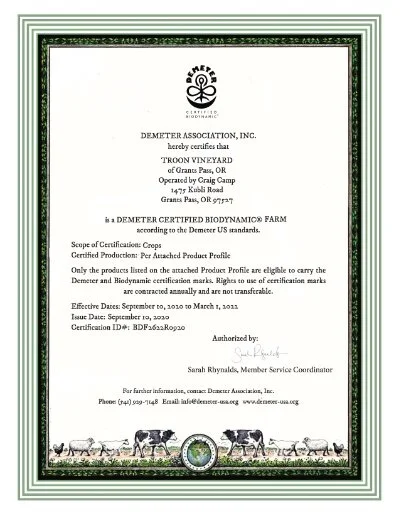
Troon Vineyard one of twelve Demeter Biodynamic® Certified wineries and vineyard in Oregon
It started in a grown over abandoned cow pasture three and a half years ago and ended with Champagne on the patio at Troon Vineyard last week.
The start was picking the site for the compost piles. The Champagne toast was to celebrate what we have achieved in these years in-between. Troon Vineyard is now one of only twelve wineries in Oregon to be certified Demeter Biodynamic® in both the winery and vineyard. To add a bit of icing to the cake, both the vineyard and winery are now also certified CCOF Organic.
Searching with me for a compost site in an abandoned and overgrown pasture over three years ago was biodynamic consultant Andrew Beedy. The new proprietors of Troon Vineyard, Dr. Bryan and Denise White had fully committed to the concept and investment required to transform Troon Vineyard from industrial agriculture to biodynamics. Now Andrew and I started the project forward. If you were standing there that day with Andrew and me and then came back to Troon Vineyard today, you would not recognize you were on the same farm. Only Grayback Mountain, still majestically towering over the Applegate Valley, would tell you that this spot was Troon Vineyard. The distressed, dilapidated and diseased vineyard that was Troon Vineyard in 2016 has been replaced by a living farm. Today, everywhere you look is activity and, most importantly, life.
While media tends to focus on buried cow horns and other photogenic aspects of biodynamics, the heart of biodynamics is the people who practice it. A farm is not a natural occurrence in nature. Mother Nature does not plant grapevines in nice neat rows. Our goal and I believe the goal of biodynamics, is to let the natural systems of nature function as normally as possible in the rather unnatural environment that is a farm.
It takes a village to achieve a goal like Demeter Biodynamic® Certification. Fortunately we built a dynamic team to accomplish this goal. Proprietors Bryan and Denise White have provided a solid foundation for us to build on. Biodynamic consultant Andrew Beedy and viticulturist Jason Cole provided the framework for our vineyard crew, led by ranch manager Adan Cortes, to transform not only the vineyard but the entire property. Our cellar team, winemaker Nate Wall and assistant winemaker Sarah Thompson fully embraced biodynamics and daily keep us moving forward as we expand and deepen our practice of regenerative farming and winemaking.

Troon Vineyard CCOF Organic Certification
For me, I will admit this is an emotional moment as I remember first seeing this vineyard in 2016. Today, when I stand in the same spot where I first surveyed this vineyard, surrounded by the majestic beauty of the Siskiyou Mountains, I can clearly recall feeling that this was a special place and a special vineyard. To see the possibilities I saw transformed into reality sometimes seems like almost a dream, but it is a dream come true.
Certification was a goal and now it is a goal achieved. It fact it just means that we have arrived at the starting line. So much of the work over the last three years has been repairing and restoring and we are far from done with those jobs. Now the goal is to more deeply understand this vineyard, this farm, and to make the practice of biodynamics our own. To achieve certification you are given a set of rules to follow. If you check off all the boxes you achieve certification. Now, as a jazz musician must master the scales before they can improvise, that we have learned to work within the framework of biodynamics, we must learn to go beyond that framework and discover the natural system of this farm. That will be our ultimate goal. Our job is to learn what this farm needs and then do our best to provide for those needs. The next years will be focused on building biodiversity. We will be welcoming some new members to our biodynamic team as next spring a flock of sheep, more chickens, and the requisite guard dogs (Pyrénées of course!) became part of our farm.
We celebrated our certifications with a Champagne toast. We toasted not only to what we accomplished, but what we will accomplish in the future. Becoming one of the few Demeter Biodynamic® Certified wineries and vineyards is a true milestone. Now, on to the next one.
Rebirth, Regeneration, Rediscovery

Troon Vineyard, Applegate Valley, Oregon
“Troon Vineyard is a story of rebirth, regeneration, and rediscovery,” reads the lede in the Oregon Wine Press article “Troon Renaissance” in their July issue about the transformation of Troon Vineyard. The author, Barbara Barrielle, could not have better captured the spirit of what has been accomplished at this small vineyard in the Applegate Valley of Southern Oregon.
When I first visited Troon Vineyard in 2016, I felt a connection to the vineyard from the first day because I could feel the potential of this site. I can still clearly remember that day as I stared at the vineyard with the dramatic backdrop of Grayback Mountain and the Siskiyou Range. I felt that this was not only a site with potential, but with soul. The serene beauty of the Applegate Valley is unmatched by other American wine regions and, while the site and the valley were beautiful, the condition of the vineyard was not. This was a vineyard that needed to be born again.
In 2016, the rebirth of Troon Vineyard began. This was no easy task as the owner at that time did not share my vision of the potential of the vineyard and the wines. For years, Troon had been focused on what I would call “gimmick” marketing. Funny labels and contrived marketing spin were the strategies. Also, key staff members had been driven off by, shall we say, less than enlightened management practices. I still cringe when I think of the loss of one, particularly talented staff member due to insensitive treatment. Fortunately, at least, she moved on to another winery in the Applegate Valley and remains a friend to this day. I had been brought in to put the business in order so that it could be sold. I saw it as a short-term project, and I was getting ready to move on when Denise and Bryan White arrived and decided to purchase Troon. In the meantime, I'd fallen in love with this vineyard. Thankfully, they did too. For it would demand a labor of love to not only restore the vineyard but to restore honor to a tarnished brand.
Troon Vineyard had been in a dark period for some time. To say the brand was tarnished would be an understatement. I was brought in to put a bandaid on it and then to move on once first-aid was applied. That’s all the owner at that time wanted, and I just wanted to get out of Napa and have some time to find a compelling vineyard in the Willamette Valley. It did not take me long to realize I had found that vineyard, but it was in the Applegate Valley. Without an owner that is connected to the vineyard and the soil, there is no hope. The vineyard convinced me to hope anyway.
What is now Troon Vineyard was divided at that time. The west ranch was being farmed using the nuclear option by the family that had purchased it in a sale that had broken the property apart. Knowing little about farming, they pushed the vines to their limit using every chemical trick and allowing the vines to overproduce and exhaust themselves. I’ll always remember reading their spray list and seeing a product called Venom. Any product with such a name needed to be checked out. The first thing I saw on the product label was that it killed bees - all of them. These poor plants would never completely recover from this abuse, but, hopefully, the soils and the bees could. Fortunately, the east ranch was still under our control, and there I pulled the plug on chemicals in the vineyard and the cellar. It was not an easy task as the winemaking and vineyard team at the time had never been asked to aspire to make great wines, so they had not.
We had to not only regenerate the site, but the people that worked it.
In 2017, the regeneration of Troon Vineyard began. The essential step was the purchase of the Troon Winery and the west ranch by the Whites. They had already purchased the half of the original property that had been sold off and then they purchased the Troon Winery site to reunite the entire estate. The other big step was the arrival of biodynamic consultant Andrew Beedy. A huge leap forward was made as, now that both vineyard blocks were under our control, we were able to move immediately and totally to organic and biodynamic agriculture on the entire estate. Then plans were initiated for a range of research projects to dig into every aspect of the vineyard. There was a lot to learn.
This year also was the start of our compost program, which required us to produce over two hundred tons of biodynamic compost a year. That’s a lot of manure. Fortunately for us, our neighbor here in the Applegate Valley is the Noble Organic Dairy with thousands of cows eager to contribute to our cause.
Regenerative agriculture became the foundation of everything we did, and biodynamics provided the framework to build on. We were searching for the soul of this vineyard. It had been there all along, but we had to rediscover it.
In 2018, the rediscovery of Troon Vineyard began. Vineyard Soil Technologies from Napa Valley arrived and dug over seventy five-feet deep soil pits. A team of soil scientists spent a week in the pits researching every aspect of the vineyard. At the same time, we began our project with Biome Makers, as they created an annual database on the bacteria, fungi, and yeasts that made our soils unique. Master viticulturist Jason Cole came on board to manage the redevelopment of the vineyard. We wanted to understand how every aspect of the vineyard changed as we implemented biodynamics. We needed all the data we could obtain to help us make the right decisions.
There were a lot of decisions to be made as we had decided to replant the entire vineyard. The existing vines were simply beyond saving. The biggest issue was extensive red blotch virus infection, but the vines had also been weakened by the years of conventional farming. Weak vines are easy targets for other vine diseases, and these vines had become an encyclopedia of afflictions. As devastating and expensive it was to have to replant the entire vineyard, there was a silver lining as we could now choose the right varieties for this site and plant them the right way. Instead of having to deal with a hodgepodge of varieties, some less than ideal for the site, we could replant with a plan. That plan would be to focus on the varieties of southern France. Those varieties would include syrah, grenache, mourvèdre, cinsault, counoise, tannat, malbec, negrette, bourboulenc, marsanne, roussanne, viognier, clairette blanche, bourboulenc, vermentino (rolle) and picpoul. Many of these varieties will not appear as single-variety wines but will be part of blends.
Blends are to become the heart of Troon Vineyard as we create the new Troon.
In 2019 we recreated Troon Vineyard as the replanting project began as we planted ten new acres of vines. Some of these were new areas, never before planted, and others were replanting of vineyards we had removed the year before. It is always a sad experience to remove vines - even sick ones. Planting new vines is the flip-side of that emotion as there is nothing that fuels the spirit of optimism more than putting vines in the ground. We are planting not only for ourselves but for future generations. There are few things that “pay it forward” more than planting a vineyard. These vines will produce wines we’ll never taste, made by people we’ll never meet.
The work that began in 2016 was recognized in 2019 as we were awarded our first Demeter Biodynamic® and CCOF Organic certifications. There are separate certifications for the winery and vineyard. Therefore, we received our full certifications for the winery, but our “in-transition” certifications for the vineyard. We’ll get the final Demeter Biodynamic® certification for the vineyard in 2020 as it takes three full years of biodynamic farming, and in 2019 we were a few months short of that goal.
The older vines were now really showing the impact of our biodynamic regenerative agriculture program. They were healthier and producing better fruit. Our good friends in the Applegate Valley, Barbara and Bill Steele, at Cowhorn Vineyard, had graciously agreed to sell us some of their biodynamic syrah, grenache, marsanne, roussanne, and viognier to get us through the shortfalls of our own production as we replanted. So we had grapes from our own estate that were dramatically improved in quality combined with excellent fruit from Cowhorn to work with, but, as with a great violin, you need a virtuoso to play it to show what it can do. That talent arrived as this vintage was made under the guidance of new Troon Vineyard winemaker Nate Wall. Nate is an incredibly sensitive and passionate winemaker whose love for the site equals the Whites and my own. His background in science (B.S. in Biology and M.S. in Environmental Engineering) was ideal for our philosophy of searching for the science in biodynamics. His extensive experience making pinot noir in the Willamette Valley provided the light, minimalist touch needed for wines from the Applegate Valley.
The confluence of a healthier vineyard, better fruit, and the right people made the 2019 vintage a milestone vintage for Troon Vineyard. The wines from this vintage finally give a glimpse of what this special vineyard is capable of producing. The first of our new generation of wines included wines released in 2020: Piquette, Pét tanNat (100% tannat pét nat), and Kubli Bench blends that included an Amber (orange wine) and a Rosé. Another orange wine, Amber Amphora Vermentino, has been aging on the skins and stems in three amphorae for the better part of a year and will be released this fall. While most of the 2019 red wines (which we are equally excited about) will not be released for a few years, we did produce a 100% carbonic maceration Grenache, which we are enjoying chilled this summer.
So in 2020, Troon Vineyard has been reborn, we have regenerated the vineyard and the wines and created a team that has rediscovered the soul of a vineyard. Joining that team in 2020 is the energetic and creative assistant winemaker Sarah Thompson. This will be the year we receive our full Demeter Biodynamic® certification that will recognize years of hard work and investment. But these achievements only mean that we have arrived at the starting line of a race that never finishes. There is no such thing as a finish line in winemaking.
Regeneration is a constant. Every year it begins again only building on the work of the preceding years. Agriculture is a relay race. We can only do our best for the land, the plants, and our wines and then, finally, pass the baton on to the next runner. Hopefully, they’ll run the race with the same intensity that we ran our leg.
Wine Photos: Planting the Biodynamic Preparations at Troon Vineyard
One of our main goals in practicing biodynamics in our pursuit of regenerative agriculture is to minimize inputs from off the farm. So we are planting and using the components to make the biodynamic preparations from plants that we grow ourselves.

Winemaker Nate Wall and assistant winemaker Sarah Thompson planting valerian to make biodynamic preparation 507 in the Troon Vineyard biodynamic preparations garden and area. We also make our BP 500 an 501 at this spot.
Two Conferences, Two Biodynamics

Winemaker Nate Wall and consultant Andrew Beedy make Biodynamic Barrel compost at Troon Vineyard
In a time that seems far-far away these days, within a few months of each other, I attended two biodynamic conferences. One was the Biodynamic Wine Conference in San Francisco and the other was the Biodynamic Conference in Portland. While the names of these two conferences only differed by one word, the conferences themselves were worlds apart.
The Demeter sponsored Biodynamic Wine Conference was all about down-to-earth biodynamic and organic farming. The sessions were about composting, soil microbiome, and building mycorrhizal communities. It was also about asking questions. What tenets of biodynamics worked and which didn’t? It was an excellent conference that both inspired and informed. A few months later, I attended the Biodynamic Association’s Biodynamic Conference and found myself in another world - literally another world. Scanning the conference schedule I was hard-pressed to find sessions with the practical focus of the previous conference. However, there were sessions like, “How to Invite Elementals onto Your Farm”, “How Inner Development Affects Our Tasks on the Farm” and “5 Solutions for Land-Based Wealth Distribution”. I discovered there were two worlds of biodynamics and they were worlds apart.
I came to biodynamics the same way most wine people do. At first, I was extremely skeptical, but time-after-time I would taste a wine that impressed me and time-after-time they were biodynamic wines. Skepticism slowly turned to curiosity, then turned to conviction. As I met more biodynamic winegrowers I was impressed by their practical approach and commitment to soil health as the foundation of healthy vines. Healthy vines in healthy soils give you the best chance of making worthwhile wines.
One of the wines I loved was Nicolas Joly’s Coulée de Serrant, but I found his writings on the subject too esoteric. Then there was Rudolf Steiner himself. After a few attempts to read his writings, I was quickly cured of any desire to try again. After all, he died in 1925 and most of the agricultural writings I read are more likely to have been written in this century. Agricultural science has evolved a bit in the last 95 years. So, as I pursued biodynamics I relied more on working winegrowers than the writings of a long-dead philosopher, who was not even a farmer. The agricultural lectures, on which biodynamics was based, was a minor part of Steiner’s work. He only participated reluctantly and there were only eight lectures given over ten days. He died the next year.
The two conferences I attended really illuminated these two faces of biodynamics for me - the anthroposophical, “spiritual-science” side and, what I call, practical biodynamics. As I look at biodynamics, I see a framework that clearly has an effect on wine quality. We work within that framework as, at this time, we simply don’t know what parts of that framework work from those that don’t. It is our responsibility to add to this body of knowledge so that the next generation can build on the best practices and discard the worthless ones. To achieve that goal, at Troon Vineyard we are working with academics from Oregon State, the University of Oregon and Linfield College and with Biome Makers to build a database on the transitions in our soils, compost, plants, fermentations and wines as we convert from conventional to biodynamic regenerative agriculture. You can be a biodynamic farmer and not be a follower of Steiner.
For obvious reasons, the media loves to focus on the Steiner side of biodynamics. Let’s face it, it makes better copy than farmers simply seeking the secrets of naturally building the microbiome of their soils. Some writers don’t just focus on the more picturesque parts of the Steiner side of biodynamics, but go on the attack and lump all biodynamic farmers into the anthroposophical basket. A recent article, The problem with biodynamics: myths, quacks and pseudoscience by Joshua Dunning is just the latest in this group. On his site, he notes that he, “holds an undergraduate degree in Economics and Finance and a postgraduate MSc in Supply Chain Management from Aston University. My field of expertise lies in continuous improvement, I have worked for leading discount-supermarket chains, consulted to start-up tech companies, and am now employed by a leading UK automotive manufacturer.” I think we can assume this means he probably is not a farmer. As someone who spends most of his days on a biodynamic farm, I’d like to address some of the points he makes in his article.
“My somewhat fierce opposition to Steiner and his quackery” I don’t disagree much here. There is much not to like about Steiner. I would point out that in 1924 there was no shortage of quacks, many of whom were respected medical professionals. I’m no defender of Steiner, but judging people from one hundred years ago by today’s standards is difficult at best. However, Steiner’s racism can’t be ignored.
It seems even more unlikely that held static and unchanged that the proposed process would continue to offer the most effective form of agriculture for many decades to come. Most of what we call biodynamics today was created after Steiner died in 1925, just a year after he gave the lectures. It can be argued that Ehrenfried Pheiffer is the real father of biodynamics and it was his book Bio-Dynamic Farming that launched that concept to the world in 1938. After Pheiffer, there is a long list of people that have contributed to what is today known as biodynamics. Steiner himself would barely recognize biodynamics as practiced on commercial farms today. By the way, he probably never heard the word biodynamics.
“An example being the use of animal byproducts in biodynamics; why is the use of the horn insisted upon? Would a synthetic product be better? Why is this is not tested?” Actually there have been ongoing tests and some have been promising. At this point, the horns have been the most reliable, but it is reasonable to assume that someday they could be replaced by other containers. There is actually pressure from vegans to find alternatives. That said, the idea of a synthetic product runs contrary to the concept of building a natural system. We’re trying to use less plastic, not more. Besides, as the goal of making BP 500 is to collect fungi and bacteria, it is not unreasonable to assume that they would prefer natural materials.
“However, the advocation of pseudoscience erodes public understanding and appreciation for good science, discredits the work of serious scientists and makes it harder to encourage critical thinking.” True, except that biodynamics is now the focus of a lot of research. I would refer you to the scientists studying our vineyard. The fact is that soil microbiome and the mycorrhizal system is the hot topic of modern agri-science. Now that big money is involved, there is great interest in discovering those secrets and due to that, we will know a lot more about biodynamics in the coming decades.
“It is advised that particular preparations are stirred for an hour in order to not only dissolves the substances but ‘more importantly, release the dynamic forces” We also make compost tea, a well-proven agricultural tool. To make that compost tea, you brew it for 24 hours with active aeration that encourages the microbiological life before application. Stirring BD 500 for one hour does exactly the same thing. One side of the biodynamic community may focus on “forces” but the other side is focused on microbiology. We also believe this releases dynamic forces, but those forces are fungi and bacteria.
“It’s difficult to find reliable estimates of the financial costs of converting to biodynamic, even trickier is establishing the cost variation between working organic and biodynamic.” Actually, the organic part is far more expensive than the biodynamic part. The biggest expense is the farm equipment - mechanical weed control, etc., but that is also required for organics. Compost tea brewers are expensive, but are not part of the biodynamic system. Compost is very expensive and time-consuming, but that too is part of organics. The actual biodynamic preparations are very inexpensive to produce. You have to be organic to be biodynamic, so the additional cost and time to be biodynamic are not significant.
“However, there were no differences in several other variables measured, including pH, cation exchange capacity, moisture content, and ammonium, potassium, and phosphate levels. In contrast, researchers found that biodynamic preparations reduced both compost pile temperature and nitrate concentration.” The main difference between standard compost and biodynamic is that the biodynamic process does have lower pile temperatures. In fact, biodynamic compost is not considered compost by the USDA for this reason. The lower temperatures create the conditions for more robust microbiology in the compost, which would be reduced by the higher temperatures. The faulty thinking here is that the compost is used as a fertilizer, which is not its primary function. The goal of biodynamic compost and BP 500 for that matter, is to rebuild soil microbiome. It is primarily a probiotic, not a fertilizer. Vines do not require nutrient-rich soils. With a well established mycorrhizal community, they can easily extract all of their requirements without additional fertilizers.
“No differences were found in weed control using preparations 500– 508 or in cover, species richness, diversity, and evenness of weed species” Weed control? The preparations have nothing to do with weed control. Weed control is attained by mechanical methods and cover crop management.
“Addition of biodynamic preparations not only increases labour and materials costs but also widens the ecological footprint of the practice because of higher machinery use for applying the preparations.” As pointed out above, the actual costs of biodynamics over organics are minimal. As we are able to apply the biodynamic preparations 500 and 501 (the only BP preparations directly applied in the vineyard) using a small ATV and sprayer instead of a tractor it actually reduces tractor passes, soil compaction, and our carbon footprint. We can further reduce tractor passes by including barrel compost teas with our powdery mildew sprays.
“On a total of 8 pages in Demeter’s biodynamic certification document, the regulator makes reference to cosmic influence and rhythm.” The American Demeter certification recommends trying to follow these rhythms - if possible. While it may be possible in your garden at home, it is not on a large commercial farm. In our view, the cycles of the moon are more a timepiece than a cosmic influence. These were the tools that ancient farmers had and they used the moon as a clock in the sky based on successes and failures that they had in the past. Perhaps there is a small edge to be gained here so, if possible, we’ll pick those days. If there is any chance of making better wine, no matter how small, we’re willing to give it a shot. Practically, it is impossible to run a 100-acre farm based on the moon and stars. If something has to get done we do it, no matter where the moon or planets are in the sky. There is only one body in the sky that totally guides our work - the Sun.
Mr. Dunning was inspired to write his article by his participation in a webinar panel. As useful as these events and conferences can be, I would suggest he spend some time on a commercial farm actually practicing biodynamics. He may well find that the actual practices don’t always line up well with the myths.
I agree that there are many ideas that have crept into biodynamics over the decades that strain credulity and science. Indeed, pseudo-science and quackery are issues that I believe have held back the adoption of the many aspects of biodynamics worth investigating. Certainly, Steiner and devotion to him as a spiritual leader is also holding back biodynamics. The fact is that Steiner was anti-alcohol and the first vineyards that started farming biodynamically in Europe were rejected by the biodynamic community and for that reason formed their own organization - Biodyvin. I often think that may also become necessary in the United States.
Biodynamics is a process, not dogma. It is a search to find the natural systems that make your farm unique. Each individual farm has to find its own way. The structure of biodynamics is just a starting place. The ultimate expression of biodynamics is when you develop the ideal system for your farm. That system may not contain elements of what is known as biodynamics today and will almost certainly include your own discoveries. I have always considered attaining our Demeter Biodynamic® certification as the beginning, not the finish line. Perhaps certification itself is something you eventually go beyond as you discover your own answers.
There are many mysteries about how the microbiome of the soil works in harmony with plants. The science here is still young and much is not understood. To me, biodynamics honors those things we do not yet understand. Because we are still learning, it is not productive to label all things not understood as some sort of voodoo. We should be humbled by our ignorance and find joy in what we learn about nature as it is in that knowledge that we will find answers to so many of today’s issues. Some, but not all of those answers can be found in biodynamics.
I believe in elementals. They are the fungi and bacteria that make our soils live.