Wine Photos: Planting the Biodynamic Preparations at Troon Vineyard
One of our main goals in practicing biodynamics in our pursuit of regenerative agriculture is to minimize inputs from off the farm. So we are planting and using the components to make the biodynamic preparations from plants that we grow ourselves.

Winemaker Nate Wall and assistant winemaker Sarah Thompson planting valerian to make biodynamic preparation 507 in the Troon Vineyard biodynamic preparations garden and area. We also make our BP 500 an 501 at this spot.
Planting New Vineyards at Troon - Hands

It was before 6 a.m., but there were already a lot of holes. Dawn had not broken, but a dim light was just starting to flow over the mountains. Hundreds of holes had already been dug. Around thirty people moved their spades rhythmically, almost silently, as they dug twelve-inch holes, one after another. This is how you plant, or should I say, how they plant a vineyard.
Last week at Troon Vineyard in Oregon’s Applegate Valley, we planted about a third of the vines we need to plant this month. That was over four thousand holes, dug by hand in less than two day’s work. But digging the hole was only the beginning. Once the holes are dug, they must each receive, by hand, a shovel full of Biodynamic compost mixed with Azomite and Calphos and then a vine needs to be dropped in each hole. On each vine, the biodegradable root cover had to be removed by hand due to the requirements of our organic certification. Then, on their knees, with their hands, each hole is filled and the vine is in its new home.
One day these vines will give birth to wines served in some of the best restaurants in the world. But it is these people in the pre-dawn hours with their spades and on their hands and knees that brought these vines to live in this vineyard.
Winery tours and articles like to feature barrels, tanks, and machines, but it is the hands of the people that craft them that make wines of place come to life. From the moment the vines are planted, to when they are tended in the vineyards, to the cellar work that turns grapes into wine, the best wines are handmade wines.
Hands, not things make memorable wines. Hands hold the spades that dug the holes to plant them, hands shovel the compost to help them grow, hands prune and position the shoots as they grow, hands pick the grapes, hands sort the fruit that arrives at the winery and hands hold the glasses when it’s time to savor the hand labor that put the wine in those glasses. Making and enjoying wine is a hands-on experience.
The thousands of holes dug by dozens of hands will start to produce wine in three years. Many hands will touch each of these vines as they grow over the next years. Your delight and pleasure in the wine they will one day produce will be the result of the work those hands. Hand to hand to hand and, finally, to the glass in your hand.
Wines of place, with terroir, touch you because of the many touches that have brought the wine to you.

Planting grenache noir at Troon Vineyard

Placing new vines one-by-one in the freshly dug holes. Each of the wrappers on the roots also had to be removed.
Planting New Vineyards at Troon - Getting to Know You

Troon assistant winemaker Cary Willeford applies Biodynamic Preparation 508 to newly arrived vines
Standing there looking at the now real Troon Vineyard block 9, newly planted with mourvèdre, was an emotional experience. So much planning, work and investment transformed from an idea into a vineyard. There in front of me, I could finally feel the wine that would come from these vines. Putting a plant in the ground that hopefully will be producing wines long after I’m gone is a very different experience than planting a crop that will be replaced after one season. But it was the day before that we got to know each of these vines.
The process of preparing these vines for their new home begins the day before planting. Troon winemaker Nate Wall and assistant winemaker Cary Willeford and I spent the day preparing and applying a series of Biodynamic Preparations to the new plants. First was Biodynamic Barrel Compost, which we dynamized for twenty minutes by hand before applying to the roots of each plant to give their microbiome a head start. Meanwhile, we had been preparing a tea of Biodynamic Preparation 508 (equisetum or horsetail). Which was also dynamized by hand then sprayed on the leaves and graft junctions. This preparation helps the plant ward off fungal diseases like powdery mildew. The time, care and intention that went into this process I believe are integral to what makes Biodynamics such a powerful agricultural system. The culture we built by providing care and attention to each plant changes our relationship to them and to each other.
Biodynamics achieves many goals. Your soils are healthier, your plants are healthier, your fruit tastes better, your wine is better and, obviously, its better for the environment. It is a lot of work, but it is also a lot of fun. You feel good about what you’re doing everyone feels pride in a shared worthwhile endeavor.
Yesterday afternoon all of our existing vineyards were also treated with Biodynamic Barrel Compost, we did not want them to feel left out. After all, plants do talk to each other you know.

Troon assistant winemaker Cary Willeford and winemaker Nate Wall apply Biodynamic Barrel Compost to the roots of the new vines.
Planting New Vineyards at Troon - It Only Looks Like the Beginning
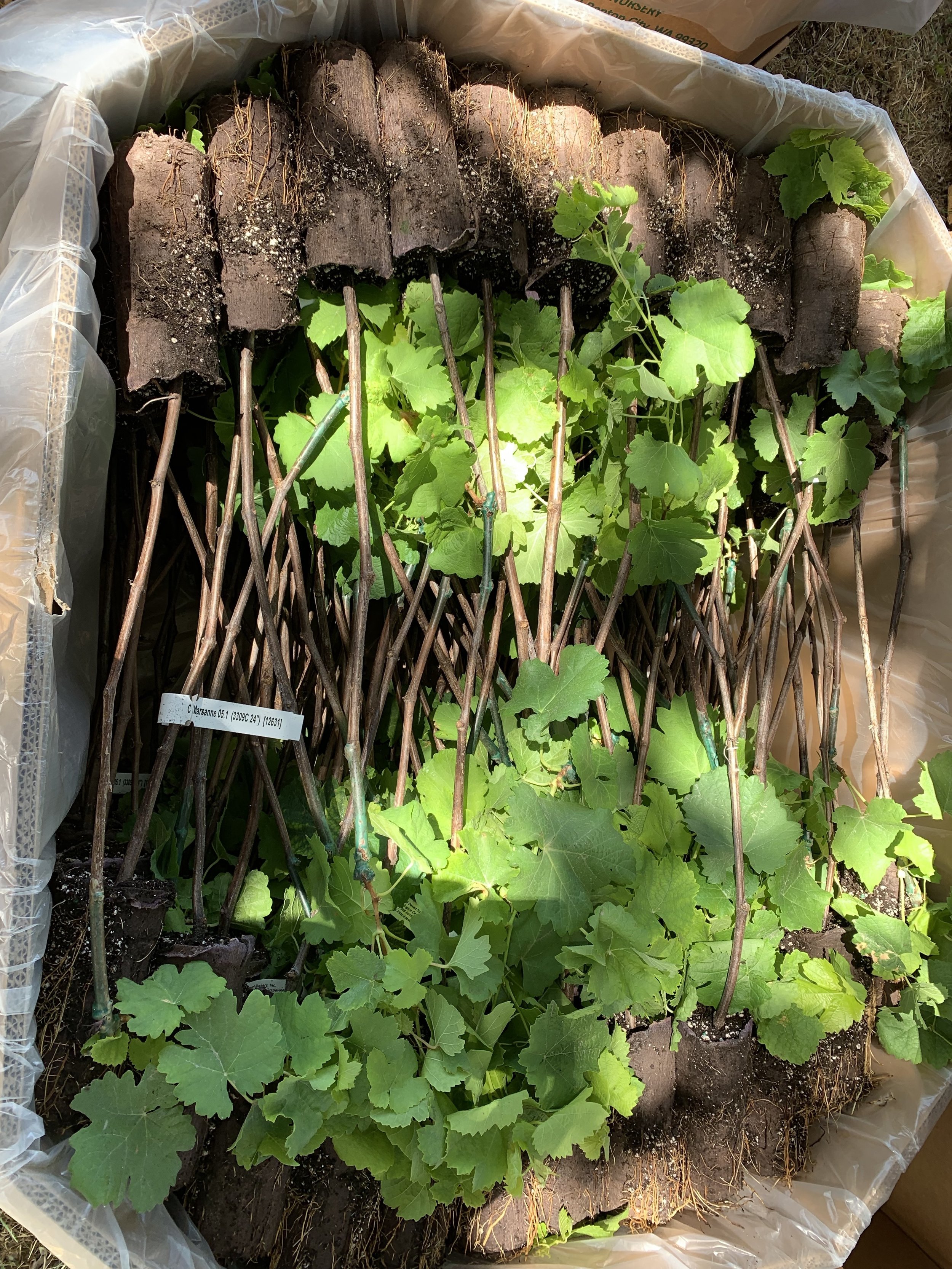
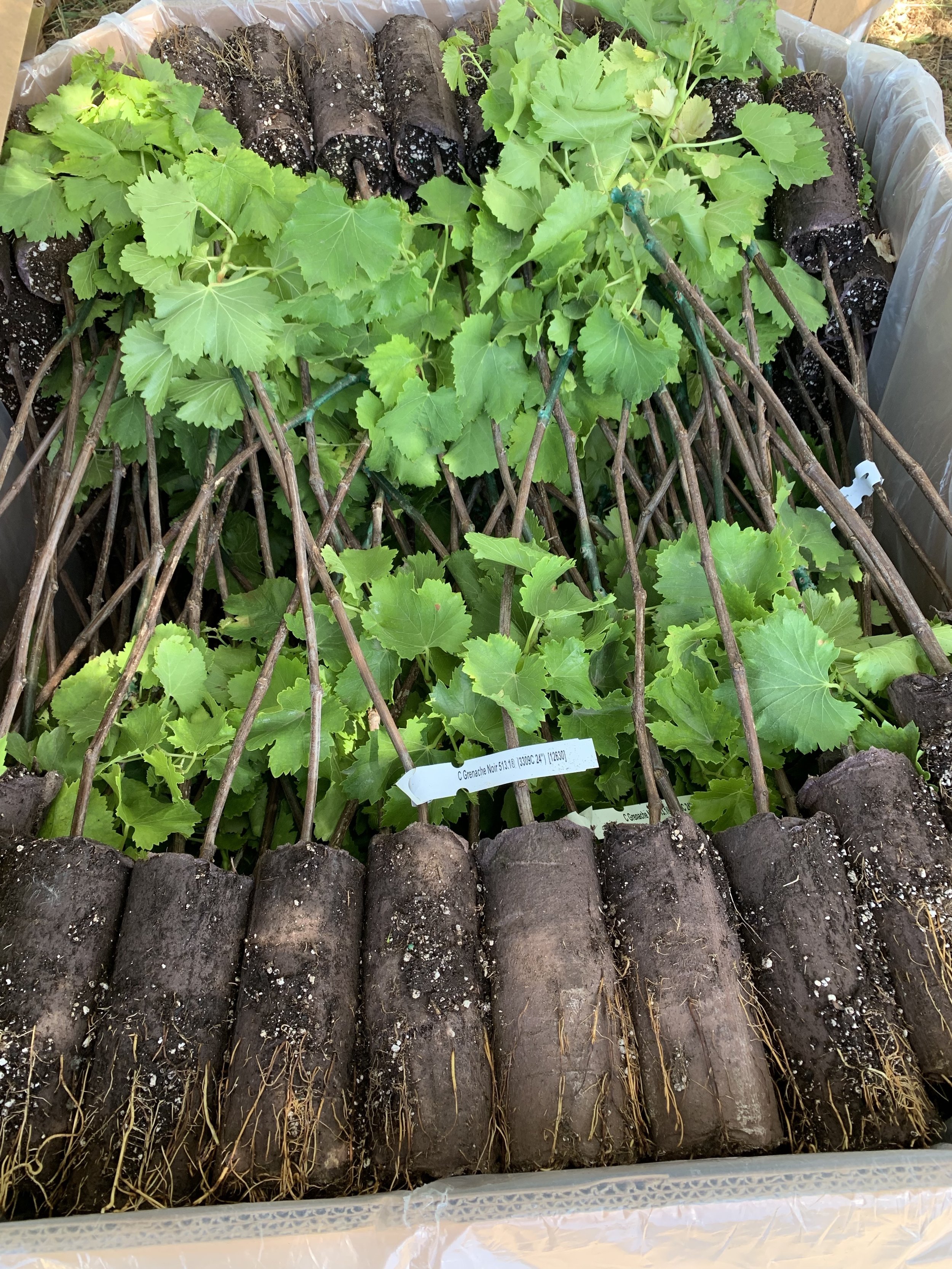
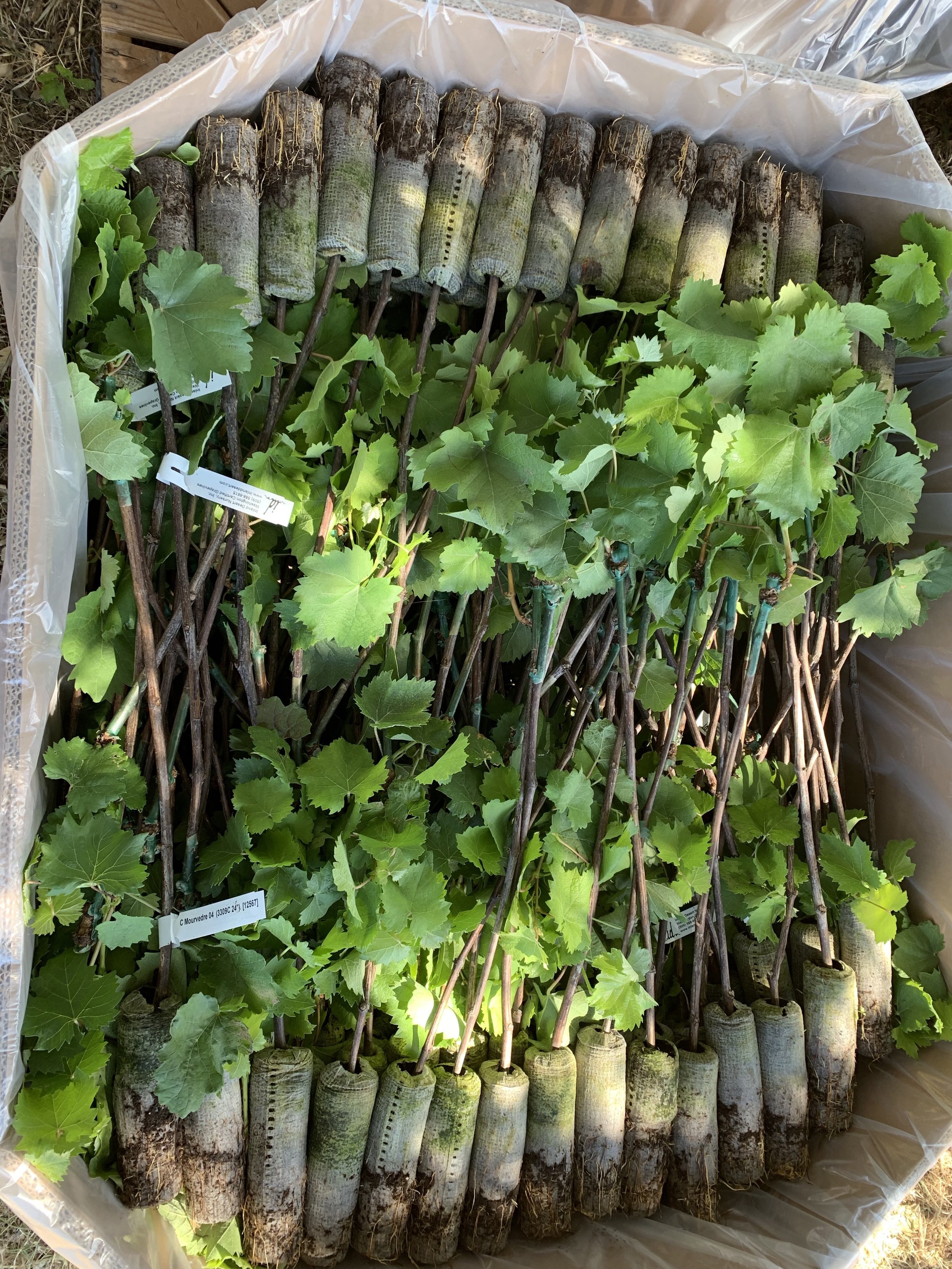
New vines arrived at Troon Vineyard yesterday from Inland Desert Nursery in Washington - mourvèdre, grenache noir and marsanne all neatly packed into shipping boxes. Next week more classic southern French varieties will arrive and within the next ten days, we’ll have planted over 14,000 vines to create ten new acres of vineyard.
Stacked in their shipping boxes they look like the beginning of a project, but it only looks that way. This project started a year and a half ago and the arrival of the vines themselves is closer to the end than the beginning of the project of planting a vineyard. The first step was extensive soil studies as Vineyard Soil Technologies dug more than seventy five-feet deep soil pits to create detailed soil profiles. Based on that data we selected ten acres as ideal for vineyard development. Combining the soil data and climate data with our experience we selected the varieties we felt would be best matched to each vineyard block to be developed. We then begin working with Inland Desert Nursery to obtain the clones of the varieties we chose to focus on. The varieties we were looking for are not the most popular so ordering from the nursery long in advance is required.
Planting does not begin with plants. First, there was the soil work and that filled most of the last year and a half. Once the blocks to be planted were identified the ground had to be prepared. That meant heavy equipment as a D8 ripped the ground to a depth of thirty-six inches. Prior to the ripping, we applied five tons per acre of organic compost along with other soil amendments that we discovered were required by our soil studies. This was followed by discing then yet another finishing discing. When the soil was prepared we seeded a specifically designed cover crop to add nutrition to the soil. As Biodynamic farmers, we also did our first application of Biodynamic Preparation 500.
Over the winter and spring, the cover crop prospered. This was then mowed, then disced into the soil as green manure. Then the vineyard begin to take form as we put in end posts, stakes for each vine (head-trained vines) and irrigation tubes for the soon to arrive young, and very thirsty vines. In addition, another application of Biodynamic preparation 500 was applied to both the blocks to be planted along with all existing vineyard blocks.
Only after all of this investment and work did we arrive at last Friday, when the first vines arrived. Their arrival was the culmination of all of this work, not the beginning. However, these vines mark the beginning of new wines that will come from the grapes they will yield. In that sense, they are truly a new beginning for Troon Vineyard.
As you see, the plan for planting these new acres at Troon was built upon scientific research, extensive viticultural experience, the principles of Biodynamic agriculture and on a vision to make wines with a unique character defined by our soils and the climate on the Kubli Bench in Oregon's Applegate Valley.
Over the next weeks, I will be documenting the process of planting these new vines at Troon Vineyard in words and images. I invite you to share that process with us as we build a foundation for a new generation of wines at Troon.
Taking the Parking Lot Back to Paradise

Brassica and sweet peas bloom as part of the cover crop regenerating soils at Troon Vineyard
Hey farmer farmer
Put away that D.D.T. now
Give me spots on my apples
But leave me the birds and the bees
Please
Don't it always seem to go
That you don't know what you've got
'Till it's gone
They paved paradise
And put up a parking lot
- Joni Mitchell, Big Yellow Taxi
I felt like I was walking on blacktop. Hard, hot and lifeless it looked like a place where a parking attendant would work, not a farmer. But this was a vineyard. Each vine looked like it was a weed growing out of cracks in the blacktop on some worn parking lot.
Living soil gives life. In this vineyard the soil was dead and the vines were dying. Yet, it was a beautiful site and the vines were giving some good wines even as they struggled to survive. They deserved better.
There seemed only one route back to health that could provide the opportunity to make the wines I believed we had the potential to produce. That path was biodynamics, which is the best existing framework for regenerative agriculture. To craft the wines we aspired to make, our soils, indeed our entire farm needed regeneration. It is never just the soil that needs regeneration, but also the spirit. At Troon, not only our soils were abused.
How was a vineyard transformed into a parking lot? Only through the abuses of industrial, thoughtless farming can soil be so decimated. Sick soils make sick plants and these poor vines were overcome with viruses and fungal diseases that stronger plants could have resisted. It became our mission to bring them back to health so they could live out their remaining years doing what Mother Nature intended them to do with their lives - ripen grapes.
Then there is intention, perhaps the key to regenerative agriculture. Previously their intent was to extract all they could from the land and extract they did. Today our mission is to give back more than we take. To be a good farmer you must work for the farmers who will farm the land in the future with the same fervor you work for yourself.
The path from parking lot to vineyard started with science. We did extensive soil studies with Vineyard Soil Technologies and worked with Biomemakers to establish a complete cross-section of our vineyard microbiome through genetic sequencing. To know where you need to go, you first have to know where you are.
Then came the proactive part - biodynamics. The essence of biodynamics is building healthy soils. The main tool in the biodynamic toolbox is compost. Over the last years we have been applying tons of biodynamic compost to our vineyards. In addition to the compost, now that chemicals were eradicated and weed control was returned to manual methods our soils began to change, the microbiome bloomed. Today you can walk into our vineyard and easily dig your hands into healthy arable soil.
That parking lot has been replaced by paradise - a vineyard.
More Biodynamic Fake News...

Harvest 2018 at Troon Vineyard in Oregon’s Applegate Valley.
Tired old canards. When will the media get on board with modern biodynamics? While the article Weighing Up the Value of Biodynamic Wine by Vicki Denig addresses valid concerns, once again the sources for the article are either misinformed or have an ax to grind. Here is a link to the original article:
https://www.wine-searcher.com/m/2019/04/weighing-up-the-value-of-biodynamic-wine?rss=Y
“Couple that with calendar-specific workdays and strict following of the lunar cycle, and even the smallest of vineyards would face significant time restraints and financial challenges. So when a sizeable estate decides to go biodynamic, is it actually achievable?”
“However, not all winemakers are convinced. In Crete, Giannis Stilianou, winemaker and owner of Stilianou Wines, explains that with larger properties, cultivating with biodynamic principles is nearly impossible, mainly because farmers are only permitted to execute vineyard work on a small amount of very specific days”
The Demeter standard for wines states, “Observation of the Biodynamic calendar is encouraged.” It does not demand only “calendar-specific work days or that “farmers are only permitted to execute vineyard work...on very specific days.” The statements above are false and following the biodynamic calendar is not required for Demeter Certification.
The work of all the biodynamic farmers I know is focused on regenerative agriculture. Their goal is to build the health of their soils and plants. In trying to follow the biodynamic calendar we are reaching for the very peak of quality. That extra edge that pushes our wines beyond just being delicious to becoming truly alive in the glass. If you can’t prune or pick on the ideal day due to weather and practical considerations you know that all of the other work you’ve done will still make exceptional wine. What we reach for by trying to do our work on certain days, by paying attention to the natural cycle of the Moon, is to go beyond simply delicious and make a wine that sings of the vineyard itself. A wine that is transparent and living.
“And for others, size isn't even the biggest issue. Stu Smith, partner and enologist at St. Helena-based Smith-Madrone Vineyards dug deep into the world of biodynamics – and still wasn't convinced. "I discovered that Rudolf Steiner had never been a farmer," he says, noting that Steiner went from student to agricultural theorist, without any experience in the field. Smith explains that when he'd challenge biodynamic farmers on their lack of trials and published results, their response was always that it's a belief system.”
Mr. Smith “discovered” that Rudolf Steiner had never been a farmer. Digging deep? An amazing discovery? I think not. Rudolf Steiner is famous for being a philosopher and founding the Waldorf schools, not for being a farmer, as a quick look at Wikipedia will show you. What we today call biodynamics was only outlined by Steiner in a series of lectures in 1924. He did not go from “student to agricultural theorist”, but gave the lectures at the end of his life at the request of a group of farmers. The modern practice of biodynamics has been built after his death on the experience and experiments of several generations of biodynamic farmers. None of the biodynamic wine growers I personally know consider biodynamic farming a “belief system”, but see it as a framework to build on with a goal of taking their farming to a new level. Contrary to what Mr. Smith may believe, Nicolas Joly is not your typical biodynamic winegrower.
“Smith also takes issue with what he deems to be close-mindedness amongst biodynamic farmers, from both large and small estates. "They are the only group out there that says 'our way is the only way, and everyone else is doing it wrong'. Organic and sustainable farmers don't do that, but biodynamic farmers do."
This, simply, is total bullshit.
“And when it comes down to it, Smith sees it all as a fast-track to making money. "There are so many wineries that need to find their place in the sun," he says, calling out the appeal of biodynamics to Millennial consumers. "In my opinion, it's a marketing ploy – do you see biodynamic carrots? Lettuce? Peaches? No. They're doing it in wine in America as a marketing concept so they sell their product easier and get a higher price for it."
Yes, Mr. Smith, you do see biodynamic carrots, lettuce, and peaches, just not enough of them. The reason you see few of these biodynamically certified fruits vegetables and wines is that practicing biodynamics is hard work and unlikely to reward with you with enough additional profit to justify the effort. You choose biodynamics because of a commitment to reach for something special. Demeter USA currently has certification protocols for Fruit and Vegetables; Nuts, Seeds and Kernels; Bread, Cakes and Pastries; Grain, Cereal, Tofu and Pasta; Herbs and Spices; Meat; Dairy; Oils and Fats; Sweetening Agents, Confectionary, Ice Cream, Chocolate; Cosmetics and Body Care; Textiles; Wine; Beer; Spirits; Cider and Fruit Wines; Infant Formula. It seems he is shopping in the wrong markets, perhaps he should give Google a try?
Then there is his “marketing ploy” statement, which any accountant for a biodynamic winery would get a big laugh over.
“Others think that many biodynamic practices are, frankly, bullshit.”
I'll tell you the real bullshit. It’s farming with chemicals that destroy the environment and cause cancer. It’s making boring industrial wine. If a little voodoo will save the planet, count me in. Voodoo is just what people call something they don’t understand.
Biodynamic Fake News

Burying cow horns to make Biodynamic Preparation 500 at Troon Vineyard
It’s not their fault, but you see it every week. Fine wine writers printing misconceptions and flat-out wrong information on biodynamics - yes, fake news.
It’s not their fault, it’s ours. Those of us who farm wine grapes biodynamically are not doing a good job of getting out the real story. That could be because the biodynamic movement is not a monolith, but a complicated web with divergent branches and diverse self-interests. That makes for a muddled message and creates an information issue biodynamic winegrowers have to confront. While there may be divergent opinions and methods within the biodynamic community, all share a common final goal.
Here are some random recent examples of the media muffing biodynamics. The authors and publications are irrelevant as inaccuracies like these are more the rule than the exception.
”And if you’ve heard of one thing to do with biodynamics, it is probably that cow horns filled with fermented cow manure are buried in the vineyards to encourage soil fertility." "Cow horns are buried throughout the vineyard."
Biodynamic winegrowers do not bury cow horns “filled with fermented cow manure…throughout the vineyard”. In this case, the reference is to the production of Biodynamic Preparation 500. To prepare BD 500, you place very fresh, raw organic cow manure in cow horns in the fall and bury them in a single pit in a specially selected site. There they ferment over the winter and the horns are dug up in the spring. The finished BD 500 is mixed with water and applied to your soils. It assists with the formation of humus, increases available phosphorous, soil mycorrhiza and the water and nutrient holding capacity of the soil. The goal of BP 500 is to regenerate the natural microbiome and raise the quality of your soils.
“Naturally occurring cycles like moon phases dictate when to harvest ”
Moon phases do not “dictate” when we harvest at Troon Vineyard. That the phases of the moon have an impact on the natural rhythms of agriculture is a time-tested (and scientifically proven) reality. Following the ascending and descending cycles of the moon is something any natural farmer tries to do. However, the operative word here is “tries”. It’s one thing to follow these cycles in your home garden, but it’s another thing on a commercial farm. We certainly try to follow the lunar cycles, but often the realities of Mother Nature means you have to move forward. When you have to prune fifty acres of vines by a specific date, and you can’t prune when it’s raining (due to disease pressure), you can only do your best to hit the right days. When the fruit is ready to harvest, but it’s not a fruit day, but it’s going to rain three inches tomorrow your choice is easy - you pick. Any positive attributes you gain by picking on a certain day will be more than negated by the next day’s rain. We try to follow these lunar cycles whenever possible as we are seeking every advantage, no matter how small, to add that extra bit of nuance and life to our wines. The biodynamic calendar identifies ideal days for certain types of vineyard work. You try to prune on fruit days and cultivate on root days. As our goal is exceptional fruit quality, doing work on certain days is a way to fine-tune the quality of our fruit. However, we do not seek viticultural management from the man-in-the-moon, we just want a little advice, and will make our decisions based on what experience, common sense and science have taught us.
”Special concoctions of herbs, minerals, and manure may also be planted in the soil to aid fertilization.”
“Herbs, minerals and manure” are not planted in the vineyard soil to help fertilization. A range of plants (BP 502 to 507 - yarrow, chamomile, stinging nettle, oak bark, dandelion, valerian) are fermented then added to compost piles to aid in developing the right bacterial and fungal balance in the finished compost, which will then be applied to the vineyard - back to the microbiome again. It is important to note that while compost contains some beneficial minerals, it is not fertilizer. The point of biodynamic compost is to build the humus and microbiome of your soil. A healthy plant in healthy soil does not require additional chemical fertilization. This is the cornerstone of biodynamic practice. When we need to fertilize due to soils depleted by years of conventional agriculture or when growing a perennial crop like grapes, we add natural fertilizers like fish emulsion (think SNL’s Bass-O-Matic) and kelp. No biodynamic farmer would add raw manure to their field without fully composting it first. Besides the obvious health concerns, raw manure cannot do the job of properly made compost. Our compost is made from organic cow manure from our next door neighbor Noble Dairy, organic hay and our own pomace (grape skins and stems after pressing during harvest), which is then carefully composted for the better part of a year before being applied to our vineyard.
"there’s even a calendar for optimal wine-tasting days”
Then there is the currently fashionable calendar for “optimal wine-tasting days” - there’s even an app for that. However, the flower, leaf, root and fruit day thing is not part of Rudolf Steiner’s original agricultural lectures and was only added to the biodynamic culture in the 1950s by Maria Thun in Germany. Her concepts were built on research in her garden and, while her results have never been supported by independent research, there is strong anecdotal evidence that something is indeed at work here when it comes to the inner workings of plants. The base of these theories is that the moon’s gravity has an influence on the liquid in plants and soils much the same as it does on tides. A reasonable assumption. To me it is a stretch, at best, to apply this same theory to a glass of wine on your kitchen table. However, those same influences could affect the tasters themselves. Whatever the case, these concepts are a not a required part of Demeter Biodynamic certification, which is a statement in itself. Optimal wine-tasting days may have sprung from biodynamic ideas, but they are not part of biodynamic practice. However, it can be a useful excuse in a pinch if a customer is less than happy with your wine.
Biodynamics is a work-in-progress. When Rudolf Steiner gave his lectures in the early 1920s in Germany, he was living in a world in chaos, the same chaos that gave birth to the Nazis. World War I had just devastated Europe and, on the farm, the introduction of chemical, industrial agriculture terrified many people. It is in this climate that Steiner gave his agricultural lectures at the request of a group of concerned farmers. What is called biodynamics today was only outlined by Steiner himself in his lectures, and he died just a few years after giving them. Many of the practices considered essential practices of biodynamics today were layered on by those that came after him. While Steiner gave voice to the fears of that era, what we call biodynamics today is more the work of a movement than one person.
That work continues today and the growing number of winegrowers adopting biodynamics is having a tremendous impact on the movement’s future. Each year more is learned about biodynamics, and now modern agricultural science is moving towards the fundamental farming practices that define biodynamics - that the key to a healthy plant is healthy soils. Everything today is about the microbiome - in our guts and our soils. Biodynamic farmers have been giving their soils probiotics for decades. Science is just now catching up to us.
From what I have been able to read and understand (not always the same thing when reading Steiner) in Steiner’s books, he saw his concepts as only a beginning of an individual’s quest for spiritual and intellectual growth. While he did not approve of alcohol, I still think he would approve as winegrowers the world over push the pursuit of biodynamics forward. Today winegrowers are at at the forefront of connecting science and biodynamics. The winegrowing community is creating what I call practical biodynamics. Voodoo vintners we are not.
Who is to say what biodynamics will mean fifty years in the future? The only sure thing is that it will be as different from today’s practices as we are from the first practitioners in the 1920s. It will always be a work-in-progress as we will never understand everything. Mother Nature will always keep some secrets to herself.
Now that I think about it, it’s no wonder that writers struggle with understanding the practice of biodynamics, so do we. Agricultural knowledge is always evolving. There is much we don't know and much we will never know. Bringing science and biodynamics together will be the next chapter.
That’s a story worth telling well.
Some recommended reading on biodynamic winegrowing
Biodynamic Wine by Monty Waldin - certainly the most complete book available on the topic
Voodoo Vintners (in spite of the title) by Katherine Cole
Investing in a Stranger’s Future
Agriculture is cyclical. Season flows into season. Vines flower then a hundred or so days later you harvest their fruit. Animals and farmers live their life cycles together on land that sustains them both. Nature wraps us in the cycle of life.
In January we begin to think of pruning and worrying about frost. What happened last vintage is behind us and only the potential of the next fills your minds. After all, the wines in the cellar are committed to their course and it is only our role to shepherd them home. That vintage is over.
There are few things other than agriculture where you so firmly press the reset button on the first of January. Of course, we build on the experience bestowed upon us by Mother Nature each year, but that’s all nuance compared to the cycles of Nature, which make all the most important choices.
We are facing a lot of new hurdles at Troon Vineyard as we begin a ranch-wide replant designed both to correct the viticultural sins of the past and to proactively move forward by selecting better varieties and then planting them in better sites. To move forward you must be willing to break ties to the past. At Troon we’ve decided to race towards the future.
New plantings will be decidedly focused on the varieties made famous by the Rhône Valley, Languedoc and Provence. These vines have proven their proclivity for our Kubli Bench terroir. Now it’s our turn to take what we’ve learned and focus on creating some truly special wines - some of which may be a decade or more away.
To some it may seem odd to embark on a voyage knowing you will not arrive at the destination, but that is farming and winegrowing. There is never any end to the cycle of seasons and you are only part of a chain that passes the baton ever-forward in a never-ending relay race. Nothing fires my passion more than knowing that I can make a perfect baton pass to the next generation. If they can make great wines from the vines we plant, I will have done more than my job. That is my goal.
For the time remaining to me, I will become a small part of the life of this vineyard and hope that I am still around to taste at least the potential of the vines we plant over the next years. We each get our vintages and it is our responsibility to enjoy every one and to hope that our work today will be rewarded with wines we will never taste made by people we never knew. They may not know us, but the vines we plant today will speak for us in the wines they make.
Every glass of wine we drink from an old vineyard carries the voices of those that planted and worked it over the decades. Listen to us, we deserve your attention.
Harvest 2018 Photo Album - Troon Vineyard in Oregon's Applegate Valley
Mother Nature was very kind to us in 2018. Rain and cool weather are things you expect during harvest in Oregon, but not this year! All during harvest we were given warm, dry weather under beautiful blue skies. This perfect weather meant we could harvest each variety at the ideal moment. There was no pressure from the weather so our pace was almost leisurely compared to a normal vintage. It was a harvest to remember as will the wines!

Picking tinta roriz, this is our last vintage of this variety as these vines will be pulled and replanted next year.

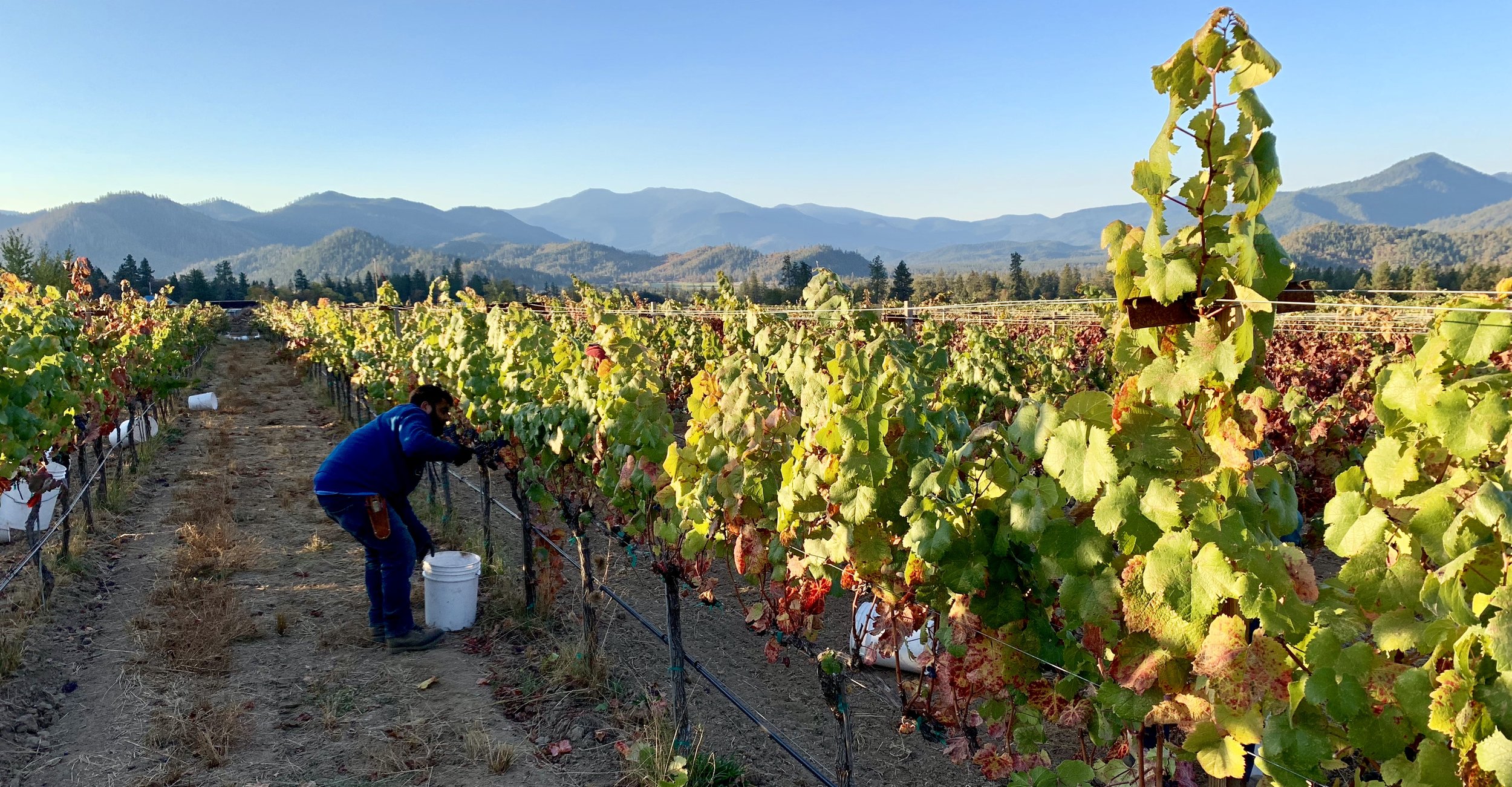
Picking starts at dawn with the vines still in the shade of the Siskiyou Mountains, which are already brightly illuminated.
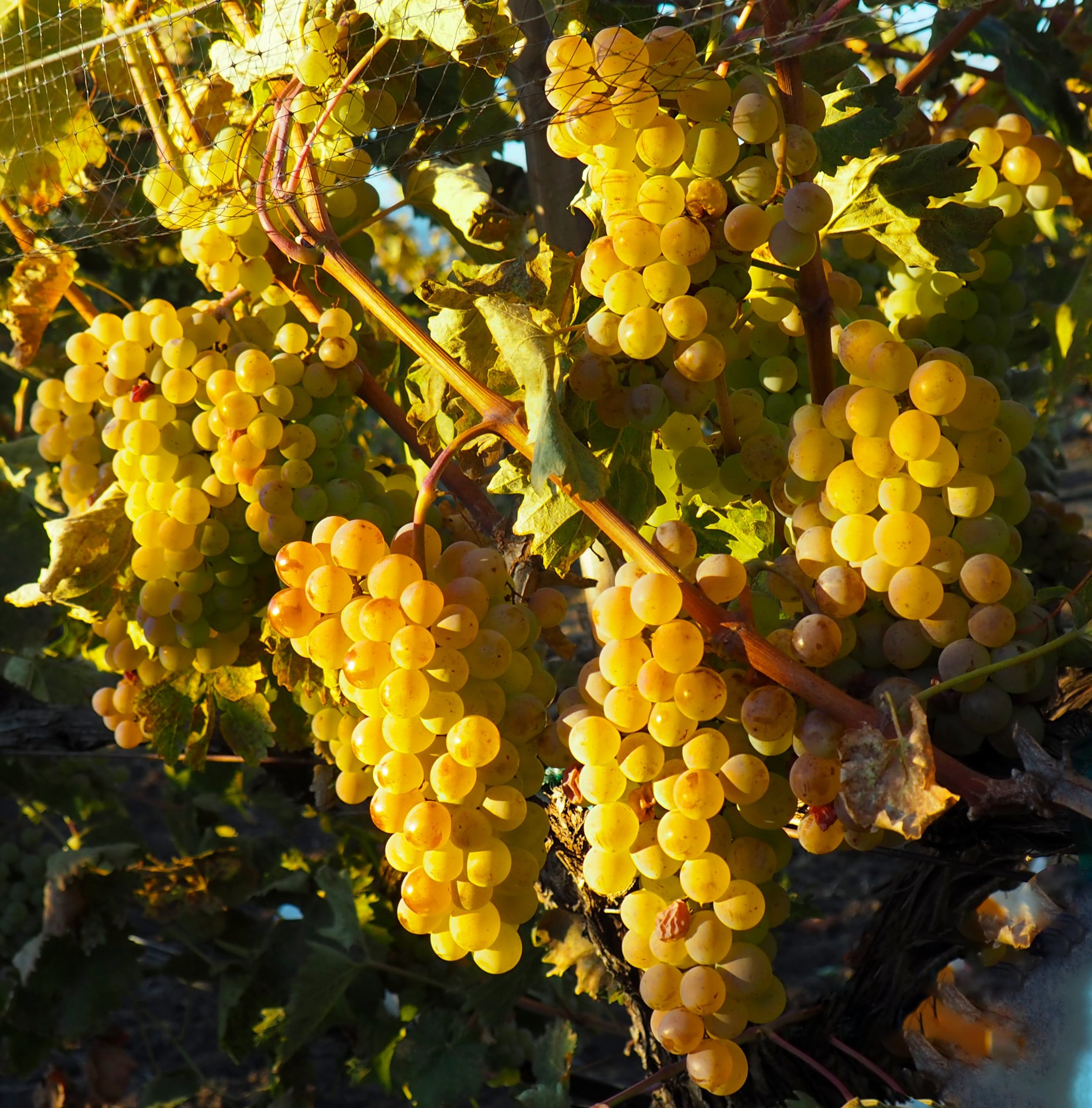
Some picure-perfect vermentino.

Banele and Jesus picking malbec as dawn breaks.
The Applegate Valley during harvest.

In a biodynamic vineyard, the leaves are fully turned color and falling off when it is time to pick the fruit. This is the natural cycle of a vine.

Vineyard manager Adan Cortes bundled up against the morning cold as he harvests vermentino.

Associate winemaker and biodynamic team leader Nate Wall fills cow horns to make biodynamic preparation 500. They will buried until next spring. Making BD 500 is something you do during harvest in the fall.

Banele, our harvest intern from South Africa, places the filled cow horns in pit to be buried until next spring. The BD 500 they will produce will be sprayed on our vineyards.

Grape pomace, fresh from the press, is added to our compost pile. All the leftovers from harvest are added to our biodynamic compost piles and returned to the vineyard.
Turn, Turn, Turn

January at Troon in Oregon's Applegate Valley
For everything, there is a season. There is a flow to the year that is defined by what is being harvested. Moments defined by what we eat and drink. As these seasonal treats start arriving at the farmers market, they mark your place in the year. Peas and asparagus in spring, summer brings peaches and tomatoes, fall brings squash and, for those of us who make wine, grapes. Each of them gives you a sense of time and place.
The wines I drink dance across the calendar along with the foods I find at the market. Cold weather brings stews, risotto, pasta, root vegetables and bolder wines - Barolo, St. Joseph, Bandol, and Tannat appear on my table. The arrival of summer brings vegetables and simple grills into staring roles and white wines - vermentino, roussanne, Sancerre, Muscadet, Soave along with wines of wildly varying shades of pink often become my wines of choice. For reds, pinot noir, Valpolicella, grenache and, most of all, Beaujolais - all wines that love a light chill - bring perfect pleasure.
Things that grow react to the season and wine is no exception. Obviously, drinking a Barolo on a hot day in August is not the same sin as insisting on buying tomatoes in January. Yet, I think the full pleasures of a Barolo are more likely to show themselves with Osso Bucco on a crisp fall evening than with a caprese on a hot summer afternoon.
Wine is food, and it is more enjoyable when served in the same way. We are drawn to certain foods at different times of the year and should apply that same common sense to wines.
I’m always mystified when people tell me they don’t like white wine or they only like big reds - the wine world’s equivalent of picky eaters. To me wine is wine, and the color is decided by the food, the season and, of course, my mood. There is no arguing with taste, but I’ll argue those picky eaters and drinkers aren’t tasting at all. They’ve already made up their minds.
The more you pay attention to what you taste the more diversity of experience you crave. That terrifying question I’ve been asked many times, “If you could only drink one wine for the rest...” - is more nightmare than fantasy. The other question I’m often asked is, “what’s your favorite wine you make” or, perhaps even worse, “what’s the best wine you make” leave me speechless. They are questions without an answer.
Each wine we make at Troon has its moment, its meal, its season. What’s my favorite wine? The one in my glass.
Courage of Our Convictions
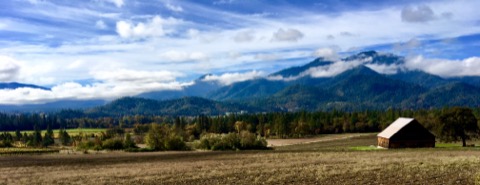
The Applegate Valley in Southern Oregon
A winemaker in Bordeaux has a universe of five. In Burgundy a winemaker has one, maybe two varieties that demand their focus. In Beaujolais they live by gamay. In Barolo nebbiolo defines the reputation of a winemaker. In Napa, if you make great cabernet sauvignon no one will much notice what else you do.
In the established wine regions of the world, a winemaker’s universe of options is preordained. In no way does this diminish their skills and accomplishments, but it does allow them to focus. To be able to focus is to be efficient and efficiency leads to consistency, which is an essential aspect of mass market success. Yet market success does not often fire the imagination or inspire innovation.
They say the pioneers take all the arrows. Welcome to the world of winemaking in one of the world’s emerging fine wine regions. I’m in the Applegate Valley of Southern Oregon, but I believe that winemakers in emerging regions around the world get hit by the same arrows. Winemaking in an emerging wine region requires the courage of your convictions. Planting a new vineyard in a new region is a true leap of faith, but as they say, the greater the risk the greater the reward.
But we don’t work in a vacuum. Years of knowledge and science have accumulated from the work of winemakers and viticulturists before us so we don’t have to push blindly forward. There are pioneers in every new region that took a lot of the arrows for all of us. Admittedly, many of these people that first planted vineyards in new regions were learning only by trial and error, but from their failures and successes, we can build a foundation for an exciting new wine region.
One such exciting new region is on the Kubli Bench of the Applegate Valley. Applegate Valley is not new as it was established as an AVA in 2000, but there is a growing energy here and we are on the tipping point. The Applegate Valley is now on the edge of breaking out. The varieties that will fuel that breakout are coming from the shores of the Mediterranean and the rugged hills of Southwest France, not from Bordeaux, Burgundy or Napa. The Rhône will have a voice, but the future of the Kubli Bench will be in the tradition of Bandol, Languedoc-Roussillon, Cahors and Madiran. These regions are now, after centuries of winemaking, escaping the shadows of their famous French cousins because of an exciting revolution in winemaking and winegrowing in those regions. We will be joining them in this winemaking revolution.
We are now making plans to either graft or replant many sections of our existing vineyards with the varieties that belong here. We’ll be planting more tannat, malbec, marsanne, roussanne and mourvèdre for sure (we already have significant acreage of syrah and vermentino), but varieties like picpoul, petit manseng, carignan, grenache (red and white) and cinsault will also find a home on the Kubli Bench. Because of everything that we’ve learned and the excellent quality of the wines we’ve already made I do not feel planting varieties like these is a leap of faith. We have the courage of our convictions.
I like making wines that people drink rather than collect. Wines that are delicious, richly flavored, and affordable that bring pleasure to people lives are as rewarding to make as they are to drink. There is no bottle more exciting than the wine that is open on your table. The Applegate Valley is a perfect place to make these kinds of wines.
I have to admit. Making wines like this is fun.
Wheelbarrow rain gage - fall in the Applegate Valley
Double-click to edit...

Double-click to edit...
Feeling Connected

The Troon Vineyard crew picking the grapes they grew. This is Vermentino bound for Troon Black Label Vermentino after a year in barrel.
There's not much to it. You pick the grapes, crush them by foot, de-stem if needed and dump them in a fermenter. The fermenter, a one-ton macro-bin sits under the old oak tree behind the winery. After a few days the fermentation begins. Just like that.
It seems so simple, so natural as we use no yeast, sulfur or acid additions as was the norm at wineries in my past. These interventions are not required by Mother Nature. Then it's hands-on punch downs every day and soon your hands are stained burgundy red. There is something different about this kind of winemaking. You are mentally and physically part of the wine. This is not a process, it's a philosophy, a way of life. You and the wine are connected.
At Troon the same crew, the same people, tend the vines, harvest the grapes and make the wines. No sorting table is needed at harvest because the pickers are the same people that farmed each vine throughout the vintage. They only pick the perfect bunches, because these grapes are their grapes. They are harvesting a full year of work with each bunch cut from the vine.
After years in the Napa Valley I was shocked at the deliberate pace of the pickers during harvest here at Troon in the Applegate Valley. In Napa the picking crews are well-oiled machines and picking is at super-human speeds, which makes the pickers seem more mechanical than human as they surgically remove fruit from vine. Here in Oregon the picking pace is slower, but not any less work. Yet by dialing back the speed of picking the harvest seems to be the work of people, not machines. A picker that knows each row and vine treats the fruits of their year long labors with the respect that only sweat equity can understand. Their work needs no second guessing on a sorting table.
The simple elegance of the process and the personal hands-on experience of growing and making wine this way cannot help but make you feel more connected. You are connected to the land, the vines, the wines, the people who make them and to the people who will drink them. Feeling this connection is the most rewarding feeling I've ever had in thirty-five years in the wine business.
Wine should be a connection. It should connect the drinker with the land and people that brought the vineyard to life in a bottle of wine. This harvest I'm feeling very connected.
Double-click to edit...
Rainy Oregon Harvest Dawn
Rain clouds roll over the Siskiyou Mountains with the Applegate River in the distance. In front are Troon Estate Vineyard Tempranillo vines. There's not enough rain to be causing us any real problems and harvest continues on schedule.

Double-click to edit...
Oregon Troon Vineyard Applegate Valley Harvest 2016 Estate Vermentino
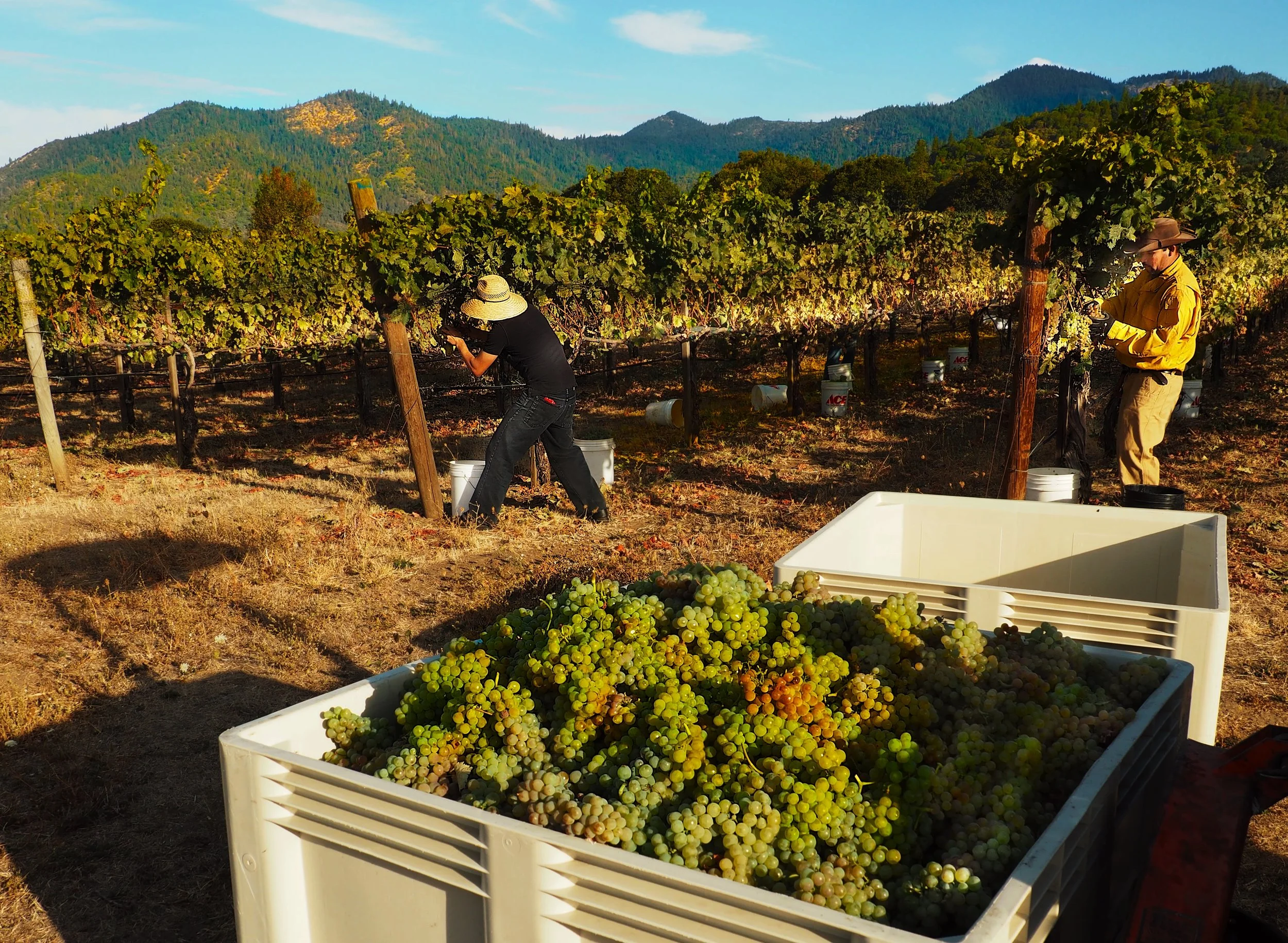
Picking Troon Vineyard Estate Vermentino just after dawn in the Applegate Valley of Southern Oregon

Double-click to edit...

Double-click to edit...

Double-click to edit...
Double-click to edit...