Planting New Vineyards at Troon - Hands

It was before 6 a.m., but there were already a lot of holes. Dawn had not broken, but a dim light was just starting to flow over the mountains. Hundreds of holes had already been dug. Around thirty people moved their spades rhythmically, almost silently, as they dug twelve-inch holes, one after another. This is how you plant, or should I say, how they plant a vineyard.
Last week at Troon Vineyard in Oregon’s Applegate Valley, we planted about a third of the vines we need to plant this month. That was over four thousand holes, dug by hand in less than two day’s work. But digging the hole was only the beginning. Once the holes are dug, they must each receive, by hand, a shovel full of Biodynamic compost mixed with Azomite and Calphos and then a vine needs to be dropped in each hole. On each vine, the biodegradable root cover had to be removed by hand due to the requirements of our organic certification. Then, on their knees, with their hands, each hole is filled and the vine is in its new home.
One day these vines will give birth to wines served in some of the best restaurants in the world. But it is these people in the pre-dawn hours with their spades and on their hands and knees that brought these vines to live in this vineyard.
Winery tours and articles like to feature barrels, tanks, and machines, but it is the hands of the people that craft them that make wines of place come to life. From the moment the vines are planted, to when they are tended in the vineyards, to the cellar work that turns grapes into wine, the best wines are handmade wines.
Hands, not things make memorable wines. Hands hold the spades that dug the holes to plant them, hands shovel the compost to help them grow, hands prune and position the shoots as they grow, hands pick the grapes, hands sort the fruit that arrives at the winery and hands hold the glasses when it’s time to savor the hand labor that put the wine in those glasses. Making and enjoying wine is a hands-on experience.
The thousands of holes dug by dozens of hands will start to produce wine in three years. Many hands will touch each of these vines as they grow over the next years. Your delight and pleasure in the wine they will one day produce will be the result of the work those hands. Hand to hand to hand and, finally, to the glass in your hand.
Wines of place, with terroir, touch you because of the many touches that have brought the wine to you.

Planting grenache noir at Troon Vineyard

Placing new vines one-by-one in the freshly dug holes. Each of the wrappers on the roots also had to be removed.
Electromagnetic Soil Scanner
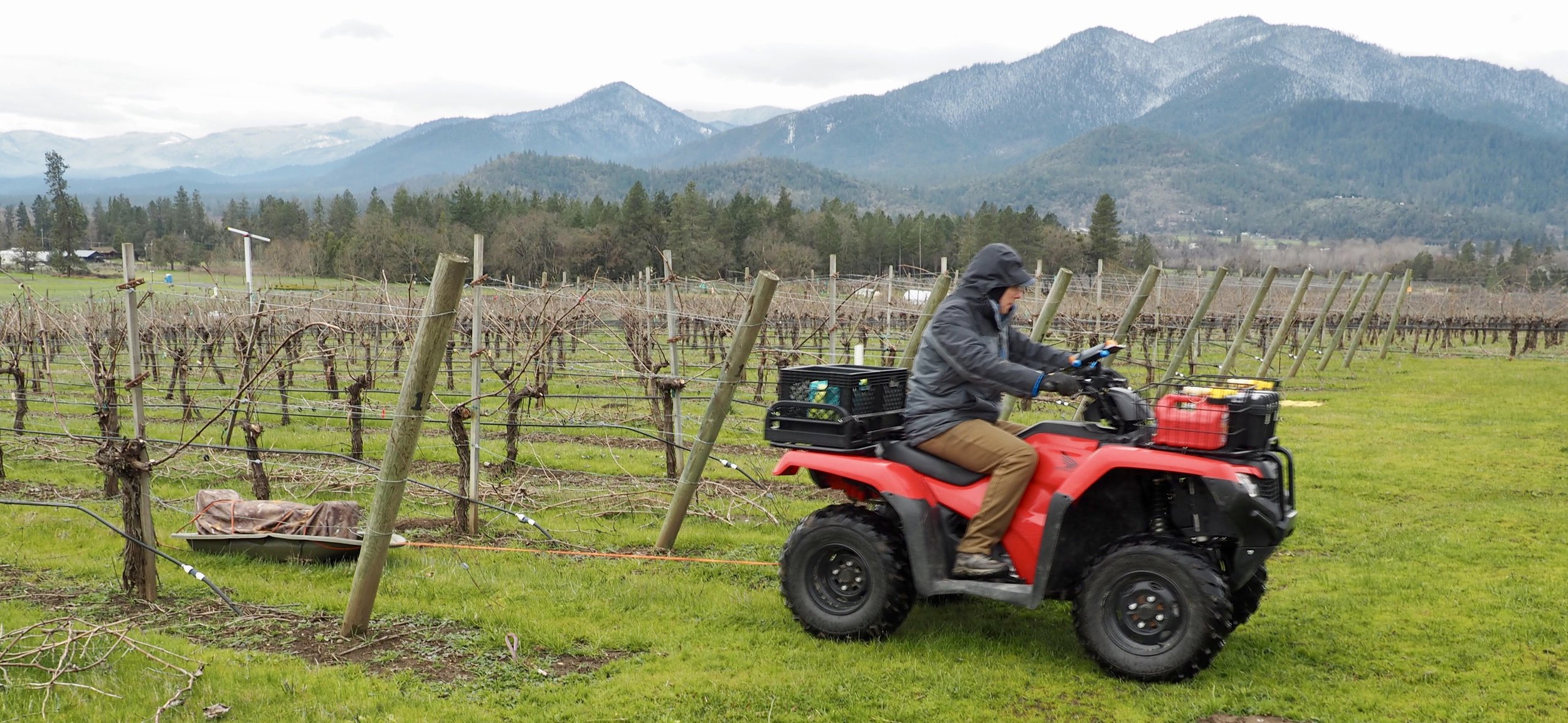
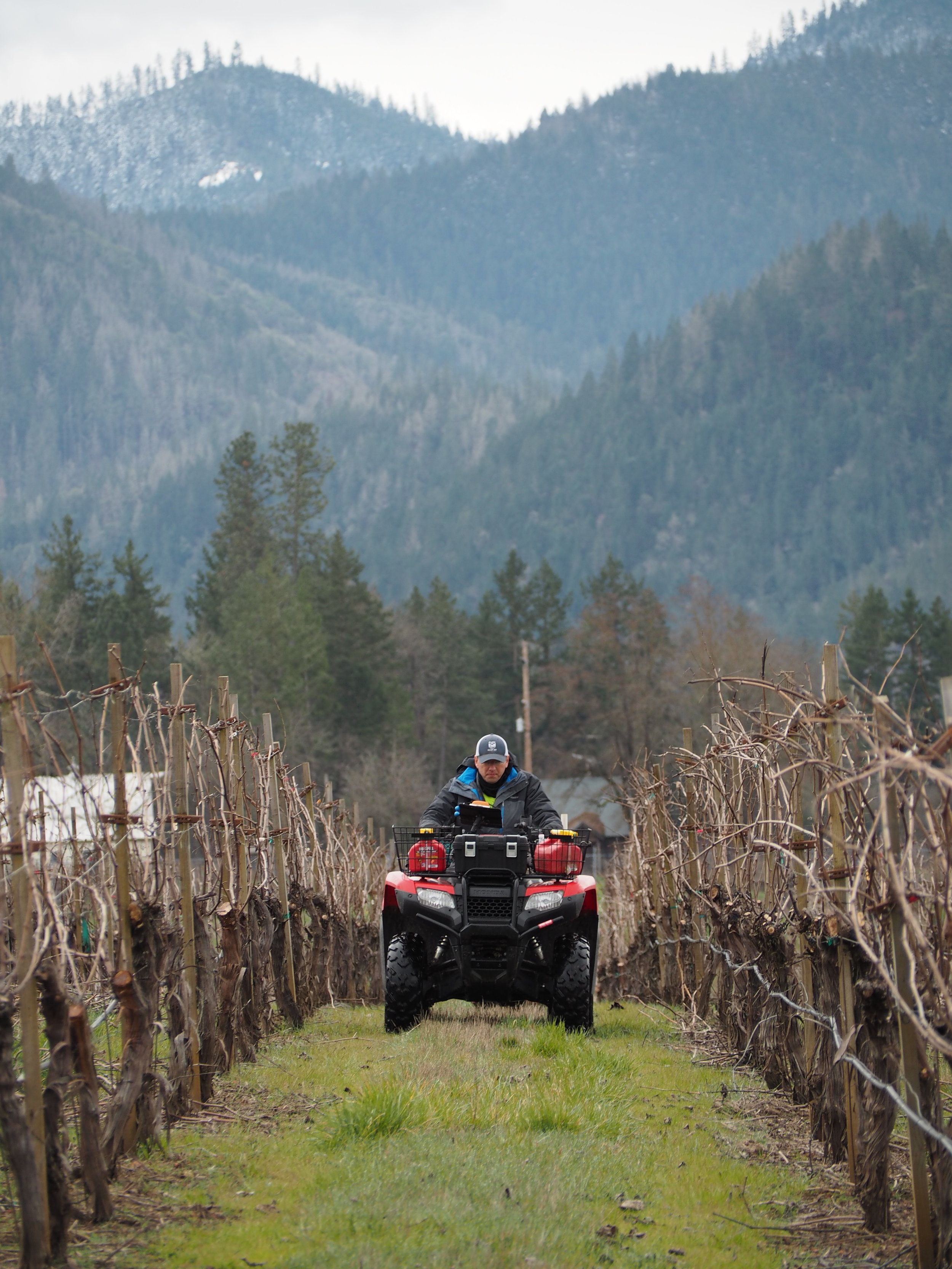
Our soil studies at Troon Vineyard started today with Nick Madden here for the day to do a complete electromagnetic soil scan of our vineyard blocks. We've retained Dr. Paul Anamosa and company to do a complete analysis of our vineyard blocks. Armed with this scan data we will be selecting locations for about eighty 5 feet deep pits to fully map our soil types. This data will help us select the proper varieties as we add new vineyard blocks and replant old ones. The scanner is on the sled behind the ATV. Here is some information on exactly what Nick is doing https://d.pr/dtaYMK
”Electromagnetic induction (EMI) has been used to characterize the spatial variability of soil properties since the late 1970s. Initially used to assess soil salinity, the use of EMI in soil studies has expanded to include: mapping soil types; characterizing soil water content and flow patterns; assessing variations in soil texture, compaction, or- ganic matter content, and pH; and determining the depth to subsurface horizons, stratigraphic layers or bedrock, among other uses. In all cases the soil property being investigated must influence soil apparent electrical conduc- tivity (ECa) either directly or indirectly for EMI techniques to be effective. An increasing number and diversity of EMI sensors have been developed in response to users' needs and the availability of allied technologies, which have greatly improved the functionality of these tools. EMI investigations provide several benefits for soil studies. The large amount of georeferenced data that can be rapidly and inexpensively collected with EMI provides more complete characterization of the spatial variations in soil properties than traditional sampling techniques. In addition, compared to traditional soil survey methods, EMI can more effectively characterize diffuse soil bound- aries and identify areas of dissimilar soils within mapped soil units, giving soil scientists greater confidence when collecting spatial soil information. EMI techniques do have limitations; results are site-specific and can vary depending on the complex interactions among multiple and variable soil properties. Despite this, EMI techniques are increasingly being used to investigate the spatial variability of soil properties at field and landscape scales.”
Haymaking and Grape Picking
 We’ve been blessed in San Francisco to have two extensive exhibitions of works from the famed Impressionist museum in Paris, the Musée d’Orsay, at the de Young Museum of Fine Art. In the first of these two exhibitions one work haunted me a bit more than some of the others. That work was Haymaking by Jules Bastien-Lepage. In this piece the exhaustion of the agricultural worker at the end of the day is powerfully portrayed.

In California and most agricultural states the majority of the real work is done by Mexicans who risk arrest and face the brutal prejudice of Americans (none of whom seems to want the jobs they take) to earn a living for their families. If you think you have any idea what they go through you are lying to yourself. From the most expensive California wines to Two Buck Chuck, none would exist without these workers. This is a concept that few consider as they sip their expensive wine in an even more expensive restaurant while raging on about how we should be building a wall along the Mexican border. It seems that good taste in wine does not improve the conscious of those drinking it. When we take a sip of wine, it seem the least we could do to remember and honor those that sweated to bring it to us.
What struck me in the photo above was the ballet-like symmetry which flowed through this crew as they worked. They are picking Stewart Vineyard Merlot just south of the town of Napa. The wine from these grapes is beautiful and they are a part of it.
Veraison Starts In Napa
 Just a few bunches have started, but veraison is on its way. This is some Cabernet near Yountville.
June Spraying in Napa

A vineyard is sprayed at dawn during late June in Napa. Vineyards here are sprayed at night or at dawn as most applications require cool temperatures to be effective.
