Loving Grana Padano

You're at the store with two pieces of cheese in your hand. They are equal in size. They are the same price. One is Grana Padano the other is Parmigiano Reggiano.
You'd buy the Parmigiano right? The king of cheeses, why not go for the best? But think for a second. These two pieces of cheese are the same price. That means you're probably getting top-of-the-line Grana Padano, while the Parmigiano is almost certainly mass produced and on the lower end of the Parmigiano spectrum. Do you want to pay for the name or the cheese?
You're at the store with two bottles of wine in your hand. They are equal in size. They are the same price. One is cabernet sauvignon the other is syrah.
You'd buy the cabernet right? The king of wines, why not go for the best? But think for a second. These two bottles of wine are the same price. That means you're probably getting top-of-the-line syrah, while the cabernet is almost certainly mass produced and on the lower end of the cabernet spectrum. Do you want to pay for the name or the wine?
Grana Padano and Parmigiano Reggiano are the same type of cheese. While at its pinnacle many connoisseurs consider Parmigiano the ultimate expression of this style of cheese, there are many passionate producers and consumers of Grana Padano that would take exception with their position.
One thing I've learned is that dollar-for-dollar you get better value for Grana than you do with the more famous Parmigiano. Often it's a far better choice to buy the most expensive product with a less famous name than the lowest price product with a more exalted name.
I apply the same strategy to buying wine. If I have $30 to spend cabernet sauvignon, pinot noir and chardonnay don't even enter my mind. My thoughts go to gamay, syrah, tempranillo, aglianico, vermentino, chenin blanc and on and on. Today it seems the choices are limitless.
Like the Reggiano cheese place name, many wine appellations get bonus points for name recognition that spot them extra dollars on each bottle over their competitors. When you buy wine from a famous place name you pay a premium for that privilege. Is it worth it? Sometimes yes. There are experiences you can get from Bordeaux, Burgundy, Barolo and Napa that are truly sublime. But with the $30 I want to spend, sublime will not be found in those appellations. You can find extraordinary wine experiences on a budget if you're willing to go beyond these famous place-names. Think El Dorado, Mendocino, Rogue, Sablet, Madiran, Languedoc, Corsica, Sardegna, our own Applegate Valley and, as with the varieties, the options go on and on.
Never in the history of wine has it been easier to drink great wines without spending a fortune. Next time you're in a wine shop hold that bottle of cabernet in one hand and a different wine from a place or variety you don't know in the other and ask yourself what you want to pay for - the name or the wine?
A Fool and His Money...

"Nobody ever went broke underestimating the intelligence of the American public," perhaps H.L. Mencken.
"There's a sucker born every minute," perhaps P.T. Barnum.
These quotes are part of American folklore even though there is every reason to believe they were never uttered by the the two men who are given credit for them by popular culture. However, the basic truth they convey is not in dispute. There always is the fool and his money, a story which goes back to the Bible and before.
These phrases where brought to mind by the recent article in Wine-Searcher titled "The Most Expensive Wines in California." While it is no surprise to find the name Screaming Eagle at the top of the heap the real revelation is that it's not their Cabernet Sauvignon at the pinnacle, but their Sauvignon Blanc.
The Screaming Eagle Sauvignon Blanc is selling on the open market at - wait for it - $3706 a bottle, which importantly at that price, does not include tax. Most people will be shocked that someone would spend that much money on a bottle of Sauvignon Blanc. I am not shocked. I am offended.
I am not offended by the obvious stupidity of such a purchase, I just find such waste an insult to the human race. It is impossible to comprehend how an individual can be so hollow, so vacuous as to spend that much money on a bottle with no history. Perhaps I could understand such a price on a bottle that belonged to Thomas Jefferson, but, come to think of it, those also turned out to be frauds.
In our problem-filled world this kind of wasteful public comsupution is repugnant. You'd think someone could have enough self-discipline to suffer through a measly $700 bottle of Sauvignon Blanc and then still have $3,000 left to do something meaningful for our planet and the beings that live upon it without experiencing undo hardship.
If you're going to to throw money in the trash at least be sure it ends up in a dumpster where someone who really needs it can dig it out of your garbage.
This report follows last weeks article by the always erudite Andrew Jefford in Decanter called "Beyond Best" Notes Jefford, "If a particularly commodity is high-status, sought-after and limited in supply, then ‘the best’ will always be disproportionately more expensive than other quality categories of that commodity, by virtue of nothing more than its rarity."
Indeed these "unicorn" bottles as they have become known are no longer wines, but commodity status symbols to be rolled out in situations that gain the owner the greatest visibility and status. It's no longer about the wine, but about who has the means required to possess the unicorn. Again Jefford gets to the heart of the matter, "In other words, tasting great wine can often be a pre-programmed, ritualised experience. It may be exquisite, but it isn’t necessarily interesting."
I will go along with Jefford in his quest to find the interesting, something which rarely applies to rituals. In its soul wine is a living agricultural product and the production of it is done by people close to the land. Wine is made by winemakers, vineyard workers and nature and the process is dirty, sweaty, exhausting and sometimes dangerous. All to often, especially in places like the Napa Valley the people that own the land are not the ones that work it and make the fruit into wine. The quest for ego gratification has twisted the wine business and the way we make wines. Wine is agriculture not religion.
Someone who spends $3000 on a bottle of Sauvignon Blanc should be the subject of ridicule not adulation. They are the proverbial "sucker born every minute" and their waste should be objects of our scorn.
In the early eighties corporate behemoth Heublein was gulping up wineries and had ingested Napa Valley icons Inglenook and Beaulieu. Each year they would have a national road tour to show off their international portfolio of famous wine names. An upscale hotel ballroom would be lined with tables laden with great bottles from around the world. At the head of the room was a stage where ancient Grand Cru Bordeaux would be offered to the crowds. The line for just a sip of old Lafite or Latour would wind out of the ballroom and down the hall and tasters would wait hours for a thimbleful. This would leave them no time to sample the other treasures in the room and wines from the greatest names in the Rhône, Alsace and the rest of France would go almost unnoticed. In the center of the room were two long tables featuring their new acquisitions Inglenook and Beaulieu. On each of those tables were twenty-year plus verticals of Inglenook Cask and BV Private Reserve going back to the 1950s. Much to my pleasure these tables were ignored by the throngs waiting to get a half ounce of old Bordeaux while I tasted and re-tasted these legends. I never got a sip of the old Claret, but I did get to spend an entire afternoon immersed in those sublime classic Napa Valley Cabernet Sauvignons. That was more than interesting.
It always appears that the great wines are the ones at that head table, in the spotlight, but like most sleight-of-hand that's an illusion. The most interesting wines are rarely the most expensive.
For some reason it almost always seems to be men who drop these outrageous sums on these extreme unicorn wines. I wonder what they are trying to buy? One thing for sure, it's certainly not wine.
Note: The price on the Screaming Eagle Sauvignon Blanc is not what the winery charged, but the resale price set by people reselling the wine.
Double-click to edit...
The Hoax
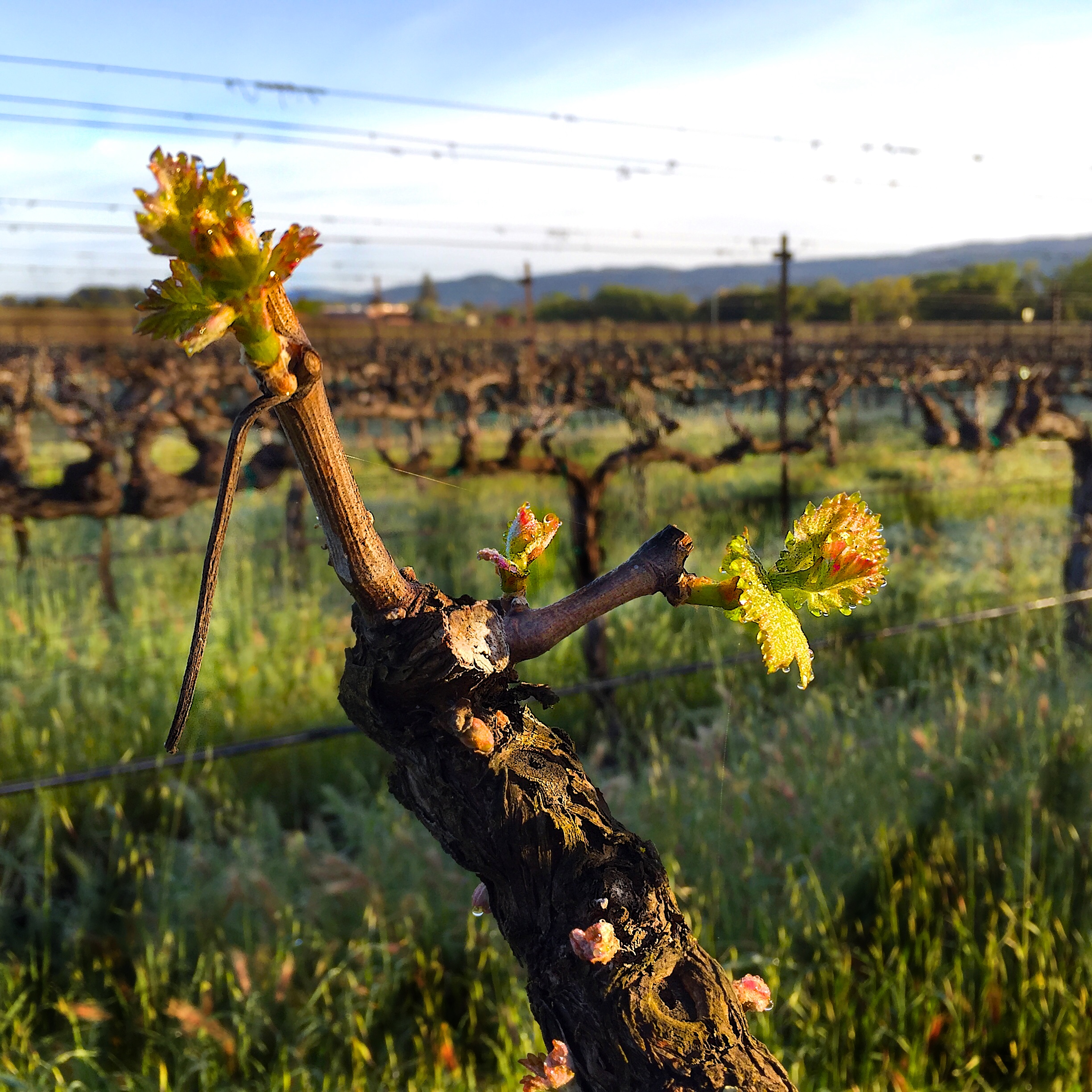
Cabernet Sauvignon bud break in the "cooler" Yountville AVA on 3/26/16
The Napa Valley is well into bud break for cabernet, yes late breaking cabernet, early varieties like chardonnay and pinot burst weeks ago. Even in the north Willamette Valley bud break is on with chardonnay. There is a new "normal" now when it comes to bud break on the west coast. In the Napa Valley, this year is a bit later than last year, even though it’s weeks ahead of years past hardly anyone notices as it just doesn’t seem so late anymore.
It's a good thing this climate change is a hoax, otherwise California might really have something to worry about. After all, harvesting cabernet before the end of September is much more convenient for the winery crew as they can trick and treat with their kids unlike earlier generations of winemakers who were just too busy at the end of October.
Anyone who grows things knows for a fact that the climate is changing. Perhaps if we actually do something about it now, in the future, winemakers will be missing Halloween with their kids once again. That's too bad for the kids, but very good for our planet and for our wines.
He Had a Gun

He had a gun. The neighborhood was like a war zone. He handed me a brown paper bag with twenty grand in $20 bills. Outside there where dozens of street people huddled in the nooks of the building, most of them savoring pints of MD 20/20. Leaving that run down building with a bag of money was more than a little intimidating in a neighborhood where they would probably kill you for five bucks.
I made to to my car and hightailed it out of there. I had made my first big score. The twenty thousand dollars in the brown paper bag was my first payoff. I had just collected on a big gamble. This was my first payment for the 1982 Bordeaux futures. There would be more than a few of the brown paper bags of money from the man with the gun over the next few months.
This is a true story and what selling wine was like in the Chicago of the early 1980s. Such were the logistics of the red-hot 1982 Bordeaux futures campaign. I had finally made it in the fine wine business. However, the gun and the brown paper bags full of cash were not exactly what I had envisioned as I poured over Edmund Penning-Rowsell’s The Wines of Bordeaux and dreamed of the glories of the Premier Grand Crus.
Now I'm in the Napa Valley three decades later. While the neighborhood has changed I'm still scratching for bags of money and wouldn't mind a few right now. The economics of winemaking in the Napa Valley requires the biggest bags of money. Oddly enough, those bags of cash given me by the man with the gun seem somehow cleaner than the cash bags required to play in the Napa Valley these days. The buyers that filled those cash bags in 1983 actually got their moneys worth, either in great wine or in huge returns on cases sold on today’s auction market. Dollars invested in the Napa Valley today are highly unlikely to repay such an investment in either financial or spiritual terms.
In 1983, the man had the gun to protect himself from the criminals outside. These days its getting harder to see who has to be protected from who. The wine industry seems at a cross road, with big money wineries on one side and consumers on the other. But there is a world of wine where consumers and winemakers are on the same side.
The "natural" wine movement may be controversial and not all the wines may live up to the hype, but you can't deny you feel more soul in these wines than in the high end cult wines of the world.
I'll take the music of Aretha Franklin over Celine Dion anyday. It's just got more soul. I feel the same way about wine.
Double-click to edit...
Fall Napa Valley
It finally feels like fall in the Napa Valley. Some actual rainstorms and cool dew on the leaves in the morning. All the grapevines changing colors are beautiful with each variety having its own distinct hue.
A New Cabernet for Cornerstone Cellars: Michael's Cuvée

Essentially all wines are cuvée blends to one degree or the other. Unless a wine comes from a single barrel or tank that passed from fermenter to bottle with no additions all wines are are blends. They’re either blends of barrels or vineyards or varieties or all of the above. The important thing is why you make a cuvée. Like so many wine terms, reserve for example, there is no legal restrictions in their use so it is only the integrity of the producer that gives these terms their meaning.
We have the privilege of working with some of the finest vineyards in the Napa Valley, which means some of the finest vineyards anywhere in the world. They are so exceptional that we have decided to bottle them in small single vineyard lots in order to let their beautiful personalities clearly sing in their own voice. The first of these single vineyard wines will be released this fall.
However, sometimes even the finest singers love to sing with others finding a new harmony and complexity in blending the textures of their voices. It’s the same for winemakers, we can’t help but explore the new layers and personalities that can be created by blending.
It is in this spirit that our Cornerstone Cellars Michael’s Cuvée was born. A selection from our finest vineyards and varieties, Michael’s Cuvée is a unique expression of the best of each vintage brought together in a new and distinctive harmony. Such an important wine could not have just any name and so we chose a name deeply and emotionally tied to the entire history of Cornerstone Cellars. Michael’s Cuvée is named for founder Dr. Michael Dragutsky, whose spirit and passion have fueled Cornerstone Cellars since our founding in 1991.
As befitting the first release of such an important wine, the 2012 Cornerstone Cellars Napa Valley Cabernet Sauvignon, Michael’s Cuvée is a true statement wine. Combining some exceptional vineyards with an extraordinary vintage we have crafted a memorable wine that will evolve for many years to come. The 2012 Michael’s Cuvée is 91% cabernet sauvignon with 9% merlot. The blend was selected from the Oakville Station Vineyard (To Kalon) 57%, 28% Kairos Vineyard in Oak Knoll and 9% Ink Grade Vineyard on Howell Mountain. Less than 250 cases were produced.
The 2012 Cornerstone Cellars Napa Valley Cabernet Sauvignon, Michael's Cuvée is a classic, powerful, but elegantly structured Napa Valley Cabernet Sauvignon. Deeply colored with rich, cassis laden aromatics, it is youthful and concentrated at this point and will develop even more complexity and elegance as it ages over the next decade or more. While voluptuous and richly textured it is still bright and fresh with a long, smooth finish.
The Pineapple Express Arrives in the Napa Valley
The arrival of a storm brings welcome rain and beauty to the Napa Valley
Clouds at dawn signal the arrival of the "Pineapple Express in the Napa Valley. Soon the spring mustard and the vines will get a good drink
Double-click to edit...
Stunning twisting cloud formation at dawn over the Napa Valley vineyards of Yountville
Giving Thanks: Napa Cab, Willamette Pinot
November in Oregon's Willamette Valley
Just in time for Thanksgiving I’m excited to share my new Cornerstone Oregon releases with you. Certainly there is no better match for the traditional cuisine of this American holiday than wines from America’s premiere pinot noir and chardonnay region: Oregon. With the 2014 vintage I passed my first decade making wine in Oregon and I am more convinced than ever that it is here in the United States that pinot and chardonnay can best show their true personality.
For this reason at Cornerstone Cellars we do not make any chardonnay or pinot in California as, while there are a few examples of wines that are true to these varieties, the vast majority of wines produced in California from pinot and chardonnay speak far more of winemaking than terroir. I believe in pinot and chardonnay grown in the Willamette Valley just as fervently as I do in cabernets, merlot, syrah and sauvignon blanc grown in the Napa Valley.
Very soon Cornerstone Oregon will be at the same production level as Cornerstone Cellars in the Napa Valley (about 5,000 cases each) and so these wines are of the highest priority to me.
As from the beginning of Cornerstone Oregon in 2007, our wines are a collaboration between myself and my friend and the Northwest’s premiere winemaker, Tony Rynders. The style of Cornerstone Oregon reflects my over three decade immersion in the wines of Burgundy and Tony’s two decades in the Northwest, which includes stints as the red wine winemaker at Hogue and a decade as winemaker at Domaine Serene. The wines of Cornerstone Oregon are a synthesis of our perspectives and together we are crafting wines with a classic structure intertwined with a vibrant New World personality. As always, all of the wines of Cornerstone Oregon are grown, produced and bottled in Oregon.
This Thanksgiving I am giving thanks for the privlege of making cabernet in the Napa Valley and pinot noir and chardonnay in the Willamette Valley. Certainly this is having the best of both worlds.
Earthquake and a New Harvest
The Cornerstone Cellars 2013 vintage is somewhere in there.
In the pitch darkness of your deepest sleep a nightmare suddenly launches your bed into the air jarring you awake. But waking only makes it worse as you realize that it was not a dream, but reality that launched your bed off the ground. But that's just the beginning as your entire house has been tossed in the air. Even beyond that you finally understand it's not just the bed, nor the house that has been flipped into the air, but the very ground itself.
Before your can fully comprehend what has happened it's over and everyone is holding each other trying to regain some sort of belief that the floor beneath their feet has become something that you can actually stand on. Then the adrenaline hits and you spring into action. That action mostly involves mops, brooms and dealing with the shock. For the next eight hours we cleaned, first our house, then repeating the experience at our Cornerstone Cellars tasting room in Yountville. By noon we had the worst of the mess cleaned up. We were spattered with wine like we'd been working crush all day and our hands were filled with small cuts from all the shards of glass that covered everything.
That's an earthquake. A few minutes of terror followed by hours of the most mundane, yet adrenalin fueled housecleaning you can imagine. After a few minutes, through the daze of shock, it occurs to you, you may have lost a year of your life, perhaps more. Could the entire vintage be gone? Could all of our wine be gone?
Through the haze of shock and exhaustion the harsh reality starts to sink in. It did not really hit until later in the day, when I was asked about our wines and suddenly tears started to well in my eyes as if the potential loss was just too much to ever consider. We started out in 2007 to make wines with what we perceive as refinement, balance and elegance. Achieving the style of wines you want is not an overnight thing. In winemaking you only get one learning experience a year. The 2013s were not the result of just one year of work, but the result of six years of work. When you lose a vintage you don't just lose the wine from that year, you lose the wine you achieved through a lifetime of experience. For a small producer like us, the wines change each year influenced by the weather and our increased knowledge of each vineyard and the fruit that comes from it. When you make wines that are not manipulated you literally only make that wine once in your life as each year is unique. Not only does the weather change, but you change. So whatever wine we lose will be losing something truly unique. The intersection of nature and humans at one point in time.
A week has now passed and with each day you get a little less jumpy. The aftershocks continue and we even slept through a 3.2 quake last night. However, we still don't know the extent of the wine we lost. A few more days will tell the story. We have been lucky so far only suffering broken wine bottles, minor cuts, smashed dishes and jangled nerves. At this point I am clinging to the hope that our luck will continue as we dig our barrels out of the confused pile the once orderly barrel room has become.
With harvest upon us we are experiencing death and birth at the same time. While we have certainly lost some of our work from the 2013 vintage forever, the hope and excitement of a new vintage is also upon us. As forward is the only direction we can go we are choosing to focus on what are about to create rather than what has been destroyed. It's time to celebrate the new vintage not mourn for the old one.
I believe this will be an exceptional vintage in the Napa Valley, perhaps the Earth itself thinks so too.
A Beautiful Factory
It was majestic, breathtaking. It cost tens of millions of dollars. It was the most beautiful factory I'd ever seen. Such are the temples of wine in the Napa Valley. Shrines to people rather than agriculture. The days of Bottle Shock have long passed to be replaced by sticker shock. The Napa Valley is no longer the place a farmer can bring his winemaking dream to reality.
Today in the Napa Valley people build pyramids to their own memories just as the pharaohs did in ancient Egypt - and for the same reason. Immortality is expensive. Making wine is farming and it's hard to think of anything less glamorous. The choice for the ages is obvious - temples last longer than wines.
I was visiting one of Napa's new pyramids a few weeks ago and it was perfection. Majestic floor to ceiling windows filled with vineyard views, a winemaking facility loaded with the cutting edge technology and, of course, it was all integrated with equally cutting edge modern art. There was only one thing missing. There was no soul, no soul of the wine and no tie to the land. The connection to the land was lost as everything about the place was about people - nothing was about nature and dirt, which was nowhere to be seen except through perfectly clean, massive windows. It was there to see, but there was nothing to touch or that could touch you.
You can buy the land, the equipment, the art and the media, but in the end the wines will have no soul, no soil, unless it is really inside of you. Without that soul, no matter how much you spend, you just end up with a beautiful factory and like all factories you pump out an industrial product. Designer wines designed for points not people.
The marketing employed to sell these wines is as cold as the facility they're made in. Data points replace people and social media becomes a strategy not a conversation. You don't want to get your hands dirty.
Corison Winery
On Route 29 in the heart of the Napa Valley is a plain gray barn where the wine, and only the wine, tells the story. There Cathy Corison has endured the pointless point-ridden decades for wine when only points mattered and pH did not. Today she has been magically rediscovered without changing a thing. It seems actually having a vision and a passion, not simply an ego and a bottomless checking account, have become fashionable again. This, at least, is something we can be thankful for in the Napa Valley
There are real wine temples, like that plain gray barn, out there in the the Napa Valley and across California, but as in Indiana Jones, you'd better choose wisely. Most people choose poorly forgetting that it's in the cup of a carpenter that you're more likely to find real wine.
In Spite of the Fact...
Double-click to edit...

Chardonnay, Napa Valley, Yountville 8/9/14. Beautiful in spite of the fact this is no place to grow chardonnay.
Opening Day
2013 Corallina
Opening Day has come and gone, which means only one thing: it's time for our spring wine releases! These two new releases are all about fun and immediate gratification and should be in your glass right now!
Nothing says spring more than the beautiful coral color of our 2013 Cornerstone Corallina Napa Valley Syrah Rosé. One of our Artist Series wines, Corallina Syrah Rosé is an explosion of pastel colors both inside and outside the bottle. As always, Cornerstone Cellars always does things a bit differently and Corallina Syrah Rosé is no exception. This is what I call a real rosé, not a wine drained off of a red wine tank as a second class citizen, but a classic, authentic rosé. The vineyard, tucked off in a cool section of Oak Knoll, was destined, before the first leaves appeared, to be Corallina Syrah Rosé and farmed to produce rosé each day of the vintage. Picked at the precise moment to capture the brilliant fruit flavors, just three hours gentile skin contact in the press was all that was needed to get that touch of coral color we love. Then the wine was fermented totally dry and aged in mature French Oak barrels for five months to achieve a unique creamy texture on the palate. The 2013 Cornerstone Corallina Napa Valley Syrah Rosé is totally seductive. You will not be able to resist. With only 417 cases produced it is sure soon be only a beautiful pink memory.
Each year Stepping Stone by Cornerstone North Coast Red Rocks! has gotten better and better as we've gotten better and better at making it. Our inspiration has always been the beautiful blends of Southern France from Languedoc-Roussillon and Provence. These wines have a savory complexity mixed with pure charm that is so perfect for the rustic, flavorful country French cooking of those regions. With the release of the 2012 Stepping Stone by Cornerstone North Coast Red Rocks! I feel we have hit the target. Bright, savory and vivacious, I can't think of a better wine for our own American country cooking, which at this time of year usually means grills, steak, chops, sausages and burgers. With the release of the 2012 Red Rocks! I believe we have crafted a wine with the balance and depth that makes it a true Cornerstone. As always with Rocks!, the blend is our secret and the pleasure is all yours.
Baseball and summer food are back and we've got the perfect wines to go with both!
Taking the Road Less Traveled - Cornerstone Cellars Black Label
2011 Cornerstone Napa Valley Cabernet Franc, Stepping Stone
Sometimes you come to the fork in the road and you must make a choice as you can't travel both. We've made ours. We decided to take the path less traveled.
The choice was simple: quality or price. There was no hesitation in our choice as quality was the only answer. The market is price obsessed, but we believe there are those that understand you get what you pay for from wineries whose ego is based on what's in the bottle instead of on the ego of the owner. For many there is a deeper understanding that in wine, true quality is not in a label, but in the hearts of the people who craft it. Ninety-five percent of the wine in the world is an industrial product, manufactured based on market research, and the rest is divided between charming country wines and people with a passion to let nature express its beauty through their wines. Oddly enough, many of the world's most expensive wines fall into the first category, not the latter.
Our decision was to move forward and to let something old and comfortable fade away. As comfortable as Stepping Stone was to everyone as the wines got better and better, there comes a point when you have to forgo comfort to obtain excellence. This is especially true in the narrow confines of the Napa Valley, which is a mere thirty miles long and five miles wide. This small valley is one of the world's most distinctive vineyard regions and such distinction does not come cheaply.
Our vision is to make dramatic, elegant and complex wines from great vineyards. This means that the value in our wines is not that they are inexpensive, but that they have such an expressive personality, combined with our singular character, that their value is not on their price tag, but on your palate.
So we have decided to take the path less traveled and give up a less expensive line of wines to introduce a new range of wines made with no concessions in the tradition of our iconic White Label Cornerstone Cellars wines. The one thing we have not left behind is our obsession with offering exceptional values. However, we are a small company and can't do everything. To produce this new group of exciting wines something had to go by the wayside. So this is both the end of an era and a new beginning as we could not travel both paths.
With the 2010 vintage we say goodbye to Stepping Stone and with great pride introduce you to Cornerstone Cellars Black Label selections. Our first release of our Black Label wines is from the 2011 vintage and includes Napa Valley Cabernet Sauvignon, Cabernet Franc and Syrah. These are not wines declassified from our White Label Reserve wines, but wines produced from specially selected vineyards. While our White Label wines are unabashedly made to cellar for decades, our Black Label wines are selected from vineyards that naturally produce a more forward style of wine that can be enjoyed in it's youth, but will gain complexity and depth with shorter term cellaring.
The roads between price and quality diverged, but not the one between price and value. So we took the one less traveled by, quality, and that has made all the difference. While the reception to raising prices can be frosty, we know that once these new wines are tasted that other path will soon be forgotten.
We are proud and honored to introduce you to a totally new range of wines: Cornerstone Cellars Black Label Selections.
Feeling Perfectly Wonderful
2010 Cornerstone Cellars Howell Mountain Cabernet Sauvignon
Winemaking is a journey with no end. You set goals, but as you achieve them you just have higher aspirations. The more you achieve, the more you know there is to achieve. With the two Cabernets we are now releasing we have achieved a goal we set for ourselves, but now our vision for what we will achieve in the future is even sharper.
Our first goal was to craft wines with elegance and finesse while still honoring the power, which is an accurate expression of Napa Valley terroir. It was also our goal to achieve wines with appropriate levels of alcohol. We do not simply want to have low alcohol levels for the sake of that alone by following some pre-set recipe, but to produce wines from grapes harvested at just the right moment, the moment that defines that vintage. We don't want underripe grapes anymore than overripe ones. Perhaps the most important thing to us is having acid levels that make the wines refreshing, even in their youth. What you will not get from us are wines suffering from the "big wine" syndrome so favored by certain well known critics. What you will get are wines that fire up your saliva glands with the zesty acidity required to truly compliment cuisine. If you like massive, oaky cabernet with 16% alcohol (no matter what it says on the label) with high pH and residual sugar you won't like these wines and we can live with that. Our first goal is to make wines we love to drink and our second goal is to find wine lovers who agree with us. We are not interested in making wines that try to satisfy the broadest range of consumers possible.
The 2010 Cornerstone Cellars Cabernet Sauvignon releases reflect well this vision. They are very different wines telling two distinct stories. We make different wines for that very reason as we find each expresses aspects of the Napa Valley well worth telling. By Napa Valley standards 2010 was a cooler vintage, which means by Bordeaux standards it was a a very good year. It reemphasizes my opinion that the problem vintages in Napa are the hot ones , not the cooler ones. The cooler weather helped us towards our goal to make balanced wines. While the "big wine" folks struggled with 2010, we loved it.
The 2010 Cornerstone Cellars Napa Valley Cabernet Sauvignon expresses the personality of three exceptional vineyards: Ink Grade on Howell Mountain, Oakville Station in the To Kalon district and Kairos in Oak Knoll. They weave together to produce a wine that reflects the character of the Napa Valley as a whole. The power and structure of Howell Mountain combines with the rich velvety Oakville Station and both are lifted by the bright aromatics and freshness of Kairos. However, Cabernet Sauvignon alone does not tell the whole story in this wine. Often I find that cabernet sauvignon on its own has a big start and finish, but can be a bit hollow in the middle. Here is where cabernet franc and merlot come in. A touch of merlot fills that hole in the middle and brings a beautiful silky texture. Cabernet franc is like MSG in a dish lifting and defining flavors. Together they achieve umami, that elusive savory personality that defines great wine.
The 2010 Cornerstone Cellars Howell Mountain Cabernet Sauvignon is a wine of time and place. Sourced from the organically farmed Ink Grade Vineyard on the high slopes on the east side of Howell Mountain. Grown on the distinctive powdery, white tufa soils as contrasted to the red, clay based soils on many Howell Mountain vineyards, this is a firmly structured wine, which we make to express, not hide its richly tannic character. This is a wine born and made to age. I recommend waiting five or more years to let the many layers in this wine to expand and integrate. If you can't wait, an hour or two in a decanter will help reveal the treasures still hiding in this young wine. Once again, a small touch of merlot is added to expand the textures on the palate.
Perhaps the most important thing to me is these wines give me the complete experience that I seek in wine: lifted aromatics, brightness on the palate, refreshing flavors and long, layered flavors that go on and on. Most of all they are wines that make me want a second glass. There is no such thing as a perfect wine, but in the fact that these wines purely represent the vineyard, vintage and varieties that gave them birth, I feel perfectly wonderful about them.