Drink and Yelp

She was nasty; complaining and putting us down. No matter, it's only your life's work; better get a thicker skin. But then I thought better of it, when someone's full of it you should stand up for yourself.
Of course I'm talking about a Yelp review. I can't really complain as, after over 122 reviews, Cornerstone Cellars has a four and half star rating. Honestly you can't do any better than that. Indeed it's an accomplishment of which I am extremely proud.
At a winery tasting room, odds are pretty good that that outlier one star review was by someone who had too much to drink and was refused anything more to drink. Nothing pisses off a drunk more than cutting them off.
So I have decided to stick up for myself and, contrary to Yelp's recommendation, take on the that rare dissatisfied customer. Now, obviously if you're getting bad review after bad review you'd better do some soul searching, but in our case nothing could be further from reality.
For Cornerstone Cellars, out of the last twenty-five Yelp reviews eighteen have five stars and four have four stars or better. Take a look here and be sure to read the one star review. Perhaps they were not feeling so great when they woke up the next day and wrote them.
Yelp is powerful and for us, for the most part, a great thing. The only real issue I have with Yelp is that they don't take into account that usually the people that write bad reviews for winery tasting rooms are the ones that have indulged in a bit too much fruit of the vine. They need to find away to take that into account and banish such wine induced rants.
In Sideways Miles drank and dialed, the equivalent of drinking and Yelping. We do not recommend either.
Harvest 2015 Rhone Rangers 9/9 9/10 2015
Kari checking on Corallina fresh from the press
Today and yesterday we’ve been Rhone Rangers as on Wednesday we brought in our first marsanne and rousanne from the David Girard Vineyard in El Dorado. As exciting as that was, today is always a special day for us as we harvested our Crane Vineyard Syrah for what has became a very special wine for us - Corallina Syrah Rosé.
In what as become a rather innocuous wine category as rosé became more popular, I’m very proud that Cornerstone Cellars is known for making a rosé with true character. I’m glad the media agrees with us making Corallina Syrah Rosé the top ranked rosé in California http://cl.ly/d3uE
Gorgeous Corallina juice
The only problem with the 2015 Corallina Syrah Rosé will be there won’t be very much of it. Due to poor fruit set we are looking at about a 40% drop in production. No worries, we’ll be sure our friends get their Corallina first! As always we seek to make Corallina better every year and this will be the first vintage that is 100% barrel fermented. This will make the wine even deeper and more complex. The juice this year is particularly deeply flavored and colored and I expect the 2015 to be a dramatic rosé.
The marsanne and rousanne are part of our new expanded “Wine Dance” series of wines made from classic Rhone Valley varieties. Joining Corallina Syrah Rosé will be this rousanne/marsanne blend, a viognier, a grenache and a mourvedre from El Dorado and an old vine syrah from Mendocino. These are our “Rhone Rangers” and you’ll be introduced to these new releases in 2016. The style is ultra-traditional with no new oak used to maximize the bright, fresh fruit flavors of these wines.
Munching on marsanne
We co-fermented the rousanne and marsanne and the juice had this glorious, rich honeyed character that is sure make an expressive and delicious wine.
Tomorrow will be a very long day. We’re hitting the vineyards at 5:30 a.m. and will be picking two merlot and one cabernet franc site here in the Napa Valley. I’m sure the sun will be down before we get everything in the fermenters.
A New Cabernet for Cornerstone Cellars: Michael's Cuvée

Essentially all wines are cuvée blends to one degree or the other. Unless a wine comes from a single barrel or tank that passed from fermenter to bottle with no additions all wines are are blends. They’re either blends of barrels or vineyards or varieties or all of the above. The important thing is why you make a cuvée. Like so many wine terms, reserve for example, there is no legal restrictions in their use so it is only the integrity of the producer that gives these terms their meaning.
We have the privilege of working with some of the finest vineyards in the Napa Valley, which means some of the finest vineyards anywhere in the world. They are so exceptional that we have decided to bottle them in small single vineyard lots in order to let their beautiful personalities clearly sing in their own voice. The first of these single vineyard wines will be released this fall.
However, sometimes even the finest singers love to sing with others finding a new harmony and complexity in blending the textures of their voices. It’s the same for winemakers, we can’t help but explore the new layers and personalities that can be created by blending.
It is in this spirit that our Cornerstone Cellars Michael’s Cuvée was born. A selection from our finest vineyards and varieties, Michael’s Cuvée is a unique expression of the best of each vintage brought together in a new and distinctive harmony. Such an important wine could not have just any name and so we chose a name deeply and emotionally tied to the entire history of Cornerstone Cellars. Michael’s Cuvée is named for founder Dr. Michael Dragutsky, whose spirit and passion have fueled Cornerstone Cellars since our founding in 1991.
As befitting the first release of such an important wine, the 2012 Cornerstone Cellars Napa Valley Cabernet Sauvignon, Michael’s Cuvée is a true statement wine. Combining some exceptional vineyards with an extraordinary vintage we have crafted a memorable wine that will evolve for many years to come. The 2012 Michael’s Cuvée is 91% cabernet sauvignon with 9% merlot. The blend was selected from the Oakville Station Vineyard (To Kalon) 57%, 28% Kairos Vineyard in Oak Knoll and 9% Ink Grade Vineyard on Howell Mountain. Less than 250 cases were produced.
The 2012 Cornerstone Cellars Napa Valley Cabernet Sauvignon, Michael's Cuvée is a classic, powerful, but elegantly structured Napa Valley Cabernet Sauvignon. Deeply colored with rich, cassis laden aromatics, it is youthful and concentrated at this point and will develop even more complexity and elegance as it ages over the next decade or more. While voluptuous and richly textured it is still bright and fresh with a long, smooth finish.
Giving Thanks: Napa Cab, Willamette Pinot
November in Oregon's Willamette Valley
Just in time for Thanksgiving I’m excited to share my new Cornerstone Oregon releases with you. Certainly there is no better match for the traditional cuisine of this American holiday than wines from America’s premiere pinot noir and chardonnay region: Oregon. With the 2014 vintage I passed my first decade making wine in Oregon and I am more convinced than ever that it is here in the United States that pinot and chardonnay can best show their true personality.
For this reason at Cornerstone Cellars we do not make any chardonnay or pinot in California as, while there are a few examples of wines that are true to these varieties, the vast majority of wines produced in California from pinot and chardonnay speak far more of winemaking than terroir. I believe in pinot and chardonnay grown in the Willamette Valley just as fervently as I do in cabernets, merlot, syrah and sauvignon blanc grown in the Napa Valley.
Very soon Cornerstone Oregon will be at the same production level as Cornerstone Cellars in the Napa Valley (about 5,000 cases each) and so these wines are of the highest priority to me.
As from the beginning of Cornerstone Oregon in 2007, our wines are a collaboration between myself and my friend and the Northwest’s premiere winemaker, Tony Rynders. The style of Cornerstone Oregon reflects my over three decade immersion in the wines of Burgundy and Tony’s two decades in the Northwest, which includes stints as the red wine winemaker at Hogue and a decade as winemaker at Domaine Serene. The wines of Cornerstone Oregon are a synthesis of our perspectives and together we are crafting wines with a classic structure intertwined with a vibrant New World personality. As always, all of the wines of Cornerstone Oregon are grown, produced and bottled in Oregon.
This Thanksgiving I am giving thanks for the privlege of making cabernet in the Napa Valley and pinot noir and chardonnay in the Willamette Valley. Certainly this is having the best of both worlds.
Being Franc
2011 Cornerstone Napa Valley Cabernet Franc, Black Label Stepping Stone Cuvée
Every vineyard, vintage and variety has its center. It's our job as winemakers to find that center and let it speak through the wine. If you think I feel there is Zen in crafting a wine you'd be right. When you find that center the wine truly has not only something to say, but something worth listening to.
This is why Cornerstone Napa Valley Cabernet Franc is so distinctive. We let it be Franc. Many wineries seem to want to tame the cantankerous cabernet franc's edgy personality, but we don't. In fact, we revel in its idiosyncrasies. Being Franc is everything to us.
Where is cabernet franc's center? For me it a little on the wild side, sauvage, as the French call it. Not wild like crazy, but like nature. Cabernet franc should have an edge aromatically showing wild herbs and mint and a firm structure that grabs your attention. Like most really interesting things, it's not for everyone. Perhaps that what we like about it as we freely admit we are not trying to make wines for everybody.
Finding cabernet franc in the Napa valley is not easy and, unfortunately, expensive. We have been fortunate to find some amazing sites that allow us to weave the diverse characters of vineyards in St. Helena, Oakville, Coombsville and Carneros into a wine that embraces its Franc-ness. A dollop of spicy merlot from Carneros rounds out the texture and expands the aromatics with the herbal touch of merlot from a cool site echoing the sauvage of the cabernet franc itself. The fresh acidity lifts and separates each aspect of the wine allowing it to be voluptuous, yet finely balanced. This is a full figured Napa beauty that displays all of its seductive charms while never losing its elegance or firmness. I don't know if we make a sexier wine.
Just a note on the vintage, there have been a lot of knocks from the press on the 2011 vintage in the Napa Valley, proving once again a little bit of knowledge can be dangerous. The fact is if you took the weather we had in 2011 and gave it to Bordeaux they would be drinking Champagne and slapping themselves on the back. The only people that had trouble with this vintage are those winemakers dreaming of making big-point-fruit-bombs by picking at brix levels approaching thirty. Winemakers that were looking to harvest ripe grapes, as compared to overripe ultra-hang time fruit, cruised through the vintage just fine. A case in point being our 2011 Cornerstone Napa Valley Cabernet Franc, Black Label Stepping Stone Cuvée.
We believe we have found our center with the 2011 Cornerstone Napa Valley Cabernet Franc, Black Label Stepping Stone Cuvée by being willing to let franc be franc. We hope you will take the time to enjoy this wine in a state of mindfulness. Being Franc requires concentration.
Adding Fuel to the Fire
Me pouring Cornerstone Oregon at World of Pinot Noir
Sometimes a pat on the back also gives you a kick in the butt. It never hurts to have some fuel tossed on the the fire of the passion you are pursuing. That is how I feel about Alder Yarrow's article about me and Cornerstone Cellars on Vinography - fired up.
I knew going in it would be a challenge to market Napa Valley wines made in a more elegant style. Certainly it would have been easier to just make a massive wine, slathering on oak and alcohol in a style many critics adore, but where is the pleasure in making wines you don't like to drink?
When we started releasing our more restrained style of Napa Valley wines we took our lumps from Laube and Parker, which, proudly puts us in a sort of elite club with some very fine winemakers whose vision we share. However, rejection by the old boys club has been more than countered by the likes of this exciting article in Vinography and excellent reviews in Connoisseurs Guide to California Wines, The Wine Enthusiast, Stephen Tanzer and a host of wine bloggers.
It's easy to make wines that get big points from the old guard, you can hire a consulting company that guarantees results point-wise (do they charge by the point?). But is it really easier? Does scamming the system just to get those points really bring you satisfaction? Maybe for some, but not for me.
What brings me satisfaction is tasting a wine we created and having it excite and thrill, well, me. What brings me even more satisfaction is seeing someone else have that experience too.
It also brings true satisfaction to have someone I respect as much as Alder write such a, for me, moving article on the work we are doing at Cornerstone Cellars. Please take the time to read his article at the link below.
“Cornerstone continues to evolve, but like the rapidly shortening line of a tether ball accelerating towards the pole, the wines of Cornerstone are beginning to gravitate towards a quality and consistency that is quite admirable, and the equal of any of Napa’s stalwart producers. Camp and Keene seem to be laying the foundation for becoming a fixture in the valley. Their Yountville tasting room has already become one of the town’s most visited, and thanks to Camp, the winery has quickly become among the most successful industry players in social media and new internet technologies such as geofencing.”
Curiously Cabernet
2010 Cornerstone Cellars Howell Mountain Cabernet Sauvignon
Frequently, as people taste our Cornerstone Cellars Cabernet Sauvignon wines I get the same comment over-and-over, “your wines actually taste like cabernet sauvignon.” It appears that many people find it curious to taste the varietal character of cabernet sauvignon in their glass of Napa Valley Cabernet Sauvignon. However, this is not as curious as it might seem.
Indeed Cornerstone Cellars Cabernet Sauvignon tastes curiously like cabernet, or, at least like cabernet used to be. Used to be as in the wines that made the Napa Valley great like those that won the famed Judgement of Paris in 1976. Perhaps the most important aspect of the Judgement of Paris was not that the California wines won both the white and red judging, but that the judges themselves could not discern which wines were French and which Californian. Such a confusion is not likely to take place today as Californian wines have increased in girth, dominated by sweet oak, overripe fruit and alcohol. The fashion for big wine with big flavor, promoted by certain critics, erased the character of the noble cabernet sauvignon variety as well as any sense of place of the vineyard itself. The resulting wines showcased winemaking technique instead of treasuring the character of variety and vineyard.
There have always been producers that ignored fashion to make elegant wines which honored the true flavors of Cabernet. Wineries like Corison, Dunn and Ridge have carried that flame for decades. I am proud to say Cornerstone Cellars has joined that group of wineries making wines that taste curiously like Cabernet Sauvignon.
What does Cabernet Sauvignon taste like? First of all it does not taste jammy, sweet, flabby or like oak barrels. Classic Cabernet is bright and alive with a herbal tingle that wakes the tastebuds. Most of all, everything is brought into sharp focus by a fine tannic structure that makes Cabernet Sauvignon the most intellectual of wines. Pinot noir may be the most sensual, but Cabernet is the most thought provoking.
We are now releasing several new wines that taste curiously Cabernet, now that’s something to think about. For us it’s something that makes us very proud.
Taking the Road Less Traveled - Cornerstone Cellars Black Label
2011 Cornerstone Napa Valley Cabernet Franc, Stepping Stone
Sometimes you come to the fork in the road and you must make a choice as you can't travel both. We've made ours. We decided to take the path less traveled.
The choice was simple: quality or price. There was no hesitation in our choice as quality was the only answer. The market is price obsessed, but we believe there are those that understand you get what you pay for from wineries whose ego is based on what's in the bottle instead of on the ego of the owner. For many there is a deeper understanding that in wine, true quality is not in a label, but in the hearts of the people who craft it. Ninety-five percent of the wine in the world is an industrial product, manufactured based on market research, and the rest is divided between charming country wines and people with a passion to let nature express its beauty through their wines. Oddly enough, many of the world's most expensive wines fall into the first category, not the latter.
Our decision was to move forward and to let something old and comfortable fade away. As comfortable as Stepping Stone was to everyone as the wines got better and better, there comes a point when you have to forgo comfort to obtain excellence. This is especially true in the narrow confines of the Napa Valley, which is a mere thirty miles long and five miles wide. This small valley is one of the world's most distinctive vineyard regions and such distinction does not come cheaply.
Our vision is to make dramatic, elegant and complex wines from great vineyards. This means that the value in our wines is not that they are inexpensive, but that they have such an expressive personality, combined with our singular character, that their value is not on their price tag, but on your palate.
So we have decided to take the path less traveled and give up a less expensive line of wines to introduce a new range of wines made with no concessions in the tradition of our iconic White Label Cornerstone Cellars wines. The one thing we have not left behind is our obsession with offering exceptional values. However, we are a small company and can't do everything. To produce this new group of exciting wines something had to go by the wayside. So this is both the end of an era and a new beginning as we could not travel both paths.
With the 2010 vintage we say goodbye to Stepping Stone and with great pride introduce you to Cornerstone Cellars Black Label selections. Our first release of our Black Label wines is from the 2011 vintage and includes Napa Valley Cabernet Sauvignon, Cabernet Franc and Syrah. These are not wines declassified from our White Label Reserve wines, but wines produced from specially selected vineyards. While our White Label wines are unabashedly made to cellar for decades, our Black Label wines are selected from vineyards that naturally produce a more forward style of wine that can be enjoyed in it's youth, but will gain complexity and depth with shorter term cellaring.
The roads between price and quality diverged, but not the one between price and value. So we took the one less traveled by, quality, and that has made all the difference. While the reception to raising prices can be frosty, we know that once these new wines are tasted that other path will soon be forgotten.
We are proud and honored to introduce you to a totally new range of wines: Cornerstone Cellars Black Label Selections.
A New Beginning
Do over.
Every vintage is a do over. You agonize over every possible imperfection and then look forward. It is not so much that you feel you were unsuccessful. How can you as critics rack up scores (not repeated in this points-free zone) and rave about your current releases. The thing is once the wines are in the bottle they are what they are and your mind goes to the future. As a winemaker your mind is in the future building, always building, on past vintages. Vintages are experiences, part of a voyage, not just end results. Winemakers have no favorite vintages just treasured experiences and the pain and pleasure of continually second guessing yourself.
The vines are now being pruned in the vineyards and the cycle that is agriculture begins again. In many ways it is comforting to work in a world governed by such a precise metronome. You know how you got here and where you're going.
There are always frustrations though as winemaking is slow motion business - you only get one 'iteration' per year. What are some of my current frustrations?
- Alcohol levels continue to challenge us. While we have reduced them by more than 1% over previous vintages, we're not quite there yet. I think the sweet-spot for Napa Valley Cabernet is between 14 and 14.5% and for Oregon Pinot 13 to 13.5%. this gives you the depth, complexity and mouthfeel we hope for while still letting terroir show through. It's a tightrope, but we'll get there - we are getting there.
- The cost of making wine in the Napa Valley continues to increase and will force wine prices even higher.
- Too many wine reviews are published without ever tasting the wine with food. This is like tasting just the sauce and then writing a review of the whole dish. You can never understand how it all works together.
- The fact that so many sommeliers do not have an open mind when it comes to California and, in particular, Napa Valley wines. They are not all the same.
What makes me happy?
- The limitless potential of Oregon makes it one of the most exciting wine regions in the world. This is a region where you can argue the best vineyards have not even been planted yet. It's a brave new world with no where to go but up.
- The growing appreciation of wines with a more balanced, restrained style is exciting. While for the most part this reawakening of taste has not enlightened old-school wine media yet, new wine media is all over it. The old guys better wake up or get left in the dust.
- The growing recognition and excitement around rebel, back-to-your-roots winemakers in the staid world of the Napa Valley.
- The exciting, exploding community of wine lovers on social media. Finally small wineries can actually have a marketing edge over corporate wineries. After all, real people are a lot more fun to have a conversation with.
- What I am happiest about is how far we've come with our wines. They are so, so much better. Uplifting wines that are refreshing and elegant. While I know I will always think we can do better no matter how great the vintage, these are wines I am proud of sharing with anyone.
Do over? Not really, each vintage is a new beginning. How lucky are we?
The Cornerstone Story...
The second vintage at Cornerstone Oregon
In 1991 Mike Dragutsky was touched by the dream to make great wine and founded Cornerstone Cellars. In 1979 Craig Camp gave up his career in journalism to tell the story that flows from the vine to the glass. In 1997 Jeff Keene escaped from the confines of the research laboratory to let his creativity flow in the winery. In 2008 they joined forces to intertwine their talents and vision and Cornerstone Cellars was reborn in the Napa Valley and Oregon's Willamette Valley.
In late 2007 Dragutsky and Camp began the drive to make wines at Cornerstone Cellars that are defined by their elegance, dedication to terroir, appropriate alcohol levels and that are crafted to enhance meals. They recruited Keene to join as winemaker as they knew he shared their vision of balanced wines, driven by acidity and freshness. Today's Cornerstone Cellars style combines Camp's European wine background, starting as an importer of Burgundy, Bordeaux then by three years working at wineries in Italy, with New Zealander Keene's cool climate background, both in his native country's vineyards and at Haven's Wine Cellars here in Napa. Their passion for balance combined with the entrepreneurial spirit of founder Dragutsky define the vision of Cornerstone Cellars as defined in their mission statement:
Vintage, Vineyard and Variety
"Excellence is never enough, we have to go beyond and establish an ever higher goal each vintage. Our goal is to craft wines that are not only exceptional, but memorable. Each of our wines expresses the essence of vineyard, variety and vintage, which combine each harvest to create something never to be exactly repeated."
In 2008, Cornerstone Oregon was born in the Willamette Valley as a collaboration between Cornerstone Napa's Craig Camp and renowned Oregon winemaker Tony Rynders. While longing to make pinot noir and chardonnay, Camp firmly believed that the Napa Valley was no place to make classically styled, elegant wines from these varieties. As a result a totally separate project was born as we believe it is more important where the vines put down roots than where we do.
What we believe:
Cornerstone Cellars wines are the combined personal vision of Dragutsky, Camp and Keene of what makes a wine great. The symbiosis of their personalities are realized in our wines.
We are not about statistics and points, terroir is terroir and every vineyard must find its own balance.
There is no finer place in the world to grow cabernet sauvignon, cabernet franc and merlot than the Napa Valley. It is both an honor to be able to craft wine from such outstanding fruit and it our responsibility to make each wine to the very best of our ability.
We make pinot and chardonnay in Oregon because we think it is a world class place to grow those varieties that the Napa Valley is not. It's more important where the vines put down roots than were the winemakers do.
We do not make wine for everyone. We make what we believe in, not what the mass market demands. We will not be a slave to the fashion of the moment, we make wines we love to drink. What makes a great wine does not change, it's not like having hemlines to go up and down according latest whim.
Our wines all express our vision of the 3 V's: vineyard, vintage and variety.
We are an atypical Napa Valley winery and we like that way.
Hard Chard
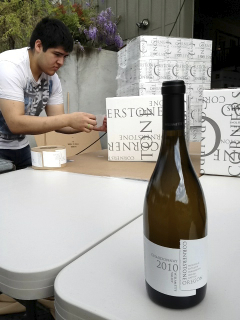
Firsts are always hard and hard this one certainly was, which always makes the experience even more delicious. In this case it also makes the wine more delicious. This September we’ll be able to share this experience with you.
It was with a surprising sense of satisfaction that I picked up the first bottle off the bottling line. It was, of all things a chardonnay. I confess I have little affection for most renditions of this variety in the New World. However, winemaker Tony Rynders changed my mind and I am sure this chardonnay will change yours.
The hard part I was referring to in this wine was a backbone. A concentrated minerality and racy acidity that will hurt the teeth of those that love oaky, sweet chardonnay. That is the way I decided to make it. I would never dream of making a spineless chardonnay. Cornerstone has never been about spineless wines and I have no place for them at my table.
So this September I will be extremely proud to introduce you to the 2010 Cornerstone Oregon, Willamette Valley Chardonnay. Less than two hundred cases were produced. It’s a lean, mean machine and I wish I could wait another year to release it as it certainly needs a few years in the bottle to show all has to give. I can only hope that some of you will lay some bottles away in your cellar.
How did it get here? Well, first of all there was a challenging vintage to deal with, but that’s something winegrowers in places like Oregon and Burgundy deal with seven vintages out of ten. There was a lot of mold when the fruit came in, but we hand-sorted like madmen and delivered only the clean bunches to the fermenter. Starting the fermentation in stainless steel tanks, the wine was racked into mature French Oak barrels to continue and finish fermentation. Those barrels were home to our chardonnay for the next fourteen months where it mellowed and broadened its flavors and, most of all, its complexity. Only 80% of the wine went through malolatic to preserve its perfect tightrope of acidity. In fact, nothing in the cellar was allowed to pilfer anything from the wine.
In a strange twist of conventional wisdom, our Cornerstone Oregon, Willamette Valley Chardonnay is a better oyster wine than our Cornerstone Cellars Napa Valley Sauvignon Blanc, which finds its soul mates in crab and lobster. What these two white wines have in common is they will both age beautifully. This is our goal. To let each wine express its true spirit and find the match at your table that nature intended. That nature is something you’ll find subtly expressed in all our vintages after 2008. This is just a start as we will push ourselves each vintage to ever higher expressions of vineyard, variety and vintage. I believe that the Napa Valley is a perfect place to grow sauvignon blanc and that the Willamette Valley is a perfect place to grow chardonnay. Our vision is to go where the variety loves to be, not to force the variety to love where we put down roots. After all, nothing is more important to a wine than the soil that gave life to the vines. That essence flows from the soil through the roots to be mixed with sunshine to create wine.
To understand my hesitance to make a chardonnay you have to understand my background. In the early eighties I was importing the wines of Domaine Comtes Lafon through Becky Wasserman, who I represented in the mid-west. At that time Dominque Lafon had yet to take over the estate from his father and was working for Becky. Over a two year period, on his many visits to Chicago and mine to Burgundy, I was privileged to drink a lot of great chardonnay (and a lot of other things) with Dominque. It is on this foundation my viewpoint on chardonnay is based. As a side note, just to highlight how different the wine world is today, in those days we had winemaker dinners promoting the wines of Comtes Lafon, which actually included their Le Montrachet. Times have changed, now you’re lucky and a lot poorer if you can get an allocation of Lafon. The point is, if your early reference point is Lafon Le Montrachet your future enjoyment of chardonnay may be impaired.
Certainly I am not trying to compare our Cornerstone Oregon, Willamette Valley Chardonnay to Lafon Le Montrachet, but I will say that if you love Premier Cru Chablis you will pleased by our 2010 Cornerstone Oregon, Willamette Valley Chardonnay. The reason I can say that with confidence is that I am pleased, which is something not easy to do.
I’m pleased to introduce you to something new from Cornerstone: Cornerstone Oregon, Willamette Valley Chardonnay. See you in September.
Cornerstone Updates: Wine Time Machine
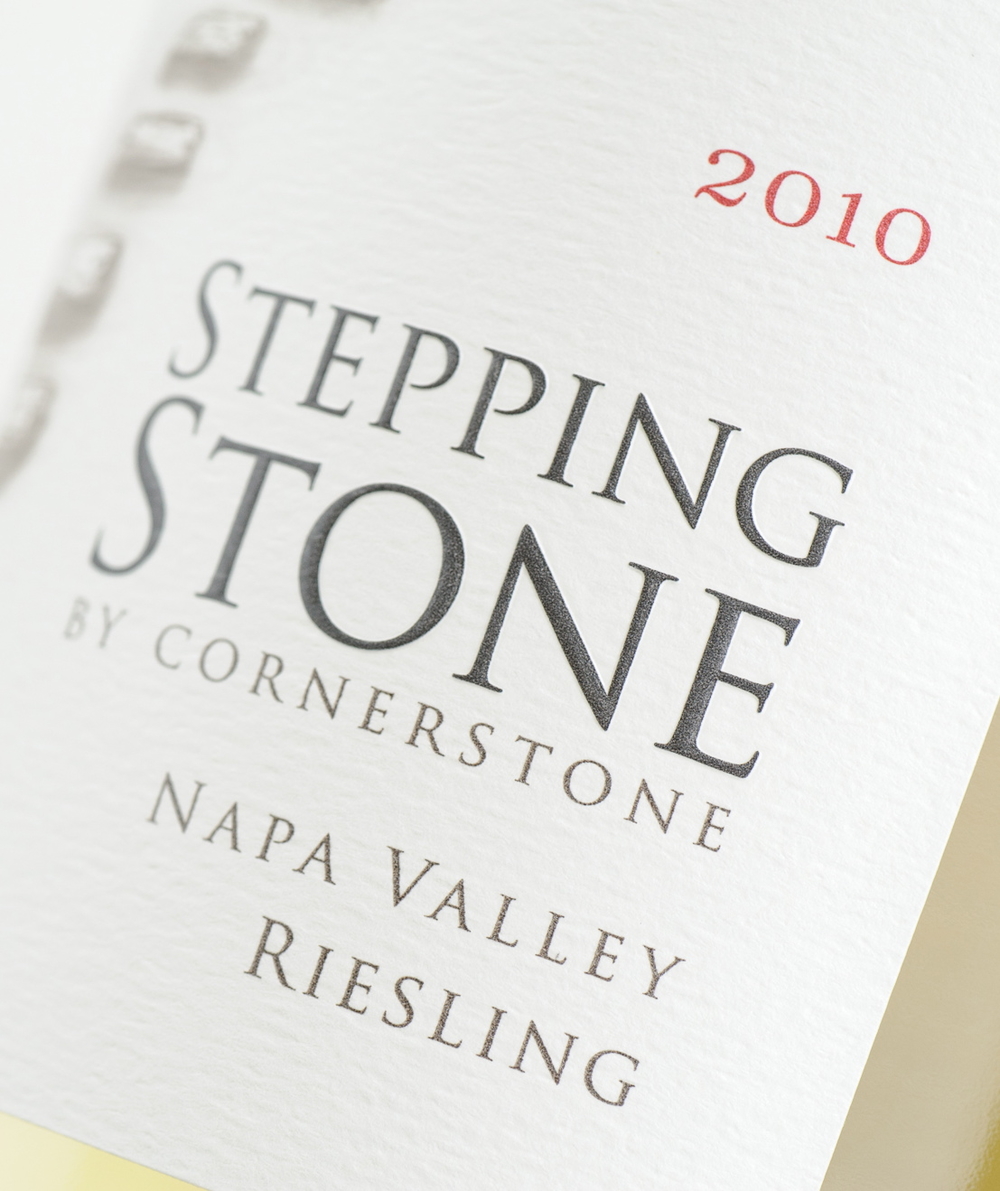
Perhaps this is part of the appeal of winemaking. The ability to be working in the past, present and future all at the same time is as enticing at the wines we make.
The seasonal cycles set our bottling season. Just after winter pruning it’s time to bottle the whites and rosé and ,as bud break flows into flowering, its time to bottle the red wines.
Our 2010 whites and rosé are already in the bottle and are just being released for sale this month. This includes the zesty Stepping Stone by Cornerstone Napa Valley Sauvignon Blanc, Cuveé Musque and the dry, intensely aromatic Stepping Stone by Cornerstone Corallina Napa Valley Syrah Rosé. New for us, and a wine we’re very excited about, is our Stepping Stone by Cornerstone Napa Valley Riesling. Our Riesling is dry as a bone with incredible floral and mineral aromatics and flavors.
Next into the bottle will be our 2009 Stepping Stone red wines: Syrah, Cabernet Franc and Cabernet Sauvignon, but you’ll have to wait at least six months to taste those when they’re released this fall. For more immediate gratification we have something new for you: Stepping Stone by Cornerstone Rocks!. We have a red Rocks! and a white Rocks!, each are blends of different varieties that will change from year-to-year depending on what inspires us. The defining terms will be delicious and fun. The Rocks! wines are house wines for Cornerstone lovers.
In July, as the grapes are ripening in the warm Napa Valley sun, we will bottle our 2009 reserve selections: Cornerstone Cellars Napa Valley Cabernet Sauvignon, Cornerstone Cellars Howell Mountain Cabernet Sauvignon and our new benchmark wine, The Cornerstone, a blend of cabernet sauvignon, cabernet franc and merlot, crafted to be a Napa Valley classic. Only 100 cases will be produced and it will be released in 2012 after a year of bottle aging.
There is another time element to this year’s vintage which ties us to an even older vintage, 1991, our inaugural vintage. As we approach our 20th harvest it is thrilling for us to be releasing innovative wine full of personality and the individuality that has always made Cornerstone one of the Napa Valley’s most dynamic wineries.
Starting next week we’ll be pouring our 2010 Stepping Stone whites and rosé in our Yountville tasting room. Please join us for some tastes of the past, the present and some hints of what the future holds: our wine time machine.