Vineyard Venom
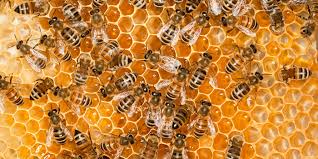
When I first arrived at Troon Vineyard, the then vineyard manager reviewed the previous year’s vineyard applications. Other than the usual nastiness like Roundup, one product immediately grabbed my eye - Venom. I was not familiar with this product, but, with a name like Venom, I did not expect anything good.
A trip to the manufacture’s website confirmed my worst fears. Venom proved just as nasty as it sounded, “This compound is toxic to honey bees. The persistence of residues and potential residual toxicity of dinotefuran in nectar and pollen suggest the possibility of chronic risk to honey bee larvae and the eventual instability of the hive.” for the complete manufacturer information sheet click here
That’s right, it kills honey bees. All of them.
There was no more Venom or anything like that used at Troon from then on. Today, now that we have converted to biodynamic agriculture, we use products with much gentler names and impacts on the environment. For example, now we use products with names like Regalia, an organically certified biofungicide that works by strengthening the plants own defenses rather than poisoning anything and everything whether good or bad. It does not seem to be a coincidence that conventional chemical agricultural products often have scary names as, indeed, they are dangerous to everything - people as well as bees.
Products like Regalia not only sound less threatening but are less dangerous in the long-term as conventional chemicals tend to create fungicide-resistant strains that then require even more powerful chemical applications to combat them. Organic products like Regalia are based on bacteria that are already in the environment, which trigger the plant's natural defense system. In other words, we are only encouraging the plant to does what it does naturally
“When treated with Regalia, a plant’s natural defense systems are activated to protect against attacking diseases. Research shows that plants treated with Regalia produce and accumulate elevated levels of specialized proteins and other compounds known to inhibit fungal and bacterial diseases. Regalia induces a plant to produce phytoalexins, cell strengtheners, antioxidants, phenolics and PR proteins, which are all known inhibitors of plant pathogens. Regalia provides synergistic properties between a plant’s natural ability to protect itself and the effectiveness of antifungal and antibacterial protection.“ Marrone Bio-Innovations
Humans consider themselves smarter than plants, but we’re not. When it comes to producing grapes, the vine understands more about producing beautiful ripe grapes than we’ll ever know. It is arrogant on our part to believe we can do better. That arrogance has led to the use of chemicals that destroy the vines natural ability to feed and defend itself and to weaker plants addicted to fertilizers and chemicals. A weak plant does not produce the kinds of grapes that produce great wines. The single most important thing for quality wine is a strong, healthy grapevine. Our job as winegrowers is to help the vine do its work, not to do its work for it. When it comes to growing grapes, we are the apprentice and the vine is the master craftsman. This is a good thing to remember in this era of cult wines and winemakers. It is the vine and the soil that create memorable wines, not people. People are quite capable of producing commercially successful beverage wine products, but only vines and vineyards can give you sublime, individual wines. In a well-farmed vineyard with healthy vines and good soils, the winemaker's role is more as a shepherd than artist or technician. If you are not humbled by nature you are not connected to it, don’t understand it and can’t transform that power into wines that are anything other than industrial.
Biodynamics finally clicks in your brain when you realize as a farmer you are not a general in charge of a battlefield, but just another cog in the gear that makes nature work. Arrogance and chemical interventions have led to disaster. Farmers who realize their place in nature produce better and healthier foods and wines. This is a mindset that can be achieved by farmers large and small.
Now at Troon, instead of destroying honey bees we are building three aviaries with accompanying pollinator habitats. The bees deserve this respect as we are just two of the myriad of intertwined pieces that make a farm a whole. We owe them something for the past sins of our predecessors. It will be an honor to welcome them back home.
Turn, Turn, Turn

January at Troon in Oregon's Applegate Valley
For everything, there is a season. There is a flow to the year that is defined by what is being harvested. Moments defined by what we eat and drink. As these seasonal treats start arriving at the farmers market, they mark your place in the year. Peas and asparagus in spring, summer brings peaches and tomatoes, fall brings squash and, for those of us who make wine, grapes. Each of them gives you a sense of time and place.
The wines I drink dance across the calendar along with the foods I find at the market. Cold weather brings stews, risotto, pasta, root vegetables and bolder wines - Barolo, St. Joseph, Bandol, and Tannat appear on my table. The arrival of summer brings vegetables and simple grills into staring roles and white wines - vermentino, roussanne, Sancerre, Muscadet, Soave along with wines of wildly varying shades of pink often become my wines of choice. For reds, pinot noir, Valpolicella, grenache and, most of all, Beaujolais - all wines that love a light chill - bring perfect pleasure.
Things that grow react to the season and wine is no exception. Obviously, drinking a Barolo on a hot day in August is not the same sin as insisting on buying tomatoes in January. Yet, I think the full pleasures of a Barolo are more likely to show themselves with Osso Bucco on a crisp fall evening than with a caprese on a hot summer afternoon.
Wine is food, and it is more enjoyable when served in the same way. We are drawn to certain foods at different times of the year and should apply that same common sense to wines.
I’m always mystified when people tell me they don’t like white wine or they only like big reds - the wine world’s equivalent of picky eaters. To me wine is wine, and the color is decided by the food, the season and, of course, my mood. There is no arguing with taste, but I’ll argue those picky eaters and drinkers aren’t tasting at all. They’ve already made up their minds.
The more you pay attention to what you taste the more diversity of experience you crave. That terrifying question I’ve been asked many times, “If you could only drink one wine for the rest...” - is more nightmare than fantasy. The other question I’m often asked is, “what’s your favorite wine you make” or, perhaps even worse, “what’s the best wine you make” leave me speechless. They are questions without an answer.
Each wine we make at Troon has its moment, its meal, its season. What’s my favorite wine? The one in my glass.
Becoming One with Wine
The world feels somehow different today at Troon Vineyard. I guess you can’t reinvent a vineyard without reinventing yourself. Reinventing and reinvigorating people and a vineyard at the same time is about the simplest way I can explain our transition to biodynamic farming. Everything just feels more alive.
Over the last week what was all planning, items on a Trello board, started to become real. New equipment, new ways of thinking and a new spirit all converged at Troon Vineyard this week. The first step was just a simple piece of string

Twine ties in a block of our vermentino
After years of plastic ties in the vineyard, many of a particularly noxious green color, we have replaced them with hand-knotted pieces of twine. The contrast between the bilious green of the old ties and the warm, earth tones of the twine ties running down the rows tying the canes to the wires could not be more obvious or meaningful. A simple change that tells of significant changes to come, we are becoming entwined in nature.
A somewhat physically more prominent change was the arrival of our Clemens radius weeder or “weed knife”. While a big financial investment, an efficient tool to control weeds is necessary if you are going to forgo chemicals like the seemingly ever-present Roundup. Many may debate about the evils of glyphosate, and all too many sustainable certifications allow it, but common sense tells us that chemicals like these are just not part of nature’s plan. It’s hard to describe how well the Clemens does its job as it fluidly dances the blade around each vine almost in slow motion - we actually it is in slow motion as the tractor can only go two and a half miles an hour while doing this work.
Other new mechanical arrivals include the Clemens multi-clean undervine brush, which, as the name implies, literally whisks away suckers and weeds around the base of the vine. Then there is a tank-like Domries disc and a Domries tri-till cultivator. We now have the tools to do the job right.

Creating a vortex while stirring BD 500
Then there was the really good shit, literally, which arrived this week. Now living in Southern Oregon, that phrase tends to refer to other local agricultural products, in our case, it was actually shit. This was the famed BD 500, the cow manure aged in buried cow horns. For this first application we had to purchase some finished BD 500, but by next spring we’ll have buried and fermented our own. The finished preparation does not remind of the original state or aromatics of the raw materials as it looks and smells more like very rich potting soil. To prepare 500 for application requires stirring it a very particular way. Troon winemaker Steve Hall selected one of our oldest barrels (for the history of place it had experienced) then after adding the 500 to around forty gallons of water we begin the stirring process. Steve and I alternated during the hour long process. First you stir in one direction until you build a deep vortex then suddenly reverse direction going violently from order to disorder. You repeat this process over-and-over for the full hour. This was a uniquely satisfying experience as you bond with the preparation that will become one with your soil. A very different experience than wearing haz-mat gear demanded by standard vineyard applications. Once prepared we poured the BD 500 into the sprayer and as the week came to a close our entire property had received this application.
Just knowing that the first biodynamic preparation is in our soils gives me both a sense of peace and accomplishment. We are on an entirely new voyage with a new mission. Just as the vines are reborn each spring, this spring Troon Vineyard is reborn along with them. Soon the buds will break into a whole new world of winegrowing.
Biodynamics will reinvigorate our soils and our vines, but it is also reinvigorating us. It is those combined energies that will be expressed in our wines. Wines full of energy are exciting wines and we could not be more excited about making them. Our desire to make special wines from what we know is a vineyard, a terroir, with exceptional potential is what started us on this voyage to begin with.
We are at the starting line of a long struggle to achieve our goals. Now that we have taken our first steps we feel like a sprinter whose energy has just been released by the starting gun.
The vines, the soil, the place, the wines and the people are all becoming one.

Alberto spraying BD 500 in a block of zinfandel
Natural Selection

Perfectly ripe vermentino at Troon Vineyard
Vintages come and go and with each passing harvest your focus slowly edges away from tanks, barrels and technique to dirt and climate. For wines of character and individuality, it all comes down to the vineyard, all the rest is background noise. In the cellar, it is your job to get out of the way. Actually not out of the way, that’s too simplistic. An artisan winemaker’s job is to know what to do, when to do it and to do nothing more than is necessary - minimalist winemaking is the term I prefer over “natural”. In industrial winemaking, intervention is the rule not the exception, which is the correct strategy if your goal is to produce commercially reliable wines that taste the same year-after-year.
There is little we know for sure in winemaking, but one thing I do know for sure is that if you don’t have the right dirt in the right place and the right vines in that dirt, you might be able to make good wines, but you’ll never make compelling memorable wines.
It is very simple. If you want to make exceptional wine you have to have the right grapes in the right place farmed by the right people. The right people is easy, it’s you if you have the passion, resources and discipline to do the work in the vineyard. The variety and place are much more complicated matters.
While visiting the east coast a few years ago, wondering about what it was like to grow grapes in such humid conditions, I asked a viticulturist how often he sprayed his vineyard. His response was every week - almost up to harvest. Another time I was talking to a grower from a famous west coast AVA who was farming “organically”. Asked about his spray program, he revealed that they were applying forty pounds of sulfur per acre every year. I was equally shocked in both cases because extreme measures had to be taken to grow grapes wine grapes on their sites. (Obviously calling that vineyard “organic” is a stretch of the imagination.) The vineyard on the east coast suffered from a climate unfavorable to wine grapes. The west coast vineyard was in an ideal climate, but either that individual site was less than ideal or the variety they had determined to grow in it was wrong for the site - or both.
The range of soils that can grow great wines has proven to be much broader than once thought. For example, you have pinot noir grown on high pH, alkaline soils in Burgundy, while Oregon’s Willamette Valley is dominated by low pH, acidic soils. Yet in blind tasting after blind tasting skilled, experienced wine tasters are fooled and confuse the wines of Burgundy and the Willamette Valley. However, the climate is much less forgiving than the soil - assuming healthy soils. Selecting the wrong variety for the site is almost as bad. Try to grow cabernet franc on too cool of a site and you’ll end up with pyrazine tea. Grow pinot noir in too hot of a site and you end up with a very expensive version of MD 20/20. Differences, I assure you, even amateur tasters can spot. You have to have the right variety in the right climate, the right terroir to make exceptional, memorable wines vintage after vintage.
I am always confused by terroir deniers. Any farmer knows terroir exists no matter if they are growing wine grapes, apples, asparagus or tomatoes. One major difference between wine grape farmers and other farmers is that winegrowers will insist on growing a crop that is not economically viable in their growing conditions. Or, worse yet, will insist on overcoming nature and selling wine produced from chemically abused vineyards using every winemaking trick in the book to produce commercially and critically acceptable wines.
The surest way to know if you’ve got the right vine in the right place is that the vineyard can be farmed year-after-year using ultra low-input agriculture. If you have to blast your vineyard with chemicals every week just to stop the grapes from rotting with mold before you can pick them perhaps you should rethink your choice of crops. Just because you can grow wine grapes does not mean you should.
If each year you are in a battle with Mother Nature, you will eventually lose the war.
A First, Deeper Look at Dirt

An electromagnetic soil scan of Troon Vineyard
We received our first, very preliminary, electromagnetic soil scans this week. At this point, the main use of these scans will be to determine where to dig the many, up to 80, five feet deep trenches that will we will be digging in April for analysis by Dr. Paul Anamosa of Vineyard Soil Technologies. This information will guide us as we move forward in selecting varieties for new plantings and areas for grafting. It will also provide invaluable data for rootstock selection in our new plantings.
One very fascinating point to me at this stage is that you can see denser soil patterns in long lines that coincide with vineyard rows. These certainly come from years of tractor compaction and we will be working to open up those soils as we move forward with biodynamics.
Electromagnetic Soil Scanner
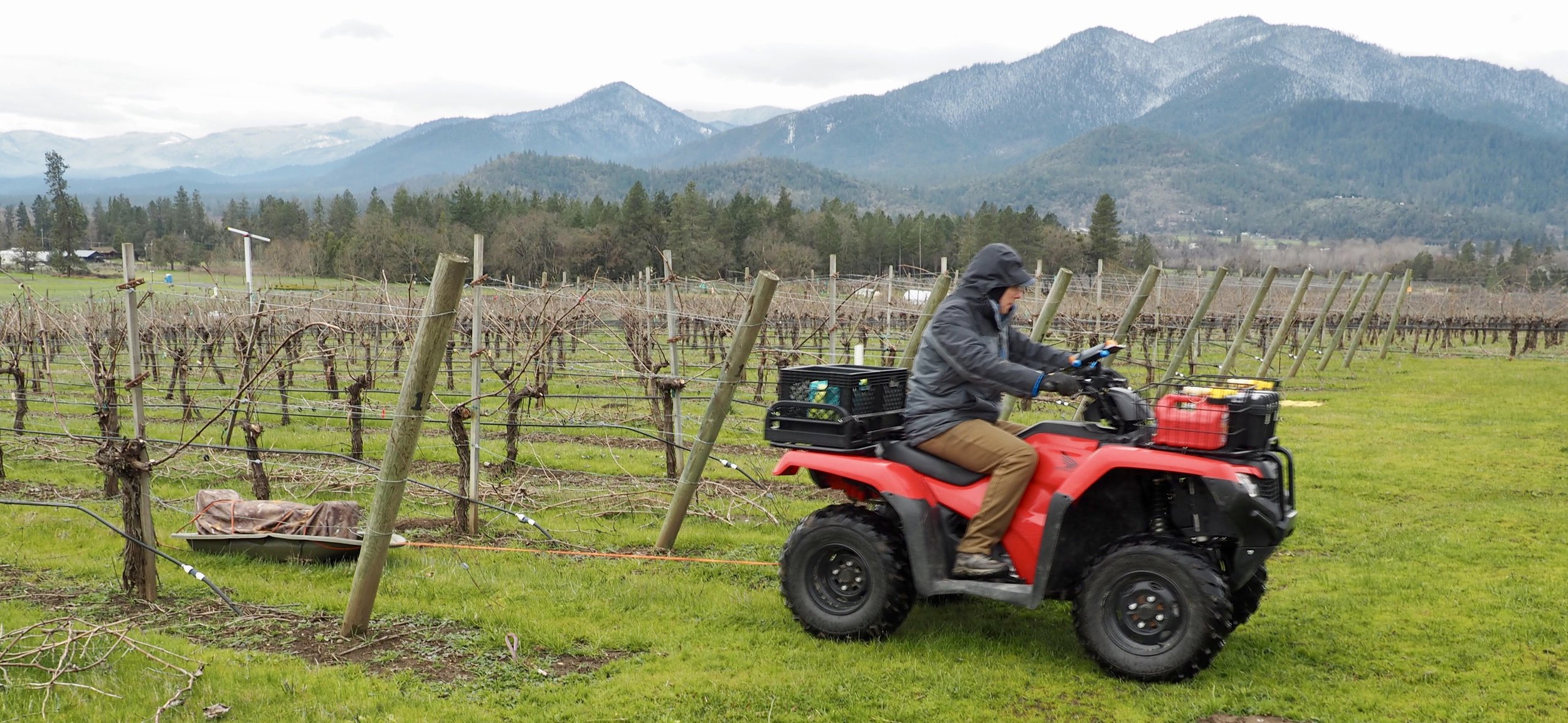
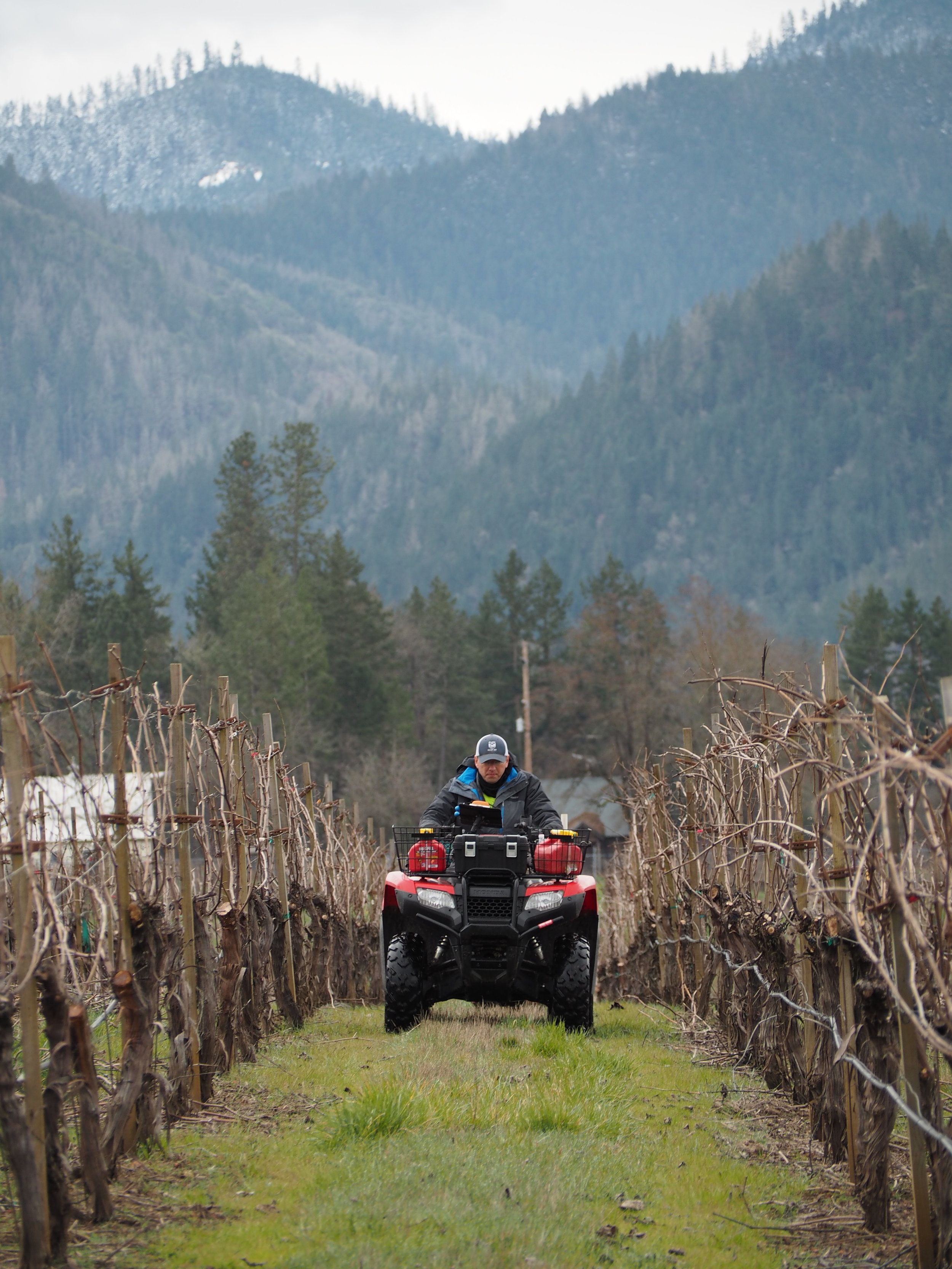
Our soil studies at Troon Vineyard started today with Nick Madden here for the day to do a complete electromagnetic soil scan of our vineyard blocks. We've retained Dr. Paul Anamosa and company to do a complete analysis of our vineyard blocks. Armed with this scan data we will be selecting locations for about eighty 5 feet deep pits to fully map our soil types. This data will help us select the proper varieties as we add new vineyard blocks and replant old ones. The scanner is on the sled behind the ATV. Here is some information on exactly what Nick is doing https://d.pr/dtaYMK
”Electromagnetic induction (EMI) has been used to characterize the spatial variability of soil properties since the late 1970s. Initially used to assess soil salinity, the use of EMI in soil studies has expanded to include: mapping soil types; characterizing soil water content and flow patterns; assessing variations in soil texture, compaction, or- ganic matter content, and pH; and determining the depth to subsurface horizons, stratigraphic layers or bedrock, among other uses. In all cases the soil property being investigated must influence soil apparent electrical conduc- tivity (ECa) either directly or indirectly for EMI techniques to be effective. An increasing number and diversity of EMI sensors have been developed in response to users' needs and the availability of allied technologies, which have greatly improved the functionality of these tools. EMI investigations provide several benefits for soil studies. The large amount of georeferenced data that can be rapidly and inexpensively collected with EMI provides more complete characterization of the spatial variations in soil properties than traditional sampling techniques. In addition, compared to traditional soil survey methods, EMI can more effectively characterize diffuse soil bound- aries and identify areas of dissimilar soils within mapped soil units, giving soil scientists greater confidence when collecting spatial soil information. EMI techniques do have limitations; results are site-specific and can vary depending on the complex interactions among multiple and variable soil properties. Despite this, EMI techniques are increasingly being used to investigate the spatial variability of soil properties at field and landscape scales.”
Get Set, Go!

Biodynamic consultant Andrew Beedy and Troon winemaker Steve Hall on the spot selected for our compost program.
This is the spot that will become the most important place of the vineyard. We’ve chosen the spot for the compost piles.
There is a day that dreams, plans and goals become a reality. On your mark, get set, go! As we crossed the starting line this week, we were firmly aware that we were starting a marathon, not a dash. This week we took our first steps to converting Troon Vineyard to organic and biodynamic agriculture. We have our eye on 2020 to achieve our first organic and biodynamic certification, but that will not be the finish line. In agriculture, there is no finish line.
We had already taken some steps forward as we had received our L.I.V.E. and Salmon Safe sustainable certifications, but we have now committed to biodynamics as our vision for the future of Troon. Our first big step was to secure the services of Andrew Beedy ([https://www.andrewbeedy.com]). Andrew's speciality is designing a complete plan that looks at your property as a whole, not just as a vineyard. Andrew has spent his entire life immersed in biodynamics as he was born on a biodynamic dairy farm in Pennsylvania. He attended a Steiner elementary school that was attached to a biodynamic farm. As a teenager, he worked on an organic farm in England. After university, he moved to California, where he worked with his mentor, the famed biodynamic consultant Alan York, who also was the biodynamic consultant for our neighbor, Cowhorn Winery, here in the Applegate Valley. Today, Andrew’s clients span the entire nation coast-to-coast.
After walking for hours with Andrew through our vineyards and our entire farm property, you can feel your perceptions began to change as you start to look at your farm as a whole rather than as simple blocks of vineyards. This extends beyond our property lines as you understand that the Applegate Valley itself is included in a whole farm, holistic plan for farming.
With conventional agriculture you identify problems and then apply various applications. Many, many of these applications are nasty indeed. While they may solve one problem, the collateral damage they cause slowly, but surely kills your soils. Soil is the plant’s foundation, and dead soils cannot produce great wines. When you farm biodynamically you eschew these chemicals, which means you have to deal with the threats to your plants before they appear. In other words, biodynamics is all about prevention. A healthy plant can better resist diseases and pests than one living in dead soils relying on chemical fixes to deal with each and every problem.
Our new compost piles will be the heart and soul of the vineyard as this is how we will be bringing our soils back to life. One way I like to explain biodynamics is that it is organic agriculture with probiotics. It is the bacteria and fungi surrounding a plants roots that allow it to take nutrition from the soil. Conventional agriculture destroys this natural system. The power of biodynamics is that it brings the microbiome of your farm back to life, which brings your soils and plants back to life.
I will be chronicling the process of bringing Troon’s soils back to life here on this blog. Over the next weeks, we are evaluating our soils and the microbiome of our vineyards, and we will be carefully monitoring and documenting the changes in our soils and vines as we practice biodynamic farming over the next years. It is a story I am very excited to be sharing. It is a process that will change our farm, our vines, our wines and us.
It will be a steep learning curve. Could anything be more exciting?
Here is a link to the Demeter Biodynamic Farm Standard for certification.
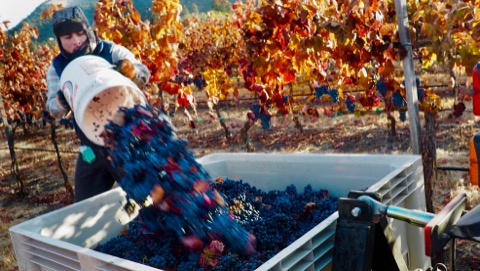
Courage of Our Convictions
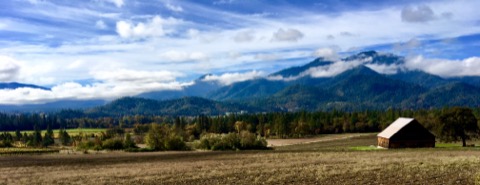
The Applegate Valley in Southern Oregon
A winemaker in Bordeaux has a universe of five. In Burgundy a winemaker has one, maybe two varieties that demand their focus. In Beaujolais they live by gamay. In Barolo nebbiolo defines the reputation of a winemaker. In Napa, if you make great cabernet sauvignon no one will much notice what else you do.
In the established wine regions of the world, a winemaker’s universe of options is preordained. In no way does this diminish their skills and accomplishments, but it does allow them to focus. To be able to focus is to be efficient and efficiency leads to consistency, which is an essential aspect of mass market success. Yet market success does not often fire the imagination or inspire innovation.
They say the pioneers take all the arrows. Welcome to the world of winemaking in one of the world’s emerging fine wine regions. I’m in the Applegate Valley of Southern Oregon, but I believe that winemakers in emerging regions around the world get hit by the same arrows. Winemaking in an emerging wine region requires the courage of your convictions. Planting a new vineyard in a new region is a true leap of faith, but as they say, the greater the risk the greater the reward.
But we don’t work in a vacuum. Years of knowledge and science have accumulated from the work of winemakers and viticulturists before us so we don’t have to push blindly forward. There are pioneers in every new region that took a lot of the arrows for all of us. Admittedly, many of these people that first planted vineyards in new regions were learning only by trial and error, but from their failures and successes, we can build a foundation for an exciting new wine region.
One such exciting new region is on the Kubli Bench of the Applegate Valley. Applegate Valley is not new as it was established as an AVA in 2000, but there is a growing energy here and we are on the tipping point. The Applegate Valley is now on the edge of breaking out. The varieties that will fuel that breakout are coming from the shores of the Mediterranean and the rugged hills of Southwest France, not from Bordeaux, Burgundy or Napa. The Rhône will have a voice, but the future of the Kubli Bench will be in the tradition of Bandol, Languedoc-Roussillon, Cahors and Madiran. These regions are now, after centuries of winemaking, escaping the shadows of their famous French cousins because of an exciting revolution in winemaking and winegrowing in those regions. We will be joining them in this winemaking revolution.
We are now making plans to either graft or replant many sections of our existing vineyards with the varieties that belong here. We’ll be planting more tannat, malbec, marsanne, roussanne and mourvèdre for sure (we already have significant acreage of syrah and vermentino), but varieties like picpoul, petit manseng, carignan, grenache (red and white) and cinsault will also find a home on the Kubli Bench. Because of everything that we’ve learned and the excellent quality of the wines we’ve already made I do not feel planting varieties like these is a leap of faith. We have the courage of our convictions.
I like making wines that people drink rather than collect. Wines that are delicious, richly flavored, and affordable that bring pleasure to people lives are as rewarding to make as they are to drink. There is no bottle more exciting than the wine that is open on your table. The Applegate Valley is a perfect place to make these kinds of wines.
I have to admit. Making wines like this is fun.
Loving Grana Padano

You're at the store with two pieces of cheese in your hand. They are equal in size. They are the same price. One is Grana Padano the other is Parmigiano Reggiano.
You'd buy the Parmigiano right? The king of cheeses, why not go for the best? But think for a second. These two pieces of cheese are the same price. That means you're probably getting top-of-the-line Grana Padano, while the Parmigiano is almost certainly mass produced and on the lower end of the Parmigiano spectrum. Do you want to pay for the name or the cheese?
You're at the store with two bottles of wine in your hand. They are equal in size. They are the same price. One is cabernet sauvignon the other is syrah.
You'd buy the cabernet right? The king of wines, why not go for the best? But think for a second. These two bottles of wine are the same price. That means you're probably getting top-of-the-line syrah, while the cabernet is almost certainly mass produced and on the lower end of the cabernet spectrum. Do you want to pay for the name or the wine?
Grana Padano and Parmigiano Reggiano are the same type of cheese. While at its pinnacle many connoisseurs consider Parmigiano the ultimate expression of this style of cheese, there are many passionate producers and consumers of Grana Padano that would take exception with their position.
One thing I've learned is that dollar-for-dollar you get better value for Grana than you do with the more famous Parmigiano. Often it's a far better choice to buy the most expensive product with a less famous name than the lowest price product with a more exalted name.
I apply the same strategy to buying wine. If I have $30 to spend cabernet sauvignon, pinot noir and chardonnay don't even enter my mind. My thoughts go to gamay, syrah, tempranillo, aglianico, vermentino, chenin blanc and on and on. Today it seems the choices are limitless.
Like the Reggiano cheese place name, many wine appellations get bonus points for name recognition that spot them extra dollars on each bottle over their competitors. When you buy wine from a famous place name you pay a premium for that privilege. Is it worth it? Sometimes yes. There are experiences you can get from Bordeaux, Burgundy, Barolo and Napa that are truly sublime. But with the $30 I want to spend, sublime will not be found in those appellations. You can find extraordinary wine experiences on a budget if you're willing to go beyond these famous place-names. Think El Dorado, Mendocino, Rogue, Sablet, Madiran, Languedoc, Corsica, Sardegna, our own Applegate Valley and, as with the varieties, the options go on and on.
Never in the history of wine has it been easier to drink great wines without spending a fortune. Next time you're in a wine shop hold that bottle of cabernet in one hand and a different wine from a place or variety you don't know in the other and ask yourself what you want to pay for - the name or the wine?
Table to Farm

Picking Vermentino at Troon Vineyard in the Applegate Valley
It's an iconic episode of Portlandia. Appearing in the very first season, it's a skit that even those that have not seen the show know. When you enter a search for Portlandia Chic... Google auto-fills the link before you even can finish typing. It's the Portlandia chicken episode. A couple in a Portland restaurant become so obsessed with determining just how local the chicken is that they actually leave the restaurant without eating to go to the farm itself.
Like most things in Portlandia, as outrageous the skits are, anyone who knows the city understands that there is a bit of reality in each of them. Indeed there are few cities where the restaurants are more obsessed with farm-to-table provenance. And with good reason, the farmers, dairies, fishermen of the Northwest provide exceptional foodstuffs. It's very hard to understand why so many of the best chefs in Portland know every farmer they work with by name - except the farmers that grow wine grapes.
In Portland restaurants that would not consider buying an egg from more than a hundred miles away, or use a cheese not from the Northwest, or pork not from Carlton Farms, it’s common to find wine lists dominated by wines from Europe. While working dead center between two world-class wine regions in Oregon and Washington they somehow rationalize buying wines that have to be shipped in containers across the ocean instead of the internationally respected wines made in their own backyard. Not too long ago I walked into a Portland oyster bar to do some serious slurping only to discover that not a single wine-by-the-glass was from the Northwest. The essentially French list was well chosen, but considering they only featured Northwest oysters maybe a local wine or two might have been in order. Perhaps I'm overly sensitive, but I'd think anyone can see the irony here. However, I am sensitive to their pain. It can take a lot of work to find interesting American wines in the wine-by-the-glass price range. But isn’t that the work that a sommelier is paid to do?
We're not talking about restaurants in Arkansas or Alaska with no significant local wine industry to draw upon, but a city within a few hours driving distance of important, world-famous wine appellations like the Eola and Dundee Hills, Yamhill-Carlton, Walla Walla and Red Mountain. These are not some upstart appellations, but vineyards that have been researched and worked for decades. These AVAs and many others literally produce wine in any style from almost any variety you could want. - also in any price point.
Incredible as it may seem, I constantly meet wine buyers in Portland who've never gotten their shoes dirty in a local vineyard. People that pour over books breaking down every minuscule detail of tiny appellations in Burgundy or Barolo ignore the vineyards that surround them. While most have understandably never been to France or Italy, it is hard to comprehend why they’ve not been to the Dundee Hills or Walla Walla. One thing for sure, you never truly understand a wine region until you’ve walked in its vineyards.
You're either a farm-to-table restaurant or you're not. It’s time they got off their butts and buy local wine as well as local food. You want biodynamic we've got it, want commercial plonk, we've got it, these and everything in-between. Cheap, expensive, rare, widely available, no problem we've got them. Popular varieties, obscure varieties, we've got them. High alcohol, low alcohol, no problem we've got them. Literally, no matter what you want in wine you can find it in the Northwest. What is their excuse? I have no problem with European wines just don't pretend to be a farm-to-table restaurant if they dominate your wine list.
Italian and French restaurants feel they need to sell wines from those countries, but little or none of the products they use to cook come from Europe - they come from here and for good reason. I understand that if you’re an Italian restaurant you feel the need to have a decent Italian wine list as part of your motif. After it all it makes you seem more authentically Italian. Yet the very essence of the best Italian cooking is based on quality local ingredients. In a country not much larger than Oregon itself, cuisine changes dramatically with a drive of a few hundred miles. When dining in Piemonte the wine selection from Toscana is going to be pathetic at best - and vice versa when you’re having dinner in Siena. No matter if you’re a French, Italian or Spanish restaurant in the Northwest, there is a wide range of local wines that will match perfectly with any dish that you are cooking - with your exclusively local farm-to-table ingredients. Wine comes from farms too.
I love farm-to-table restaurants, but I think it’s time for a table-to-farm movement for wine buyers in the Northwest. The chefs are out with the farmers and fishermen, but sommeliers need to get out with the winegrowers. The wines of the Northwest should be treated with the same respect on a wine list that local produce gets on the menu.
The closer the farm and vineyard are to my table the happier I am.
Big Wines, Small Names

An emerging American AVA - The Applegate Valley Oregon
For decades I’ve been enjoying wines from Cahors, Madiran, Sardegna, Corsica, the Languedoc, Provence, Puglia, Romagna, Sicilia, Marche, Campania, Calabria, Basilicata and on and on. Delicious wines crafted to bring pleasure to your life - to make it better. Now I’m making wine in the Applegate Valley of Southern Oregon and it feels good to be part of that club.
So many winemaking regions aspire to be Burgundy, Bordeaux, Champagne - and now Napa because that’s where the big money and points are, but, as famous and expensive as they are, they are not where the soul of wine is to be found. Just a few decades ago you were not likely to find the wines from Cahors and the other regions I mentioned above, and their many cousins, outside of the regions where they were produced, but today they’re almost everywhere. I'm aspiring to join them.
There are certain pleasures and freedoms in making wine in a no-name appellation from varieties never likely to become fighting varietals. First among those freedoms is the privilege of taking real risks that have the potential to make your wines better. First among those pleasures is being able to sell your wines at a moderate price - in making wines people can afford to drink.
When you have no star power there are no multi-million dollar auctions with celebrities, no obsessed collectors willing to pay (or actually hoping to pay) outrageous sums for the privilege to possess a few bottles. There are only people looking to enjoy your wines with friends and family. To pull a cork from a bottle of your wine with anything from a Wednesday night cheeseburger to a special birthday party with friends. There is no ceremony when your corks are pulled as everyone is just having too good of a time with each other.
There is something that really feels good about making wine for, well, people.
As pretentious and high-profile as expensive wine imbibing can be, most of the world’s wines are industrial plonk, nothing more than beverage alcohol. Our big wine stores are full of these wines. You go to a grocery store and there is row upon row of chardonnays (or cabernet or merlot or pinot noir), but in reality, they are all more-or-less the same wine. In fact, sometimes they literally are the same wine despite sporting different labels. The truth is in the world of wines the ones that offer the most pleasure, individuality and affordability are the bottles from places you may not have heard of, not from the names that are famous for being powerful brands or for being objects of desire for those with unlimited funds.
In-between the plonk and the pretense is real wine. I am not talking about cheap wine here. These are wines the sell from about $15 to about $50. They are expensive wines for the majority of wine drinkers and they have a right to expect something made with integrity and passion. These are unknown emotions in industrial wines and surprisingly rare in expensive ones. It’s not about funny labels or big points, it’s about bringing pleasure into people’s lives.
Now the Applegate Valley is not Madiran or Sardegna or places like that that have had decades, if not centuries, to understand their soils and varieties. These places know who they are and we are still learning. However, these older regions are now making far better wines than they did a few decades ago due to advances in viticulture and enology. We’re very lucky as they had to wait for generations to take advantage of this knowledge and we get to use it all right now. We can improve our wines more quickly as we stand on the shoulders of giants.
Why are we focused on varieties like vermentino, tannat and malbec? It’s simple. These are the right varieties for our soils and climate and they make better wines than easier to sell choices like pinot or cabernet. You have to make a choice. To me, it’s an easy one. If you want to bring real pleasure to peoples lives your wines have to have personalities as interesting as the people that drink them.
What makes a wine great? New oak, power, price, big bottles, wood cases and fame? Not anymore. Maybe thirty years ago there was a wide gap between a few famous place names and the rest of the wines produced, which were often no more than rustic country wines for locals. This is no longer true. The gap has not only closed, but today those once rustic country wines can actually surpass the old guard in quality.
It’s a new world of wine. I’m glad to be part of it. In-between the plonk and the pretense is real wine - real wine, real life, real pleasure.
Drink it up.
Troon, Tannat, Temptation

Troon Tannat and Malbec blocks looking west from the winery.
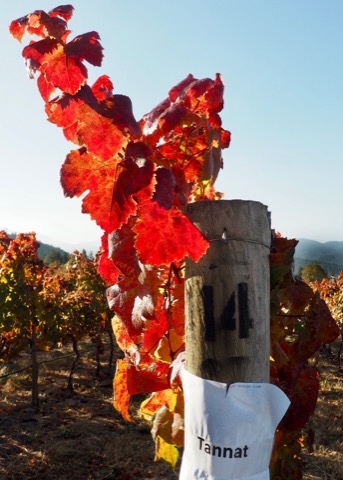
This is exciting. This is what wine growing should be about. We’re planting more Tannat - a temptation I can’t resist. Yes, Tannat, nothing could be more refreshing than being out of the “fighting varietal” business.
I believe Tannat is a variety that can define the Applegate Valley. Tannat in southern France is famed for its tannic rage, but our granitic soils take off just enough of that edge to reveal a distinctive Southern Oregon personality - all without taming its wilder side. All of our Tannat is grown on our estate vineyard on the higher, second bench of the Applegate River Valley.
Europe is full of regions like Madiran and Cahors, places Tannat has traditionally called home. Many appellations like these that almost died a few decades ago are now reborn and vital due to better winemaking and viticulture - and enlightened consumers. Happily the wine energy today seems to be shifting away from Bordeaux, Burgundy, Napa and so on to new regions and new varieties. As Leonard Cohen sang, “Hallelujah”. These wines are not new to me. In the early 80s I was introduced to the hedonistic pleasures of less than famous place names by Christopher Cannan in France and Spain and by Neil Empson in Italy. At Direct Import Wine Company in Chicago I aggressively imported wines from Madiran, Languedoc-Roussillon, Bandol, Le Marche, Puglia, Priorat and others. They were not easy to sell even at ridiculously low prices, but they were very easy to fall in love with. Of course, I was importing a small cadre of visionary, elite producers that were, in those days, leading the way for their appellations. Today there are many famed producers from these regions and most of the wines I first imported are now, rightfully, famous and not cheap.
Some of you may have tasted previous vintages of Tannat from Troon Vineyard, but those wines are related to these wines in name only. Starting with the 2014 vintage we moved to a natural wine growing and winemaking philosophy. Prior vintages were produced with conventional methods and it shows. These new Tannat releases are from grapes harvested from LIVE and Salmon Safe certified vineyards. The pickers are the same hands that worked in the rows for the entire vintage. Upon harvest the bins are treaded by foot for skin contact and to encourage the native yeast populations. After a day or two, they are de-stemmed into small fermenters for native yeast fermentation and hand punch downs. There are no acids, sugar, enzymes or sulfur added to the fermenters. After fermentation is complete the wine is pressed into used French Oak barrels. No new oak is used. The wines are bottled after 18 months in barrel.
The new releases:
2014 Troon Blue Label Estate Tannat, Applegate Valley $35
100% Tannat from our estate vineyard. This is unrestrained pure Applegate Valley Tannat. Deeply colored with intense dark fruit flavors and mouth-coating tannins, an in-your-face Oregon wine, yet it can seem restrained compared with many California wines. Despite the strength of this wine, I believe is not for long aging, but should be enjoyed over the next five years as it's better to revel in its youthful power rather than wait for a refinement that may or may not arrive. 169 cases produced.
2014 Troon Black Label MT, Applegate Valley $50
This is a co-ferment, not a blend, and that makes all the difference. Blending can enhance and lift the character of a wine, but a co-ferment creates a new wine all together. The unique chemistry of a co-ferment releases whole new ranges of flavors, aromas and textures that would never exist in a blend. We feel we've found the right balance with this vintage using 60% Tannat and 40% Malbec. The Malbec gives a round warmth that envelops the power of the Tannat to make a more complete and complex wine. The Tannat is from our estate vineyard and the malbec is from the Full Quiver Vineyard, which is contiguous with our estate. 240 cases produced.
As much as I like these wines, they are just a beginning point for us - a launching pad. These wines are delicious, but the upcoming vintages still in the cellar - 2015 and 2016 - have gained in complexity and depth as we learn more with each vintage. It’s a thrilling voyage.
Applegate Valley Harvest Dawn

Winter storms are starting to roll in off of the Pacific here in the Applegate Valley of Southern Oregon. In front are the zinfandel vineyards of Troon Vineyard, which were picked well before the rains arrived. Now all the fruit is harvested we more than welcome the rain.
