La Gramière on Tour
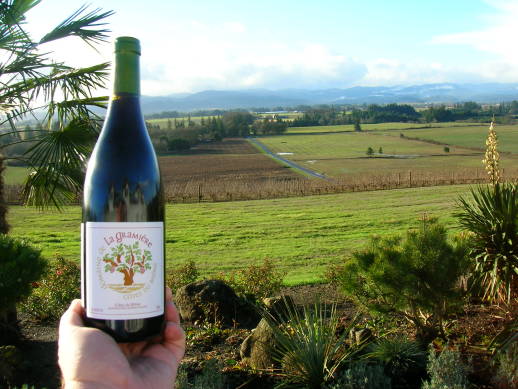
La Gramière Côtes du Rhône, the new wine from our favorite winemaker bloggers in the Rhône, Amy Lillard and Matt Kling, is on its inaugural world release tour. Pictured here, I show a bottle of La Gramière around Oregon’s Willamette Valley and our vineyards at Anne Amie. However much I want to try a bottle of their new wine, as it is unfined and unfiltered I will give it a month or so to adjust to its new surrounding here in Oregon. Natural wines like La Gramière, which are produced with as little intervention as possible, require patience on the part of the consumer as their natural harmony is disrupted by the stress of travel. Just like you are blasted by jet lag when you travel back-and-forth over long distances, natural wines need time and rest to show their best. When the time is right I will share my comments on their new wine. However, I will certainly not “review” it as this wine is a statement of passion shared with us by Amy and Matt and this is to be respected at all costs as something all to rare in winemaking today.
Welcome to Oregon La Gramière!
(you can welcome La Gramière to your house by calling importer Kermit Lynch at 510.524.1524 )
Road Warrior: Vietti on Tour
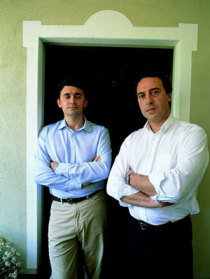
This Luca is none other than Luca Currado, renowned winemaker for the famed Azienda Agricola Vietti located in Castiglione Falletto in the heart of the Barolo region, Italy’s crown jewel of wine. The name of Vietti is one of this regions most important names as Luca’s father, Alfredo Currado (son-in-law of founder Mario Vietti) played an integral part of making Barolo what it is today as he was the first to bottle single vineyard wines and started the trend that made the white wine Arneis one of Piemonte’s most successful wines. Luca, along with brother-in-law Mario Cordero have taken their father’s success to even higher levels firmly establishing the Vietti label as one of the Langhe’s premier brands.
Luca looks tired for good reason. He has just finished an exhausting harvest and has immediately hit the road to promote his wines throughout the United States and then, after a day or two at home, he’s off to Moscow and St. Petersburg. This is just one of the three trips Luca makes to the USA every year. Yet, with this brutal schedule he is still able to treat every question from every consumer as important - no matter how many times he has heard it. Why is he doing this? The Vietti name is well established in all the world’s markets and they will easily sell the modest amount of wine they produce from their 70 acres of vines. Just watching Luca answers the question. He is on the road yet again because selling the wine is not enough. Luca wants people to understand what they are drinking and why it tastes the way it does. Luca pushes himself back on the road because he believes in their wines. The same passion he puts into growing the grapes and making the wines goes into selling the wines. He wants them to know why they like his wines.
Finally the “Barolo Wars” of the nineties are fading away as producers step back from the excesses of experimentation and emulation to combine the best knowledge of modern enology and viticulture with the distinctive methods and vineyards that made Barolo great to begin with. The Vietti wines are some of the best examples of this modern, yet more thoughtful and sensitive style. You cannot categorize the Vietti wines as either “modernist” nor “traditionalist” as they combine the best parts of both schools and don’t approach the excesses of the extreme modernists. Luca’s father Alfredo would probably not be pleased to see the barriques in their winery and these are not his fathers wines, but what they do have in common is dedication to excellence - something they both have achieved.
The following wines were tasted on Luca’s recent visits to Liner and Elsen Wine Merchants and Alba Osteria, both in Portland Oregon.
- Barbera d’Aba, Tre Vigne, 2004 - Brilliantly fresh and clean with deeply concentrated black raspberry fruit. Very lively and mouthwatering with a wonderfully zesty bittersweet finish. ($22)
- Barbera d’Alba, Scaronne 2004 - If there is a more complex barbera out there than Scaronne I’d be hard pressed to name it. A big wine, but not simply chunky big like Spinetta. Dramatic and intense while still maintaining that punchy barbera verve. Densely colored and expansive from start to the never-ending finish. Wait a few years for this one to grow up. ($43)
- Barbera d’Asti, La Crena, 2001 - Deep, earthy and brooding with almost a nebbiolo like firmness. A big (not heavy) wine that has no business with a pasta, but would be more at home with a big aged prime steak. Great complexity, with layers of earth and porcini over rich wild black cherry fruit.
- Nebbiolo Perbacco, 2004 - Bargain hunters pay attention. Here is real nebbiolo character for under 20 bucks. Fresh, bright fruit flavors soon give way to classic leather and dried rose characteristics that can only belong to nebbiolo. Forward by nebbiolo standards and more than drinkable now, I’d still age this another year or so to really squeeze all the complexity you can out of it. A great starting place if you’re new to Barolo and an everyday treat for hard core Barolo nuts. ($20)
- Barolo, Castiglione, 2000 - Brilliant , classic dark garnet color. Warm and floral on the nose with only sweet touches of tobacco and tar. Round and forward (by Barolo standards remember!) and already drinkable if matched with rich foods. One of the more focused wines you’ll taste from the warm 2000 vintage. The Castiglione selection is still only aged in the large traditional barrels, but exhibits some of the same rounded tannins many modern-style producers hope for. If you have not tasted a Barolo before this is an excellent introduction and a good buy. ($40)
- Barolo, Rocche, 1998 - A classical beauty with a brilliant translucent garnet color and aromas that won’t let your nose leave the glass. Lean and mean and fantastic - perfectly combining the unique intertwined dance of bitterness, bite, grace, delicacy, power and sweetness that makes for great Barolo. I would wait a few more years as someday this will blow you away. ($90)
- Barolo, Rocche, 1999 - If you have any chance to buy this wine do so because this is great Barolo. Take all the best parts of the 1998 and turn up the volume and you get this wonderful wine. Far more concentrated than the 98 it still retains the same balance and elegant structure. Nowhere near ready to drink, it’s still closed and brooding. Wait at least five more years and you’ll have a truly fine bottle of Barolo. ( $90)
- Barolo 2003 new single vineyard releases: Rocche, Brunate, and Lazzarito (all $116) - One sip of these baby blockbusters sends your palate into sensory overload. Huge and round, as you would expect from the burning hot 2003 vintage, Vietti has still put together a group of wines that retain balance - albeit a very rich, powerful balance. It is important to note that while these wines see barriques, they only age in small barrels for six months and spend the majority of their time in traditional large Slovenian oak casks before bottling. Certainly not yet ready to drink unless you happen to be serving well-aged wild boar tonight, with moderate aging - say about 8 years or so - these should be some excellent wines. In fact they’ll be just right for drinking while your still waiting for your 2001’s and 1999’s to grow up. The tannins in all of these wines are very substantial right now, but are really quite round, soft and integrated for Baroli this young. As you would expect, the Rocche is the most graceful and fresh of this trio, showing good structure and the wonderful bright floral character that this vineyard always seems to show. The Brunate is a huge mouthful of Barolo that expands and overwhelms the palate with its depth and richness. As usual, in spite of its girth, the Brunate is charming with an almost forward appeal. The Lazzarito will almost take the enamel off your teeth with its biting, powerful tannins and deep bittersweet fruit laden with tobacco and tar. Incredibly intense and powerful, this is a wine you should not go near for years to come as it has plenty of aging to do. I’d say eight years is the minimum for this high-strung monster. If you want drama this is your wine. My vote out of these three would go to the Rocche, but it’s too early to make that call. Tasting them together is a great look at the different characteristics of these vineyards.
(pictured above Luca Currado and Mario Cordero)
La Gramière! On The Water!
News from La Gramière:
“Colorado, Germany and California - here comes La Gramière! Yup! It’s a very busy time as far as shipments go. On October 2nd we shipped 60 cases to ColoradoPict0033_1 and then on the 6th, 50 to Germany. Our garage, where the wine is stored (in a temperature controlled setting, of course) only has river rock on the ground. At bottling we leveled the palates and then stacked the wine on case by case. This poses a problem when it comes to moving an entire palate though, no way to get a fork-lift in, or even a pallet mover. Hmmm. We built a platform for the pallet-mover to roll on and placed an empty pallet on the ground. Then we put a second empty pallet on top of the first, and subsequently re-stacked all 60 cases onto two pallets for the Colorado shipment. In Europe the standard wine box only contains 6 bottles. As you know, in the US, it’s 12 bottles. So for US customs we had to tape two boxes together in order to say that there were 12x750ml bottles equalling 9 liters of wine in each box. More fun with tape here at La Gramiere! Of course when the transporter arrived, he didn’t have a pallet-mover like he was supposed to, so we had to go borrow one from the village garden store. Luckily they could do without it for awhile! When we rolled it in and it wouldn’t fit under the slats! The pallets were too low! UGH! We finally got the first one out with a little prying and tugging, then the second one was much easier. Luckily the truck driver was super nice and more than happy to try every option in order to get them out! I won’t even go into the pick-up for Germany. It’s another funny story, but too long for this post!On Monday they are picking up 4 pallets, 200 US cases, or 2400 bottles, heading for Kermit Lynch’s store in Berkeley. Needless to say, we are spending the weekend working on our paletting techniques!”
la gramiere: Colorado, Germany and California - here comes La Gramière!
Everyone who has followed the lovely story of La Gramière on their blog should get their orders in now as their wine is on the way to the USA. I’m calling in my order for a case to San Francisco tomorrow!
Luca Currado on eRobertParker.com
One of my favorite people and winemakers Luca Currado of Vietti is a guest on eRobertParker.com. Check out his comments at the link below.
Mark Squires’ Bulletin Board on eRobertParker.com - Wine Guest: Luca Currado, Vietti
The Passing of Henri Jayer
“It is with deep regret that I inform the board members that Henri Jayer passed away last night after a long illness. Jayer was renowned and admired the world over for his lush, seductive, well-balanced and impeccably crafted burgundies and was arguably the most famous Burgundian winemaker ever. Just as importantly, he unquestionably has had the greatest impact and influence among today’s generation of Burgundian winemakers. He was a man of strong convictions about how wines should be made but the superb quality of his wines, even in difficult vintages, certainly provided persuasive evidence that his methods worked. And the auction market voted with its pocketbook as well, according Jayer wines enormous valuations, indeed on a consistent par with those of the Domaine de la Romanée-Conti.
I knew Jayer for years and also admired and respected his philosophies, work ethic and ultimately, the results he so consistently achieved. Hanky J, as he was affectionately referred to, will be missed. My heartfelt condolences go out to his family and admirers. “
Please click here for the growing and moving tribute thread on eRobertParker.com.
IPNC 06 #2: Out of the Shadow

Now things are turned around and the same thing that took Acacia to the top is now powering Bouchaine, which has finally taken its place on the “A” team of Carneros producers. What made the wines of Acacia compelling was the talent, intelligence and passion of winemaker Mike Richmond, who has now taken his considerable talents to Bouchaine.
Meanwhile the once revered Acacia winery has been turned into an industrial production line of plonk pinot by alcoholic beverage super-giant Diageo and now Acacia is involved in hand-to-hand combat with Sanford Winery and other corporate pinot noir producers to see who can sell the most boxes of indistinguishable pinot noir. If you are trying to decide between which of these labels to buy you should flip a coin or buy the cheapest because what’s in the bottle is of little consequence or interest.
At this year’s International Pinot Noir Celebration (IPNC), Mike Richmond presented his first Bouchaine Pinot Noir that he was responsible for from start to finish and a very nice wine it is. The 2004 Bouchaine Carneros Estate Pinot Noir is a lovely wine with a graceful balance and an intriguing subtle character. It certainly shows the richer characteristics of California, but is still restrained and complex with a lingering, not heavy finish.
The emergence of Bouchaine as a first class Carneros pinot noir producer reminds us that while great wines are made in the vineyard, you have to know what to do with those grapes when you get them. Mike Richmond obviously knows what to do and, perhaps more importantly when it comes to pinot noir - what not to do.
IPNC 06 #1: Crème de la Crème - Richard Sanford Rises Again

Though Richard may have lost his label, he retained control of some of his best vineyards and from those organically farmed vines come his new wines. Emphasizing both Richard’s commitment to quality and the environment, the entire production of Alma Rosa will be bottled under screw caps bearing the recycling arrows symbol that will be familiar to those who have purchased wines in Europe - you can even return the bottles to the winery for reuse.
At this year’s International Pinot Noir Celebration (IPNC) in Oregon, Richard previewed his two premiere releases under the Alma Rosa label and both give just what you would expect from him: excellence. These two fine pinot noirs, 2004 Santa Rita Hills (2645 cases) and 2004 La Encantada Vineyard (500 cases) are svelte beauties with great complexity and a restrained finesse all wrapped in a rich, but well balanced California package.
The once revered Sanford label will now be brought to you by the same folks that give you wines like Santa Margarita Pinot Grigio and Rutherford Hill Merlot and should be avoided by anyone seeking a wine that will generate brain waves as it passes across your palate. However, Bacchus be praised, the great pinot noir wines produced by the real Richard Sanford that have given us all such great pleasure over the decades can still be found - they’re just called Alma Rosa now.
To make the picture complete for all of you old Sanford wine aficionados, Chris Burroughs, the long-haired, cowboy-hat-wearing tasting room manager of the old Sanford Winery made famous by his appearance in Sideways has followed Richard and Thekla Sanford to Alma Rosa and will be pouring wines for guests in their new tasting room. So you’ll find all the heart and soul that made the Sanford Winery great at Alma Rosa, which means at the old Sanford Winery you’ll find…
la gramiere
The romantic pull of winemaking. You see it in the eyes of everyone who visits you at the vineyard. You hear it over elegant dinners and at wine tastings as people dream of having their own vineyard and winery. For most it only remains a dream, but a fateful few take the plunge. Two such lucky souls are Amy Lillard and Matt Kling who are living in Castillon du Gard in France’s Cotes du Rhone wine region tending 4.5 hectares of grenache, syrah and mourvedre and are now into their second vintage of winemaking. While few can personally experience such a life, thanks to the blogging of Amy you can at least live it vicariously. Check out their very entertaining (and sure to turn you green with envy) La Gramiere Blog at the address below. Just reading it alone is increasing my consumption of Cotes du Rhone wines and I hope someday to get a chance to taste theirs – at the winery, of course.
Visit La Gramiere at the link below:
Randall Grahm on Terroir
In one fell swoop of the word processor, Randall Grahm has defined the value of two controversial topics: terroir and biodynamic. In an entertaining and eloquent paper for the Terroir Conference at UC Davis, Grahm has clearly defined terroir, a concept that for some reason so many choose to deny.
Notes Grahm in his paper, “Terroir is a composite of many physical factors – soil structure and composition, topography, exposition, micro-climate as well as more intangible cultural factors. Matt Kramer once very poetically defined terroir as “somewhere-ness,” and this I think is the nub of the issue. I believe that “somewhereness” is absolutely linked to beauty, that beauty reposes in the particulars; we love and admire individuals in a way that we can never love classes of people or things. Beauty must relate to some sort of internal harmony; the harmony of a great terroir derives, I believe, from the exchange of information between the vine-plant and its milieu over generations. The plant and the soil have learned to speak each other’s language, and that is why a particularly great terroir wine seems to speak with so much elegance.”
Somewhere-ness is the essence of what makes wine intellectually and emotional simulating.
Continues Grahm, “A great terroir is the one that will elevate a particular site above that of its neighbors. It will ripen its grapes more completely more years out of ten than its neighbors; its wines will tend to be more balanced more of the time than its unfortunate contiguous confrères. But most of all, it will have a calling card, a quality of expressiveness, of distinctiveness that will provoke a sense of recognition in the consumer, whether or not the consumer has ever tasted the wine before.”
Expressiveness, distinctiveness: words that should be more compelling to wine lovers than opulent, rich or powerful.
On biodynamics Grahm writes, “biodynamics is perhaps the most straightforward path to the enhanced expression of terroir in one’s vineyard. Its express purpose is to wake up the vines to the energetic forces of the universe, but its true purpose is to wake up the biodynamicist himself or herself.”
Let’s repeat that again because its meaning is so significant, “its true purpose is to wake up the biodynamicist himself or herself.” In other words putting the winemaker in visceral contact with their vineyards. It is this connection that produces truly unique and characterful wines.
Anyone straining to understand these two concepts should read and re-read this very meaningful piece. Compliments to AppellationAmerica.com for getting Randall’s comments out to the public.

PEE'ing Pinot Noir

Winemaker Annette Hoff of Monterey’s Cima Colina is the author of a fine blog and offers some very insightful comments concerning the over manipulation of pinot noir and wines in general these days. In a recent post she comments:
“The way I see it, there are two different classifications of Pinot these days in the US: PCD’s (Pinot for Cab Drinkers) and PEE’s (excuse the acronym: Pinot for Everyone Else). I like Cabernet, and I have nothing against Cabernet drinkers, but what I don’t like is the concept of placing the same expectations one has of Cabernet (dark, rich, and, well, dark, rich) on a wine such as Pinot Noir and, as it turns out, the typical PCD’s are usually dark, rich and relatively non-varietal in character. If you like that, then go to it.”
That’s some great insight. For the complete story and to visit Annette’s Cima Collina blog, follow the link below:
Doing It In the Vineyard - Sottimano Barbaresco
If you ever need proof that great wines are made in the vineyard, not the cellar, all you have to do is visit the Sottimano family in the Neive commune of Barbaresco. Faced with a string of wildly different vintage growing conditions in 2001, 2002, 2003 and 2004, the Sottimanos have excelled in each one, not because of tricks in the cellar, but from sweat and toil in their vineyards. In particular, the last three of these vintages offered challenges that many winemakers were not up to facing.
The meager sunshine in 2002 made many producers give up and sell their wine off in bulk. Not the Sottimanos, who reduced yields down to one bunch per vine and the resulting wines were lovely and charming. These wines are highly recommended for those without the cellar or patience for aging wines ten years or more.
In 2003, the sun would not stop shining, turning the steep Langhe hill vineyards into ovens that shrivelled and burnt the grapes. Ever in touch with the environment, the Sottimanos kept their yields high and did not remove as many leaves as usual. While most other producers offer over-ripe, overly-alcoholic wines from the vintage, the Sottimano wines are refined and balanced with a forward elegance and alcohols under 14%. Once again, they found just the right amount of crop for the year.
In 2004 nature offered too much of a good thing and the vines went into high gear, producing as many grapes as possible. Most producers had to take huge saigneé percentages (taking juice out of the fermenters to increase concentration) if they did not want to make Barbaresco rosé. However, the Sottimanos did not take a drop of saigneé out of their tanks as they had once again aggressively reduced their yields. In fact, they went as far as cutting the bottom half off some of their bunches. Yet again, they will produce one of the best wines of the vintage.
Father and son, Rino and Andrea Sottimano are making great wines with their backs, not with technology. That these are naturally conceived wines show in their superb balance and character. Nature is not something you overwhelm, but a spirit you need to learn to live in harmony with. If you don’t, you will always lose the battle. The Sottimanos always seem to win.
The new releases 2003 Sottimano Barbaresco single vineyards:
Fausoni – Bright garnet with touches of ruby. Very clean and spiced with touches of burnt blood oranges, bitter licorice and sweet cherry. Very lean and firmly tannic at this point. Its medium weight does not make you think of the boiling hot 2003 vintage. The finish is dominated by tannin, but sweet tarry notes are starting to emerge.
Currá – Stylish and delicate in a powerful nebbiolo sort of way. Spicy aromas with hints of wild-flowers over bittersweet tar. Quite lean and tannic at this part, not showing any over-ripeness. Very refined, but still very closed. Firm tannins finish with just a touch of oak.
Cottá – Richer, more powerful showing a deep earthy nose layered with sweet tar and bitter cherry. A real powerhouse while keeping its balance. Again there is no sign of over-ripe fruit. A great classic nebbiolo throughout. A decade or more of aging is going to be well worth it. The finish is still very closed and brooding.
Pajoré – Brilliant light ruby with garnet touches. Bright clean dark fruit aromas blend with wild-flowers, lavender, spices and a tangy tarry highlight. Very refined and elegant, but don’t let that fool you as this wine should be aged for at least eight years before pulling the cork. A great combination of power and refinement. This nebbiolo just dances across the palate before delivering a tannic crack of the whip.
My previous notes on the Sottimano wines:
An Oregon Grand Cru
 Privé Vineyard, a small patch of pinot noir vines on Oregon’s Chehalem Mountains yields a scant 250 cases between its north and south parcels. The upper section dubbed Le Nord yields only 165 cases, while the lower Le Sud offers a meager 85. There can be no doubt that this vineyard is of “Grand Cru” stature. Privé Vineyard was created by Mark and Tina Hammond and few vines or wines receive more hands-on loving care. The results are wines of stunning balance and complexity.
As you might imagine, quality of this magnitude is no longer a secret and getting on the Hammond’s mailing list is just a bit harder than finding the Holy Grail. I can only tell you to get on the waiting list now for these wines are the real thing.
The current release of 2004 Privé Vineyard, Le Sud, Yamhill County Pinot Noir is simply breathtaking and I feel ashamed to have opened one of the few existing bottles before it attained its full potential. An almost perfect blend of power and restraint, the depth and range of flavors already offered makes one pause and contemplate again and again as you savor every sip.
My other two bottles will wait three or four more years, when I know I will be moved to write about this extraordinary wine again.
Denis Mortet
Denis Mortet, a winemaker of uncontrollable passion and dedication has decided to leave us. His impact on Gevery Chambertin will be felt for many, many years. Sometimes passion must be too much to bear.
A sad day for Burgundy and pinot noir lovers throughout the world.
There are some things for which words are truly inadequate.
Barbaresco Rabajà Giuseppe Cortese
The incline of the hill is steep and every speck of the grayish soil bakes in the hot sun. The entire slope is a wave of vines and the southwest/south exposure means not a leaf misses a moment of sunshine. This is the famed Rabajà vineyard located just outside of the town of Barbaresco. Certainly this vineyard was created to produce exceptional nebbiolo and a vineyard of similar potential in Burgundy would be considered a Grand Cru. However, there is no such official breakdown of vineyards in Langhe; just an informal acknowledgement among those in the trade as to what the great vineyards are - an acknowledgment clearly defined in the selling price of the wines, grapes and land.
The sun drenched calcareous and clay-heavy soils of Rabajà produces Barbaresco wines with a unique combination of power and elegance that makes them approachable in their youth, but rewards those who cellar their bottles with wines of great complexity and refinement.
From vines in the very heart of this special vineyard come the Barbaresco wines of Giuseppe Cortese, a small producer making a fine range of wines only from their own grapes. In addition to Barbaresco Rabajà, Cortese produces the excellent Barbera d’Alba Morassina and Dolcetto d’Alba Trifolera from a vineyard area just to the south of Rabajà. The wines of Cortese have been improving consistently for years and in recent vintages they have been releasing some very fine wines. Giuseppe Cortese, after decades working as an agronomist for other top producers, founded his own estate and now with the next generation - son and daughter Pier Carlo, an enologist, and Tiziana - they are making this estate a must for collectors of traditionally styled wines from the Barbaresco zone. While the fermentations have a slight modern touch, their Barbaresco does not see a small barrel, spending the years in large casks of 17 to 25 hectolitres ranging in age from new to nine year old. Only the Barbera Morassina sees barrique and with excellent results, once again showing the affinity of the high acid/low tannin barbera for small French oak barrels in controlled doses.
Barbaresco Rabajà, G. Cortese, 2001 ($45) Bright light ruby with orange and garnet hints. Quite translucent. Elegant, floral nose with rose petals and violets blended with a buttery tar. Full structure on the palate with layers of complex flavors: dried leaves, tar, orange spice, warm tar and ripe plum flavors all of which continue into the long finish that has a touch of cassis to balance the considerable tannin. A wine with excellent aging potential.
Milano in Marche
Ampelio Bucci seems to embody the elegance and style of Milan. Yet, he is making an impact in that most un-Milan of places, the rugged hills, mountains and coastlines of Le Marche. Since the 1700's the Bucci family has lorded over their estate in Le Marche, but despite the long family history, only under the current generation have their vineyards been raised to greatness. The aptly named Ampelio (coming from ampelos, ancient Greek for vine) has transformed this estate into one of Italy's most interesting white wine producers and a leading producer of Rosso Piceno.
The large property, almost 1,000 acres, not only produces fine wines, but sugar beets, corn, wheat, sunflowers and an extraordinary extra virgin olive oil from the ancient Carbonella olive. Since 2002 all the crops on the estate have been officially certified as organic by the EEU. Ampelio has taken extreme care in his vineyards, refusing to tear up old vines even though their production is severely reduced meaning his yields are less than half that allowed by the DOC. Old vines from extraordinary vineyards farmed with great care of course produce exceptional grapes and Ampelio is to be highly commended for choosing a winemaking approach that brings these essences from the vine to the bottle. No barriques, only large well-used barrels touch his wines. The resulting verdicchio wines literally sing with complexity, richness and fresh acidity. His efforts clearly show the potential of verdicchio from the right vineyards in the right hands and decidedly make the point that barriques and their resulting oak flavors add only confusion to the richly honeyed flavors of verdicchio.
While the labels are similar, wines labeled only Bucci are the regular cuvees (and lovely they are), while wines labeled Villa Bucci are reserve wines from the oldest vines and best vineyards.
As excellent as the red wines of this property are, it is their exceptional and age-worthy Verdicchio dei Castelli di Jesi Classico wines that make them stand out in the crowded world of wines. Their unique flavors, textures and complexity make delicious companions to the finest meals. They are among the world's finest white wines.
2000 Villa Bucci Riserva, Verdicchio dei Castelli di Jesi Classico Superiore ($35)
Bright light gold. Smooth crème brulee aromas open into toasted hazelnut, vanilla with touches of ripe oranges. Rich, yet firmly bitter on the palate. Creamy, nutty flavors blend with a lively touch of bitter orange and ripe mangos. The firm flavors dominate the full, but structured finish. An extremely balanced and complex wine that I recommend aging a few more years to allow all the components to grow and blend.
2002 Villa Bucci Rosso Piceno($35)
Bright light ruby, just translucent. An elegant, layered complex nose with touches of bitter and sweet plum, black cherry, blood oranges, spices and fresh mint. Exceptional balance and refinement on the palate as bitter cherry flavors dance with chocolate, sweet plums, spices and cranberries. The finish is long, and lively with each of the aromas and flavors repeating themselves. A lovely wine that is ready to drink now and over the next 5 or 6 years. Villa Bucci Rosso Piceno wine is 70% montepulciano and 30% sangiovese.