Chanterelle Bread Pudding

Here in wine country we usually think of grapes when it comes to harvest season, but in Oregon it also means something else – mushrooms. Oregon is rich is earthy flavored things from pinot noir, truffles to mushrooms. Among the incredibly wide range of mushrooms available here, the chanterelle is among the finest and most sought after. This bread pudding works wonderfully as a main course or side dish in a more dramatic meal. A natural for pinot noir, but look for a wine driven more by earth than fruit.

The first time I made this it was a bit dry, so don’t be afraid to add more liquid if necessary. I thought it was better the second time around when it was more moist. 

3 tablespoons extra-virgin olive oil

3 cups cleaned and sliced chanterelle mushrooms

1 medium diced onion

6 stalks sliced celery (thin but not too thin)

5 cloves garlic – minced

5 cups cubed, crusty rustic bread a day or two old

2 tablespoons minced fresh sage

2 tablespoons minced fresh thyme

1 teaspoon Sea Salt

½ teaspoon black pepper

2 cups cream

1 cup milk

3 eggs

2 egg yolks

Preheat oven to 350°.

Heat oil in large sauté pan and sauté gently for two minutes; add celery and sauté for two more minutes. Add garlic and toss for one minute and remove from heat.

In a large bowl, bread cubes, chopped herbs, salt and pepper then mix in the mushroom mixture and set aside.

Butter a baking dish.

Wisk the cream, milk, eggs and egg yolks in a bowl. Pour the egg mixture into the bread mixture and mix gently, but completely.  Transfer the mixture to the baking dish and push down gently.

Bake 50 to 60 minutes, but do not overcook so as not to dry out the egg custard.

Serves 6 as a main course or 12 as a side dish.
La Gramière on Tour

gramiere on tour.JPG

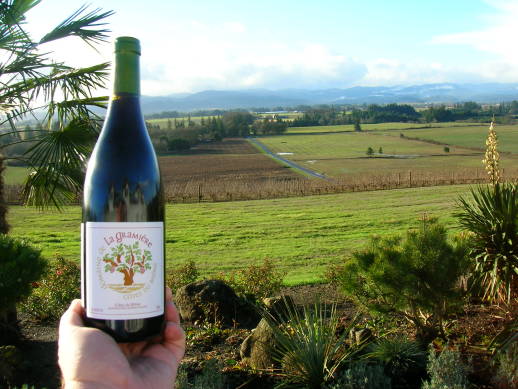
La Gramière Côtes du Rhône, the new wine from our favorite winemaker bloggers in the Rhône, Amy Lillard and Matt Kling, is on its inaugural world release tour. Pictured here, I show a bottle of  La Gramière  around Oregon’s Willamette Valley and our vineyards at Anne Amie. However much I want to try a bottle of their new wine, as it is unfined and unfiltered I will give it a month or so to adjust to its new surrounding here in Oregon. Natural wines like La Gramière, which are produced with as little intervention as possible, require patience on the part of the consumer as their natural harmony is disrupted by the stress of travel. Just like you are blasted by jet lag when you travel back-and-forth over long distances, natural wines need time and rest to show their best. When the time is right I will share my comments on their new wine. However, I will certainly not “review” it as this wine is a statement of passion shared with us by Amy and Matt and this is to be respected at all costs as something all to rare in winemaking today.

Welcome to Oregon La Gramière!

(you can welcome La Gramière to your house by calling importer Kermit Lynch at 510.524.1524 )

Bitter Barbera

barbera_vignamartina_pic.jpgI love barbera from Piemonte: racy and bitter with a biting acidity that just sings with food. Therefore it was with great anticipation that I opened a bottle of 2004 Elio Grasso Barbera d’Alba Vigna Martina. On the stove was a pot of boiling water waiting for the fresh spaghetti I just picked up at Pastaworks and a simmering pot of a simple tomato sauce, while on the table awaited some aged Parmigiano Reggiano and a chunk of fresh bread from the excellent Red Fox Bakery. Needless to say I was salivating as I pulled the cork on the barbera. The first sip confused me; where was that barbera bite. I tasted again assuming that I had just missed it, but there was nothing there. This dark ruby wine was full of sweet soft fruit layered with warm vanilla - in other words it was a lot like a merlot. If you insist on all the wines you drink, no matter the variety, taste like merlot - this is the barbera for you. However, if you want a barbera you better look elsewhere. Soft is not what barbera is about.

Always in Motion

alwaysinmotion.jpg

First it started out forward and surprisingly pleasant.

Then it seemed complex and perfect with the meal.

Then it closed down and got tannic.

At first it tasted modern, by the next day it was traditional. 

What makes the best wines interesting is they are always in motion - each sip is a different etude.

Few wines can range more in personality from sip to sip than Barolo and the excellent 2001 Paolo Manzoni Barolo Serralunga fully lives up to that reputation.  While this is a producer that gives more than a tip of the hat to the modern school, here is a  wine that proves you can’t always pigeon hole a wine based only on barrels. In fact, Mazoni uses 500 L. barrels instead of 225 L.  barriques and the results from these larger barrels are very promising both in the Langhe and in Montalcino as many producers in both areas have abandoned small barrels for larger sizes.

Winemaking is an evolutionary process and it is good to see that in the tough world of survival of the fittest that there seems to be a return to terroir movement in winemaking regions throughout the globe.  The barrique craze of the 90’s seems to have lost to the process of natural selection and less intrusive winemaking techniques  are once again becoming the dominate species.

The Eddie Haskell of Wines

eddiehaskell.jpg

“That’s a lovely dress you’re wearing, Mrs. Cleaver.” 

Leave It To Beaver’s Eddie Haskell was always ready with a empty compliment designed to cover his real character - or lack thereof.  Drinking the 2003 Opus One would be a familiar experience for June Cleaver as this wine well reflects the superficial personality of Haskell.

The 03 Opus is always at the ready with a charming compliment for your palate. Round, sweet tannins here, sweet plush oak there - everywhere your palate looks it’s greeted with oozing charm. However, politeness is the only defining character of this wine.  Behind its charming veneer is emptiness. Just when you think you’ve found something interesting it fades away into the sweet, round velvet of bland consumer correctness.

This is probably not a problem for most Opus drinkers who seek nothing beyond that initial charming compliment as it passes their lips without causing an undo interruption of their conversation, causing not another thought until the check arrives.

At $125+ a bottle, polite is not enough.


Kissing the Frogs

froginglass.jpg• 2005 Petrus: $3000 a bottle
• 2003 Château Margaux: $460.00 a bottle
• 2002 Domaine de la Romanee Conti, La Tache: $1300 a bottle
• 2003 Pegau Châteaunuef du Pape, Cuvée de Capo: $500 a bottle.

Let’s face it, when we think of French wine, we think expensive, elegant, sophisticated and chic. They are the wines you drink at Daniel in Manhattan while wearing the latest from Paris. Unfortunately for the French, only a small percentage of the wines they make fall into this elite category, and the vast majority of the wines they make are unknown and ignored by American consumers.

The world’s most famous and expensive wines are French. French wines are the only wines truly sought after by collectors. While pretenders like Screaming Eagle cause feeding frenzies with American collectors, it’s only the elite French producers that really whip both American and international collectors into a lather.

Certainly no one would argue anymore that the French have a monopoly on great wine. While bruised a bit by the worldwide explosion of interesting, well-made wines, the elite French wine juggernaut rolls on. Evidence of this is the massive coverage of the futures offering of the acclaimed 2005 Bordeaux vintage, which has been a focus of the wine media for months. In fact, a good vintage in Bordeaux still has such an impact that those vintages become great vintages for all regions in the mind of the consumer; even those wine regions with weather, vines and geography that have nothing to do with Bordeaux bask in the reflected glory of great Bordeaux vintages.

As great and historically important as the most famous French wines are, the most exciting thing about French wine is not the bottles for those with trust funds and Ferraris, but the fact that the French are making the best wine values in the world. They simply cannot be beat in the under-$20 a bottle range for making wines that still offer character, personality, and, most of all terroir — that unique sense of place that makes a wine distinct and exciting to drink.

I’ll repeat that: the best wine values in the market today are almost all French. It’s not the new world that offers wine bargains: Australian wines should actually be singular not plural, as they’re all the same jammy syrup with different labels. California wine is personality-free industrial wine produced from the same UC Davis oak-chip recipe; South American wines are thin, flavorless and produced from hopelessly over-cropped vineyards. Only their European neighbors Italy and Spain offer the French any real competition in this under-$20 category.

Ironically, as good as the French (with a lot of help from the British) were at marketing their wines over the past centuries, today they don’t seem able to sell their way out of a brown paper bag. They’ve been blasted out of the value end of the wine market by a bunch of New World wines with cute animals on their labels and snappy names that are easy to remember. This is not to say the French are blameless for this situation — all that junky wine with varietal labels from the Languedoc that flooded the market in the ‘90s convinced a lot of consumers to look elsewhere for everyday wines.

The French Appellation Contrôlée (controlled place-name) system of wine regulations established the structure that allowed French wines to dominate the market for so many years. These regulations established minimum standards for how a wine was grown and made before it could be sold with a particular name. These names were based on place above all else. The variety was important and precisely controlled. For example, a red Burgundy must be 100% pinot noir, and a Sancerre must be 100% sauvignon blanc. You won’t see those names on the label, but their regulation is far more stringent than varietal labeling as used in the New World. For example, a winemaker in California has to use only 75% pinot noir to use the name. While the best California producers would never do that to their pampered pinot noir, you can bet few under $20 are not blended with other, less noble, varietals.

While I love this commitment to place and individual personality in winemaking, the plethora of wine names this has created made a marketing nightmare for the French. Should they give up and change over to naming a wine for the grapes instead of the land? I hope they don’t, and considering the French attitude about all things French I think the names will stay the same. This means that consumers who want to drink good wine at good prices will have to do some homework.

There are so many wonderful French wines out there — the Loire Valley alone is so packed with wine best-buys that to try to keep track of only them can seem daunting. Muscadet shines as the best white wine value in the world right now. Sancerre/Pouilly Fume neighbors Quincy and Menetou-Salon produce stunning, racy sauvignon blancs. The cabernet franc wines from Chinon and Bourgueil are incredibly fragrant and seductive. The list of values from throughout France is endless, with stunning wines coming from Beaujolais, the Rhône, Provence, Lanquedoc-Roussillon and the southwest. Many of these wines come from grapes you have never heard of, but should have — like tannat, manseng, cot, picpoul and poulsard.

Such an extensive list of new words and places can be more intimidating than inspirational, and can make that giant stacking of Yellow Tail at the grocery store look tempting. However, as a few importers are willing do to the work required to not only find such wines and then to hand-sell them bottle-by-bottle, instead of memorizing The Oxford Companion to Wine, just learning the names of these brave few is enough to begin rescuing your palate from the industrial wine that has lulled it into a nap. A quick poll of the patients at WineTherapy.com came up with a list of key importers to search out for French wine bargains:

• Louis/Dressner
• Kermit Lynch
• Weygandt/Metzler
• Neal Rosenthal
• Robert Chadderdon
• Charles Neal
You’ll find their names on the back label, which means all you have to do is pick up that bottle with the strange name and turn it around to see if it’s something worth trying. That’s not too much work, is it?


Originally published in The Daily Gullet at eGullet.com

Woody

chene.jpgEach month New Jersey fine wine retailer Doug Salthouse, of SmartBuy Wines, selects an assorted case of wine and sends it out to me here on the west coast. I do this because Doug has a great palate and sends me many interesting wines I might have missed. In my latest shipment came a note from Doug, “I’m trying to stay away from the woody, manipulated wines you rail against.”

I guess he’s right, I do rail against such wines, but it’s well to remember that wood is not the enemy here. Wines like Lafon, Chateau Latour, Sottimano, Spottswoode and many others see plenty of wood and, obviously, are none the worse for it. Without a doubt many great wines would not be great without the symbiotic relationship that oak has with certain wines.

Yet the reaction of individual wines with oak is so diverse that it needs to be approached with caution. Look at the chardonnay wines from Domaine des Comte Lafon in Burgundy where the wines spend almost two years in oak and are far less oaky in flavor than many new world chardonnay wines that spend half that time in oak. What is good for the goose is not always good for the gander.

It’s not oak itself that turns my palate, but its misuse. When oak is the dominate aroma in a wine I think they’ve gone too far. A barrels main mission in maturing a wine should be that of  creating an environment of controlled oxidation, not adding wood flavors, aromas and tannins. This would have to be one of the main arguments against adding wood chips and other methods that exist only to add wood flavors and aromas to the wine. However, if it is only these things we are after chips make a lot more sense than barrels.  I think that wines made  with wood chips and such would actually be better wines if they were only aged in stainless steel with the emphasis being on freshness and fruit rather that making some soulless imitation of barrel aged wines. All to often, oak characteristics are thought of as an essential aspect of what defines great wine. Wonderful wines from Muscadet, Beaujolais and Barolo prove this not to be the case.

One of the world’s most profound wines, Giacomo Giacosa’s Barolo Monfortino, spends seven years in barrels (obviously big ones) and is not a wine dominated by wood. What makes Monfortino great is the perfectly controlled, gentle oxidation that occurs during the years in these barrels. That process is the engine that drives the myriad of reactions and changes within the wine that bring it beyond mere greatness.

It’s only an accident that we use barrels to store wine. They were the best shipping and storage containers on hand in centuries past. This was a happy accident to be sure, because barrels have proved the perfect environment for the maturation of many wonderful wines. However, we should not assume that because they can raise tasting Lafon Montrachet to a spiritural experience that they can do the same thing for every chardonnay on the planet. Lafon’s Montrachet is great because it comes from Le Montrachet, not because it comes from a barrel.

Last night with some grilled rabbit I had the lovely 2004 Roagna Dolcetto d’Alba that Doug sent me in this month’s shipment. Not a hint of oak or any other type of wood  showed in this wine and none was needed. It’s perfect just like it is.

Thanks Doug. 


Free Truffles at Ducasse!!!!!!!

ducassetruffles.jpgWant to have the full-blown truffle blow out experience dinner at Alain Ducasse’s restaurant? No problem, but the $320 per person (sans wine and tip) tab could be a bit steep. However, that’s not an issue as the Amateur Gourmet  found out. Ask and you shall receive seems to be reality. Faced with an invitation that was out of his budget the Amateur Gourmet decided to ask Alain Ducasse if he and a guest could come for free. Just as you might expect, Ducasse said yes and the results are recorded in a wonderful comic book style photo album recorded here:

http://www.amateurgourmet.com/the_amateur_gourmet/2006/11/chutzpah_truffl.html#more

Don’t miss it!!