Napa Harvest 2012
The harvest crew takes a break while waiting for the tractor to bring more bins. This is the first day of the Cornerstone Cellars 2012 Napa Valley harvest and they're picking Oakville Pinot Gris.
Why We Are In Oregon

The Cornerstone Oregon pinot noir blocks in the Clay Court Vineyard in the Chehalem Mountain AVA
The Napa Valley is one of the few perfect places on earth to grow cabernet sauvignon and sauvignon blanc. Oregon’s Willamette Valley is one of the few perfect places on earth to grow pinot Noir and chardonnay. One thing I know for sure is that if you have a cabernet vineyard next to a pinot vineyard, one or both of them are in the wrong place.
So although we had been in the Napa Valley for two decades when we decided to make pinot noir we knew we had to look somewhere other than our home. After all, it is more important where the vine puts down roots than were we had put down our roots. Our vision is to go where the variety loves to be, not to force the variety to grow in a place just because we were there. After all, nothing is more important to a wine than the soil that gave life to the vines. That essence flows from the soil through the roots to be mixed with sunshine to create wine.
Cabernet and pinot need just the opposite things as, for that matter do sauvignon blanc and chardonnay. Cabernet sauvignon is a slow ripener you need to speed up and pinot noir is a fast ripener you need to slow down. The Napa Valley is just not a great place to grow pinot noir and the Willamette Valley is no place to try to ripen cabernet sauvignon.
Cornerstone Cellars is famous for our distinctive Howell Mountain Cabernet Sauvignon, a wine of great longevity and breed and I wanted our pinot noir to be equally distinctive. That goal could only lead us to Oregon. In Oregon pinot noir and chardonnay have found a home as regal as their home in Burgundy, just as Bordeaux's cabernets, merlot and sauvignon blanc brought their blue blood to the Napa Valley.
Then there was Tony Rynders. How could I pass up the opportunity to work with one of the most dynamic winemakers anywhere? Tony’s talents led Domaine Serene to fame during his decade as winemaker there and before that he made his mark as red winemaker at Hogue Cellars in Washington. When Tony left Domaine Serene to strike out on his own I knew the time was right for Cornerstone to follow our dream to make pinot noir.
We make three wines at Cornerstone Oregon. Our Cornerstone Oregon, Willamette Valley Chardonnay is a lean, mean fighting machine type of chardonnay. No sweet oaky fruit bombs for me. If you love classic Chablis, you’ll love our Oregon Chardonnay. The Cornerstone Oregon Willamette Valley Pinot Noir is a classic, age-able pinot noir with great structure, depth and breed. Our newest Cornerstone Oregon wine is the Stepping Stone by Cornerstone Oregon Willamette Valley Pinot Noir. Every vintage, as you taste through the barrels, certain ones just seem so pretty and drinkable right now so we figured why resist them? Our Stepping Stone Pinot Noir is a barrel selection of those charming wines, while our Cornerstone Oregon Pinot Noir is a barrel selection of wines destined for greatness. One is pure charm and the other a true aristocrat.
Now as we approach our fifth vintage in Oregon our roots have grown deep in both the soils of the Napa and Willamette Valleys where with each vintage they get deeper every year. Soon they will be as deep as our roots on Howell Mountain. Great wine comes from deep roots.
Hard Chard
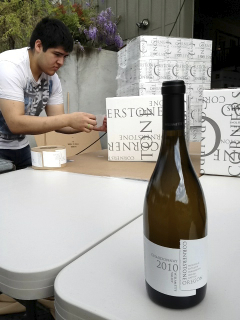
Firsts are always hard and hard this one certainly was, which always makes the experience even more delicious. In this case it also makes the wine more delicious. This September we’ll be able to share this experience with you.
It was with a surprising sense of satisfaction that I picked up the first bottle off the bottling line. It was, of all things a chardonnay. I confess I have little affection for most renditions of this variety in the New World. However, winemaker Tony Rynders changed my mind and I am sure this chardonnay will change yours.
The hard part I was referring to in this wine was a backbone. A concentrated minerality and racy acidity that will hurt the teeth of those that love oaky, sweet chardonnay. That is the way I decided to make it. I would never dream of making a spineless chardonnay. Cornerstone has never been about spineless wines and I have no place for them at my table.
So this September I will be extremely proud to introduce you to the 2010 Cornerstone Oregon, Willamette Valley Chardonnay. Less than two hundred cases were produced. It’s a lean, mean machine and I wish I could wait another year to release it as it certainly needs a few years in the bottle to show all has to give. I can only hope that some of you will lay some bottles away in your cellar.
How did it get here? Well, first of all there was a challenging vintage to deal with, but that’s something winegrowers in places like Oregon and Burgundy deal with seven vintages out of ten. There was a lot of mold when the fruit came in, but we hand-sorted like madmen and delivered only the clean bunches to the fermenter. Starting the fermentation in stainless steel tanks, the wine was racked into mature French Oak barrels to continue and finish fermentation. Those barrels were home to our chardonnay for the next fourteen months where it mellowed and broadened its flavors and, most of all, its complexity. Only 80% of the wine went through malolatic to preserve its perfect tightrope of acidity. In fact, nothing in the cellar was allowed to pilfer anything from the wine.
In a strange twist of conventional wisdom, our Cornerstone Oregon, Willamette Valley Chardonnay is a better oyster wine than our Cornerstone Cellars Napa Valley Sauvignon Blanc, which finds its soul mates in crab and lobster. What these two white wines have in common is they will both age beautifully. This is our goal. To let each wine express its true spirit and find the match at your table that nature intended. That nature is something you’ll find subtly expressed in all our vintages after 2008. This is just a start as we will push ourselves each vintage to ever higher expressions of vineyard, variety and vintage. I believe that the Napa Valley is a perfect place to grow sauvignon blanc and that the Willamette Valley is a perfect place to grow chardonnay. Our vision is to go where the variety loves to be, not to force the variety to love where we put down roots. After all, nothing is more important to a wine than the soil that gave life to the vines. That essence flows from the soil through the roots to be mixed with sunshine to create wine.
To understand my hesitance to make a chardonnay you have to understand my background. In the early eighties I was importing the wines of Domaine Comtes Lafon through Becky Wasserman, who I represented in the mid-west. At that time Dominque Lafon had yet to take over the estate from his father and was working for Becky. Over a two year period, on his many visits to Chicago and mine to Burgundy, I was privileged to drink a lot of great chardonnay (and a lot of other things) with Dominque. It is on this foundation my viewpoint on chardonnay is based. As a side note, just to highlight how different the wine world is today, in those days we had winemaker dinners promoting the wines of Comtes Lafon, which actually included their Le Montrachet. Times have changed, now you’re lucky and a lot poorer if you can get an allocation of Lafon. The point is, if your early reference point is Lafon Le Montrachet your future enjoyment of chardonnay may be impaired.
Certainly I am not trying to compare our Cornerstone Oregon, Willamette Valley Chardonnay to Lafon Le Montrachet, but I will say that if you love Premier Cru Chablis you will pleased by our 2010 Cornerstone Oregon, Willamette Valley Chardonnay. The reason I can say that with confidence is that I am pleased, which is something not easy to do.
I’m pleased to introduce you to something new from Cornerstone: Cornerstone Oregon, Willamette Valley Chardonnay. See you in September.
Light on Your Feet

Alder arrived at our table to taste our barrel sample of 2010 Cornerstone Cellars, The Premiere Cornerstone about halfway through his grind. Taking a sip, he smiled, looked up and said, “light on its feet.” My heart almost lept out of my chest. He got it. He understood the wine.
Now understanding a wine may not seem like a big deal to you, but if you have ever stood in a room pouring wine to tasters whose palates have been hammered into submission by tasting dozens of wines before yours, you know what I mean. All to often tasters arrive at your table with the looks of a punch-drunk fighter their teeth and lips wine-bloodied by roundhouse punches from a room full of bloated heavyweights. In big tastings the Mike Tyson’s of the world get more attention than the Sugar Ray’s. The heavyweights are always the champs in these tasting marathons and wines with quick moves, balance and finesse are lost to palates pounded into submission by knockout punches of tannin and alcohol.
The wines of Cornerstone Cellars are crafted to be light on their feet. This does not mean light as in thin, but light as is deft and nimble; powerful wines that are under control and in balance. Wines that you can taste every nuance of from the first sniff to the long, lingering aftertaste. Make no mistake, our goal is still to knock you out, we just don’t want to knock you into oblivion. A knock out punch from Tyson or Sugar Ray will still put you on the deck.
Not far behind the “light on its feet” comment from Alder Yarrow came some equally encouraging and rewarding notes from other wine writers. Joe Roberts at 1WineDude said of our the 2010 Premiere Cornerstone, “a mid-palate to die for.” Meanwhile Fred Swan at NorCalWine noted the, “very long finish.”
To recap, three palates I respect (read no axe to grind) noted that the wine was, “light on its feet”, “a mid-palate to die for” and a “very long finish. In other words a complete wine from start to finish. “Completeness” is a concept to often ignored in a system that honors the first sip more than the last.
I think this is perhaps the essence of winemaking, that expression of your personal vision of completeness. For some, if not most, it is an expression of economic completeness, that is making a wine that sells and gets good reviews. For others, certainly the minority, to be complete means to make a personal expression even if it’s a harder sell, or, in the case of Premiere Napa Valley, not getting the mega-bids. On the other hand, wines made from commercial inspirations are always at the mercy of the critics, while those whose foundation is built on passion will find a loyal base of consumers that share their vision of what makes a wine meaningful.
Our Premiere Cornerstone lot at Premiere Napa Valley is the prototype for that vintage’s The Cornerstone, which is the expression of what our vision tells us is the pinnacle of Napa Valley winemaking. A sip of the Premiere Cornerstone is indeed a preview of what to expect in The Cornerstone itself. Our inaugural vintage of The Cornerstone, the 2009, will be released this September.
We could not be more proud of the how we have evolved the wines at Cornerstone Cellars into wines that offer a complete experience. There could be no better representation of this than our 2010 Premiere Cornerstone. It’s wine with a beginning, a middle and a long lingering ending: a complete wine. It will knock you out.
Cornerstone Oregon in Enobytes!

2009 Cornerstone Willamette Valley Pinot Noir
Posted on 06 February 2012.
Craig Camp may no longer reside in the Willamette Valley but his presence undoubtedly still exists in the wines he is making with Tony Rynders, formerly of Domaine Serene for the California winery Cornerstone. This 2009 Pinot Noir is another great example of how the vintage has been way underrated. With just a little over two short years from harvest, this wine has settled into a smooth well-produced package that exemplifies the vintage. 2009 may have not received the accolades the 2008’s did but in time these wines just may surpass the opulence the much ballyhooed previous vintage has already obtained. This Willamette Valley wine expresses aromas of raspberry and blueberry with a hint of fresh ground cinnamon stick. On the palate, flavors of dark berry and hazelnut are offered up with a vibrant acidity that is balanced by well-integrated tannins. The finish is plush, pleasant and long enough to make this a memorable wine to savor alongside a braised lamb shank elegantly prepared for an intimate Valentines dinner. If your retailer or favorite restaurant does not offer this wine, get it online. I would get it soon because this one will not be around for long.
Rating: Excellent (91) | $50 | 13.9% ABV
Pictured above the 2011 Cornerstone Oregon Harvest
5000 Wines a Year

I saw a comment recently from a wine writer noting that they tasted over five thousand wines a year. I could only think how sad. Was this some sort of punishment? Did someone commit a crime? What a pity to turn such a pleasure into such a grind.
Another comment on a forum noted that the writer first scored the wine 88 points , but that it had mellowed into a 89 point wine after about thirty minutes. It improved by a point? I could only think how sad it is to force flavors and aromatics into one point increments. Again pleasure becomes a grind.
While I was attending a wine faults seminar by the University of California at Davis the professor passed off the answer to a question as obvious when someone asked the equally obvious question. “Professor I’ve noticed that the sample with the VA was very strong at first, but now that I’ve gone back to it several times and it gets harder and harder to pick up,” said one of the winemakers in the seminar. The professor almost off-handedly commented that was just how your nose worked. It could take twenty minutes or so before it reset itself.
So, as the Ph.D. from Davis noted, if you get a nose-full from a a wine loaded with VA or Brett or a long line of wine faults you will be severely disabled aroma-wise for a signifiant period of time. Then there is simple palate fatigue on top of that.
What does this mean? It means that the people that taste five thousand wines a year or those that nudge a wine by a point after a half hour are just kidding themselves. It can’t be done, we’re humans not machines. Your senses lose the ability to accurately judge wines even after just a dozen or so. The idea of defining the difference between 88 and 89 points as a relative quality value is simply a joke. Mother Nature did not give us the tools required.
This, of course, extends to all the major wine publications and wine competitions. What they claim to be doing can’t be done. Fact and end of story.
In addition to the fact that they’re totally inaccurate as an indicator of quality, marathon tastings and pointy nit-picking just take the joy and pleasure out of wine. They are also a slap in the face to the intellectual side of wine appreciation.
One thing I appreciate about wine bloggers over the traditional wine press is that instead of pounding through dozens of bottles and pumping out points, most take a more thoughtful approach. Wine blogs are full of tales of wines at the table, which is the only place you can really get to know a wine. Wine writing about the experience of the true pleasures of wine tells you more than any point ranking or gold medal ever can or will. There are so many good wine blogs out there these days that they cover more than enough wine to fill anyone’s needs. What you won’t find in the blogs are reviews of Screaming Eagle or Lafite, but let’s face it, if you’re buying those wines you don’t really care about reviews anyway.
My mind keeps drifting back to the person tasting more than five thousand wines a year. It sounds so terrible to me. I’m more than happy tasting a few hundred or so a year. It also means I get to enjoy wines that I really love more than once. I think it often takes a few bottles, consumed over a period of time with different foods, before you really know a wine.
I doubt there are actually five thousand wines in the world that I want to try. Someone else will have to take that punishment for me. No thanks.
ArrivederLa
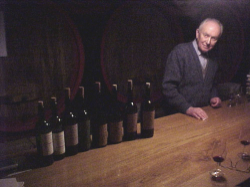
It was a cold spring morning and we could just see our breath as our eyes swept over the gentile beauty of Valpolicella. The air around us was hazy with the smoke of burning vine cuttings and the blossoms were just breaking on the trees. Just then his daughter appeared and led us down into his cellar. After a short wait he arrived surveying the group with a casual curiosity.
Over the next hour and a half he talked softly and smiled gently. For him it was enough to let his wines do all the talking. He was not looking for the deference with we treated him, but it fit him well. As always in such a group some did not understand what they were tasting, but he took no offense at their lightness any more than he did at those who where too ernest in their worship.
We tasted through the entire gallery of his creations. Their greatness requires no comment here
When we left I was the last to go. “Ringrazie, arrivederLa,” I said. I stood a good foot taller than the great man, who then reached up and patted my cheek and said, “bravo.”
We live in a “ciao” world, but to say “ciao” to such greatness just seemed wrong.
Ringrazie e ArrivederLa Signore Quintarelli
Pictured above is that tasting with Signore Quintarelli in the spring of 2000
Wine and Food

 release from my friend, winemaker Tony Rynders. Tony is making two Tendril pinots: “White Label”, a blend of his vineyard sites and Tightrope, a special barrel selection. The veal chop got the Milanese treatment and the wine was perfect with the dish and it was perfect with the wine. A very nice arrangement. The only breadcrumbs at hand were panko so the chop was even crunchier than usual. I’d do that again. The Tightrope’s tart acidity in the proverbial velvet glove was just the right foil to the breaded and fried chop. Being the foil is the wine’s job.
Cornerstone Oregon Harvest 2011

Dawn Harvest for Cornerstone Oregon in the Yamhill Carlton AVA. For more Oregon harvest photos vist the gallery here: http://bit.ly/toyBXW
Never Boring
 Their shrill barking woke me from whatever dream I was having. A pack of coyotes was having a debate in the vineyard outside my window. In my sleepy stupor I tried, but could not remember the day of the week. It sounded like dozens of them, but it was probably just a few being particularly rambunctious. Suddenly the report of a rifle echoed sharply across the valley and the coyotes were silent. Just a few hundred yards from our house, in the other direction, the first crew of cooks were arriving for work at The French Laundry. Such is life in Yountville during harvest. There is this incredible mixture of nature and urban sophistication, which only intertwines so completely in the Napa Valley. The reason I could not remember the day was simple: during harvest all days are the same. There are no regular patterns, hours or life. It’s exhausting, stressful and the best thing that happens to you every year.
So what does this vintage mean to us? It means another debate with Mother Nature, much like the coyotes outside my window had last night. As winemakers we all bark at the weather, but in reality we live within it and in the end treasure what we have been given each and every year. Like a parent we don’t have a favorite child, but revel in their differences and the memories of their unique strong and weak points. The critics will give this harvest a rating, but numbers have no soul and harvests, like all things in nature, do.
So what should you expect from a wine or from a vintage? I think you should expect personality. Those who rank vintages by number in the modern era miss the fundamental character of wine and truly do not understand wine itself. The question should never be what is the greatest vintage of this wine can I have with my dinner tonight, but should be what vintage will taste the best with my dinner tonight. The disaster vintages of days past are no more due to the dramatic advances in enology and viticulture over the last decades. On top of it we live in the Napa Valley where, let’s face it, the weather is never really that bad. The ranges of vintages today runs more from producing earlier or later maturing wines and from bigger or more elegant styles. It’s a fact of the matter in the Napa Valley an overly hot vintage has a more negative impact on wine quality than ones that are overly cool.
It often strikes me that critics want all vintages to be the same. I cannot think of anything more boring: or unnatural. Tomorrow morning at 4 a.m. we start picking our Talcott Vineyard Cabernet Franc in St. Helena. It will make a wine different from last year and from the one it will make the next. I would not have it any other way.
Cabernet Franc Harvest, Napa Valley

Waiting for Light

Pickers wait for enough light to start their day’s work. Davis Block Vineyard, Oakville Napa Valley