Krug Grande Cuvee Is Very Good

Krug Grande Cuvée Champagne is very good. In fact it is very, very good. You could even say excellent. In the case of Krug I guess you could say that is damning with faint praise. For Krug mere excellence is a failure. By reputation and price it should be sublime. It is not. The real problem for me, is that I really believe it once was.
I thoroughly enjoyed Alice Feiring’s book, The Battle for Wine and Love or How I Saved the World from Parkerization, and in particular was moved by her chapter on Champagne. It moved me because I am old enough to know what Champagne was and my palate is aware enough to know what it has become. The big name Champagne brands, with a few notable exceptions like Gosset or Bollinger, have all sold out. Today they are led by accountants and marketers instead of winemakers. All the big Champagne brands are run by corporate ownership that implements and believes in the marketing strategies so successfully employed by the perfume companies - that is image is more important than substance. What the bottle looks like and what’s on the label is everything, while what’s inside is an afterthought.
In her book Alice talks about what Krug once was and the empty symbol of conspicuous consumption it has become and it’s a very sad story. Perhaps one of the most offensive things about Krug Champagne these days is the environmental assault their packaging represents. Each bottle is packaged in a heavy, pretentious presentation box. It’s hard to believe that a company could be so unaware of the world around them. On top of the excessive price, anyone concerned at all with the environment should be offended by the packaging of Krug and refuse to buy it on that level alone. Anything that is so sumptuously packaged should automatically set off your internal alarms. If it was so good, why would they have to waste so much money (and so many trees) on the package.

A real litmus test for spotting someone not in the know about wine is that they’re drinking Krug, Dom Perignon, Cristal or anything from Veuve Cliquot. Savvy bubbly buyers are drinking grower Champagne selections from Terry Theise, Becky Wasserman or other sharp importers. In the topsy turvy world of Champagne the less famous the brand the better chance you have of getting both a good wine and a fair price.
According to wine-searcher.com, the average price for NV Krug Grande Cuvée is $179. Here’s a wine IQ test: Do you buy three bottles of excellent Champagne from the explosion of wonderful grower bottled Champagnes on the market or one bottle of excellent famous Champagne in a fancy box?
Krug used to be the best, now it’s just one of the pack.
Sunday Balloon Traffic Jam

Three balloons crowd a parking lot in Yountville as they prepare for their dawn lift offs.
Flowering Begins in Napa
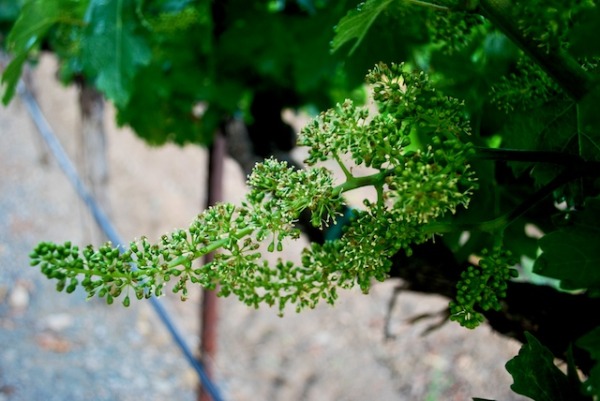
Here they come. Although only a tiny percentage so far, the vines are starting to flower. This is a cabernet vine near Yountville.
Starting Out Stinky
Pee y ew - burnt match aromas, even a bit of rotten eggs. What a wine! Well after a few minutes anyway.
The 2006 Domaine Fouet Saumur Champigny is a beautiful cabernet franc. Spicy and fresh with brush strokes of wild herbs and tiny wild strawberries as it lifts and refreshes the palate. Lighthearted, but not unsubstantial, it is charmingly just powerful enough to let you know this is a serious wine, but is confident enough to not hit you over the head with its own self-importance. This is the kind of wine it’s so hard to find produced outside of Europe. Flat out delicious.
The thing is that, like so many wines like this, when the cork is popped and the wine is first poured into the glass they can be a bit stinky. The free sulfur, which is added to virtually all wines, can be a bit pungent as it takes some time to escape (blow off) and for the slight reductive characteristics of the wine to open and clean up letting the real character of the wine show through. Wines like this are waiting for something. Like a genie waiting to get out of his bottle, minimally processed wines, like this excellent Saumur Champigny, are waiting for oxygen to finish the winemaking process. After five minutes the sulfur had disappeared. After ten minutes the fruit unfurled itself in the breeze and after fifteen minutes I had an exceptional, exciting and rewarding wine in my glass. Yes, I had to wait, but if they scrubbed it clean in the cellar before bottling this wine would have never reached the pure complexity it achieved by being a bit stinky for the first few minutes. Cramming wine into a bottle is a torturous process for a natural wine. To live for a long time in the bottle it needs to be deprived of oxygen. To fully live again it needs time to breath and let the clean air back into its lungs. You have to wait for such wines to catch their breath before drinking them.
We live in a time when consumers expect things to be squeaky clean with no effort on their part. To achieve this we give up a lot. When you cut off all the edges of a wine you end up with round, dull wines. The winemaker can really only complete 95% of the winemaking process. That last five percent is up to the consumer. If you can’t become part of the winemaking process and contribute to the last steps required to finish a wine you’re doomed to industrial wines with the souls ripped out. They may be clean, but they have no heart. On the other hand, if you are willing to become part of the winemaking team and finish the job by serving the wine properly you’ll enter a whole new world of wine, which you are a part of instead of being passive spectator. Natural wines need time and care and only you can complete the process started by the winemaker.
Heirloom tomatoes may look ugly, but they taste great. Natural wines can be a bit stinky at first, but with a little patience they blossom into beauties. Superficial charms do not make delicious wines or tomatoes.
Enthusiastically Born Again

Not so long ago I railed against The Wine Enthusiast for being a boring copy of The Wine Spectator. Not that the writing was exactly the same, but because the format was a duplicate - down to the embarrassing black tie wine orgies of those with more bucks than knowledge, palate or taste, but possessed with a perfect memory for points. So I ignored The Wine Enthusiast for years, after all, what was the point of reading a bad copy of The Wine Spectator.
Recently several things have made me reexamine my prejudice against The Wine Enthusiast, some of which were driven by self-interest, but most were inspired by my admiration for their efforts. Mainly there is the bravado and talent of the Wine Enthusiast’s West Coast Editor Steve Heimhoff, who has argued his positions with intelligence, passion and consideration for the opinions of others, on his own blog, on Twitter and on other social network outlets. While there are many print journalists who try, Heimhoff has engaged the online community with energy, honesty and mutual respect and is now reaping the rewards of his integrity with mainstream exposure and expanded respect.
For whatever reason, The Wine Enthusiast has discovered its reason for being. I don’t know when or why it happened, but I’m very happy that it did.
A Really Goode (PR) Job
 Some people just get it. Interactivity is what's it's all about these days and most PR types are driven crazy by the lack of message control when it comes to working the wine bloggers. Then along comes Sonoma's Murphy-Goode and shows them how it's all done. Murphy-Goode throws a 10k a month (lottery numbers by blogging standards) dream job out there and in the process gets ten times that in positive press. Bravi to the Murphy-Goode folks for doing it right and with class. By the way, that guy in in the video is Hardy (pictured left) of the excellent Dirty South Wine Blog and I'm sure he'd appreciate some of your votes.


VinTank and Wine Social Media Whitepaper - Wine Business News
Here is a must read for anyone in wine marketing. Vintank has made an important first step in trying to understand the new world of selling wine on the internet.
Napa, CA May 7, 2009 — VinTank, in partnership with wine industry consultant Derek Bromley, has released a whitepaper profiling social media companies impacting the wine industry. Researched and written with the intent of helping wineries make sense of a vast and confusing medium, the paper looks at the largest social media sites (Facebook, Twitter, LinkedIn) as well as the almost 30 wine social networks battling for the attention of online wine consumers, ending with an overview of the wine blogosphere. The free whitepaper is available for download at www.vintank.com/VinTank_SocialMediaReport.pdf.VinTank and Derek Bromley Release Wine Social Media Whitepaper - Wine Business Newshttp://www.winebusiness.com/news/?go=getArticle&dataid=64381
The Wine Skewer

http://wineskewer.wordpress.com/
You’re Tishin’ me! Lord knows (unless he’s a wine collector) there’s all to little humor in the wine world. If you’ve seen the latest flames on the wine forums you know what I mean. W.R. Tish, known only as Tish to his readers, delivers wit and wisdom in his wine writing and now on his own blog (link above). Tish, former editor of The Wine Enthusiast, is as passionate about wine as he is funny about the absurdities that surround it. This is sure to be good reading.


Nebbiolo
 A Barolo/Barbaresco tasting anywhere close to home is sure to attract me like a magnet. Is there anything more elusive than great nebbiolo? Outstanding examples of pinot and cabernet from around the world have long ago proven themselves, but nebbiolo from the Langhe Hills of Piemonte remains unchallenged.
The turf wars of traditionalist vs. modernist have calmed in recent times. The new wave has backed off on all the new oak and over-extraction (not yet far enough in my opinion), while the old guard is producing wines with softer tannins due to better vineyard management.
The St. Helena Wine Center hosted the following tasting last week. It was a bargain at only $20. I am always amazed more people don’t come to take advantage of such opportunities. The tasting:
Sottimano, Langhe Nebbiolo, 2006 ($24) - I bought three bottles and should have bought more. Perhaps the greatest value in nebbiolo anywhere, the Sottimano family could call this wine Barbaresco and sell it for four times as much. However as the vines are “only” fifteen years or so old they’ve decided to just sell it as Lange Nebbiolo. High toned, concentrated and still closed, this wine needs three for four more years to show itself. Sottimano is the most intelligent and light-handed of the modernists in the Langhe today. Simply great wines across the board.
Mauro Molino, Barolo Gallinotto, 2004 ($48) - The Molino wines are less over-the-top oaky these days and much better for it. Not my favorite style, but very well made and their wines show more nebbiolo varietal character than they did in the past. A very good wine at a very fair price.
Moccagatta Barbaresco Basarin, 2004 ($65) - I just could not find much to like here. Just not to my taste, but they’re a serious winery that deserves respect.
La Spinetta Barbaresco, Vigneto Gallina Vursu, 2004 ($120) - Ever see the huckster selling sham wows on late night TV? He must be the marketing director of La Spinetta. This is an almost silly wine at a price that would be silly too - except that some people actually pay it. A rip off. Why would anyone pay $120 for this wine when you can buy a great Zinfandel (which this wine tastes more-or-less like) for a quarter of the price. Anyone who drops $120 on this wine is a fool. The wine version of the Emperor’s New Clothes.
Paolo Scavino Barolo, Bricco Ambrogio, 2003 ($62) - I have never really liked these wines, but respect Paolo Scavino for his passion and dedication to making great wine - that is just not to my taste. Unlike the cynical La Spinetta, which just went out to create wines that would get big points and big bucks, Scavino really believed in his vision. Happily he too has throttled back and is making more graceful wines. This wine is very good - very modern, but still tasting of nebbiolo and the Langhe Hills. If you like the modern style, this wine is for you, not the over-everythinged La Spinetta and it’s half the price to boot.
Mascarello Barolo Monprivato, 2003 ($88) - The nose just blew me away on this wine. Could this lifted, elegant and expansively delicate nose really be from the hot, hot, hot 2003 vintage? This is just a glorious wine and easily the best 2003 Barolo I’ve tasted. Sure their 04 is better, but this wine is nothing short of outstanding and a great accomplishment in such a hot year. This wine should really not be touched until 2013.
Rinaldi Barolo Brunate, 2004 ($150) - Well if you’re going to drop $150 on a wine you might as well get perfection and this wine is about as close to perfect nebbiolo as you’ll find. From a very, very great vintage, Rinaldi took the extraordinary fruit they got from the “Grand Cru” Brunate vineyard and got everything they could out of it. A true classic that should be aged for fifteen or more years before drinking. Today it’s all closed, tannic and promise, but this wine will deliver big time.
Oddero Barolo, 1996 ($70) - If a wine can cost $70 and be a bargain this is it. The 1996 vintage has proven itself to be among the very greatest vintages in Barolo and Barbaresco. However, if you think this wine is ready to drink you’re wrong as it’s still closed and young and needs many more years to reach its peak. Yes, it’s wonderful to drink now, but in five or six more years it should be astounding. If you think about the price of this wine in the context of how good it is and that it is already thirteen years old, I think you’ll agree this is a bargain. That a famous critic rated the flabby 1997’s higher than the regal 1996 vintage is a cruel joke on consumers.


