He Had a Gun

He had a gun. The neighborhood was like a war zone. He handed me a brown paper bag with twenty grand in $20 bills. Outside there where dozens of street people huddled in the nooks of the building, most of them savoring pints of MD 20/20. Leaving that run down building with a bag of money was more than a little intimidating in a neighborhood where they would probably kill you for five bucks.
I made to to my car and hightailed it out of there. I had made my first big score. The twenty thousand dollars in the brown paper bag was my first payoff. I had just collected on a big gamble. This was my first payment for the 1982 Bordeaux futures. There would be more than a few of the brown paper bags of money from the man with the gun over the next few months.
This is a true story and what selling wine was like in the Chicago of the early 1980s. Such were the logistics of the red-hot 1982 Bordeaux futures campaign. I had finally made it in the fine wine business. However, the gun and the brown paper bags full of cash were not exactly what I had envisioned as I poured over Edmund Penning-Rowsell’s The Wines of Bordeaux and dreamed of the glories of the Premier Grand Crus.
Now I'm in the Napa Valley three decades later. While the neighborhood has changed I'm still scratching for bags of money and wouldn't mind a few right now. The economics of winemaking in the Napa Valley requires the biggest bags of money. Oddly enough, those bags of cash given me by the man with the gun seem somehow cleaner than the cash bags required to play in the Napa Valley these days. The buyers that filled those cash bags in 1983 actually got their moneys worth, either in great wine or in huge returns on cases sold on today’s auction market. Dollars invested in the Napa Valley today are highly unlikely to repay such an investment in either financial or spiritual terms.
In 1983, the man had the gun to protect himself from the criminals outside. These days its getting harder to see who has to be protected from who. The wine industry seems at a cross road, with big money wineries on one side and consumers on the other. But there is a world of wine where consumers and winemakers are on the same side.
The "natural" wine movement may be controversial and not all the wines may live up to the hype, but you can't deny you feel more soul in these wines than in the high end cult wines of the world.
I'll take the music of Aretha Franklin over Celine Dion anyday. It's just got more soul. I feel the same way about wine.
Swearing Like an Italian

I'm a unabashed fan of Luca Currado and his wines at Vietti. I had the pleasure of spending hours tasting through his cellar with him when I lived in Italy. He is a thoughtful and talented winemaker making extraordinary wines. Do not miss the current interview with Luca on I'll Drink to That with Levy Dalton, the consistantly excellent wine podcast. You can find it here.
In Italy, swearing is an artform as compared to English, where it is usually simply vulgar. In Italian swearing decorates the language adding life, spice and personality. In this interview, Luca leads us on a educational tour of this Italian artform. It's a delight!
The Vietti family story is very compelling and this interview touches on the entire modern history of winemaking in Piemonte, beautifully told by the colorful and delightful Luca Currado.
Drink and Yelp

She was nasty; complaining and putting us down. No matter, it's only your life's work; better get a thicker skin. But then I thought better of it, when someone's full of it you should stand up for yourself.
Of course I'm talking about a Yelp review. I can't really complain as, after over 122 reviews, Cornerstone Cellars has a four and half star rating. Honestly you can't do any better than that. Indeed it's an accomplishment of which I am extremely proud.
At a winery tasting room, odds are pretty good that that outlier one star review was by someone who had too much to drink and was refused anything more to drink. Nothing pisses off a drunk more than cutting them off.
So I have decided to stick up for myself and, contrary to Yelp's recommendation, take on the that rare dissatisfied customer. Now, obviously if you're getting bad review after bad review you'd better do some soul searching, but in our case nothing could be further from reality.
For Cornerstone Cellars, out of the last twenty-five Yelp reviews eighteen have five stars and four have four stars or better. Take a look here and be sure to read the one star review. Perhaps they were not feeling so great when they woke up the next day and wrote them.
Yelp is powerful and for us, for the most part, a great thing. The only real issue I have with Yelp is that they don't take into account that usually the people that write bad reviews for winery tasting rooms are the ones that have indulged in a bit too much fruit of the vine. They need to find away to take that into account and banish such wine induced rants.
In Sideways Miles drank and dialed, the equivalent of drinking and Yelping. We do not recommend either.
Formatted Wine

Wine can indeed be a study in contrasts as emphasized by an article read and a podcast listened to on the same day this week.
The first, an article in the Napa Valley Register, contained these quotes about a wine in the Premier Napa Valley Auction, “Through the study of phenols, the wine is broken down into its key chemical components to determine the optimal levels of extraction while the grape skins are in contact with the freshly pressed grape juice. The science of phenols is used as a predictor of wine quality… (this wine) represented the highest recorded phenolic reading to date at 4,600 iron-reactive phenolics in parts per million. This high reading translates to a more complex wine featuring higher quality attributes, including taste, mouthfeel and body.”
Just a few hours later I was listening to the I’ll Drink to That! with Levi Dalton podcast interview with Jacques Lardière, formerly winemaker of Maison Louis Jadot in Burgundy and who is now making wine in Oregon at Jadot’s Résonance Oregon winery. First of all, if you are serious about wine, listening to Dalton’s interviews are a must. Secondly, if you’ve never listened to the podcast before, do not start with the Lardière interview as, as Dalton notes in his introduction, this interview needs to be listened to a few times before it sinks in. I assure you a few listens are well worth the effort.
The contrast between the article and the podcast could not have been more obvious. Lardière spoke of “vibrations” and wine as a spiritual component of the earth itself. The Napa wine was in a contest to achieve the highest rate ever of iron-reactive phenolics. If it’s hard to believe they’re making the same product it’s because they aren’t.
In his interview, Lardière refers to, “formatted wines.” Formatting is a technical term that makes me think of technology, not nature and wine. Formatting is important for your hard drive on your computer. But, personally, I’d prefer to think of the vibrations the wine and I exchange rather than the emotions I had last time I reformatted my hard drive.
Back To The Garden

Saffron Fields Vineyard Yamhill Carlton AVA Willmatte Valley Oregon
"And we've got to get ourselves back to the garden," wrote Joni Mitchell, but I always hear the urgency of Crosby, Stills and Nash when I think of these words.
Today I arrived back in Oregon for the Oregon Wine Symposium right on the heels of finishing Premiere Napa Valley. It's most decidedly the yin and yang of wine experiences.
Behind me is a week of massive parties, dinners and nude dancing girls painted in gold followed by an auction that raised $5 million all dedicated to promoting the Napa Valley as the greatest wine region in the world. It is an amazing event and a major accomplishment. The Napa Valley wine community deserves great respect for a stunning marketing success. However, I never feel at home there even after seven years. It just does not mirror my values and what I want to achieve with my wines. The Napa Valley is a bigger is better, in all things, environment slowly squeezing out all but the ultra-wealthy and corporations.
Arriving in Portland today brought me a lightness of spirit and, best of all, a feeling of reconnecting to what I love most about wine. A connection to nature and slowing life down.
So for a few days I will slow things down and think about terroir, indigenous yeasts, biodynamics and what winemaking in Oregon means compared to the Napa Valley. I think my blood pressure dropped ten points as soon as I stepped off the plane at PDX.
It seems I've "got myself back to the garden."
Winemaking On The Fly
Oregon winemaker Tony Rynders rushing to get pinot noir into the winery before the storm hits during the 2013 vintage.
Recently I’ve been tasting some of the upcoming pinot noir releases from Oregon’s 2013 vintage. As you might suspect from the vintage reports, the quality can vary a bit due to the significant rain storm that hit towards the end of harvest. Fortunately both the winemaking and vineyard skills in the Willamette Valley have advanced dramatically and most of the wines are very good and many are excellent.
The question is then, why are the ones that are excellent significantly better than other wines grown in the same vintage conditions? For me the answer is clear. It is the ability of the winemaker to think and work on the fly. Such skills are earned over years of work, not at enology school. The intuition of when to pull the trigger on a pick at the last possible second and the skills to look at the condition of the fruit as it comes in and know just what to do are talents learned on the battlefield, not the classroom. Some winemakers have the ability to adjust to conditions and to make great wines in vintages of widely differing conditions, while most others struggle if taken out of their comfort zone.
In my over thirty years in the wine business one of the very best winemakers I have had the pleasure to work with is Tony Rynders. Vintage after vintage he seems to ignore the whims of Mother Nature and make outstanding wines no matter what she throws at him. There is a lot of justifiable buzz in the wine press about the 2012, 2014 and 2015 Oregon vintages, but I often find the somewhat less heralded years (read less extracted) more to my taste.
In 2013 the best of both worlds came together when the skills of a winemaker like Tony Rynders took what nature gave in 2013 and made some of the most elegant, balanced pinot noir wines that you could want. The 2013 vintage of Rynders’ Tendril Wine Cellars wines are soon to be released and I urge you to get in line and on the mailing list for these ultra-limited production wines. Many of the wines are produced in quantities of fifty cases or less so they will not be around very long.
Wineries like Tendril Wine Cellars are making Oregon’s Willamette Valley one of the most exciting wine growing regions in the world.
Recharging My Batteries
A recent wait staff training at Ruth's Chris in San Francisco gave my batteries a needed recharge. It reminded me who the critics are that I should be concerned about as a winemaker - the people that drink them.
The wait staff loved my wines and they rekindled my love for them too. They tasted alive and fresh and were just what I hoped they would be.
Last weekend brought another recharge as I presented my upcoming 2013 vintage Napa Valley releases to our distributor in southern California. They loved them for their balance and refinement. That’s what I love them for too.
It’s not that wine criticism has no place, the issue is that some critics actually love a style of wines that most normal wine drinkers don’t prefer. Sugary, bloated and alcoholic should describe neither wines or critics.
My continued support and enthusiasm for wine commentary on wine blogs is that it comes from real people drinking real wine the way it is actually consumed in the real world. The average consumer is far more likely to get wines that match words on a wine blog than from a critic tasting hundreds of wines, in a matter of hours, on their own. That's like saying you have a better idea of what a tiger is all about by seeing one in a zoo rather than in the wild. It's odd that an activity that is pointless generates almost all the point ratings given to wines.
Winemakers have to try to remember that wine is about not about critics. It’s about people enjoying food and each other.
Hopefully we are on the edge of a pointless era for wine as it's time that the point of wine is not points. Points are for games.
Singularity
Purity and delicacy are wine descriptors that do not appear often in reviews of top scoring wines. Terms like powerful, opulent and dense are the genre of pointy wines.
Poor Beaujolais seems destined to miss the mark for ratings defined by such descriptors. Youthful, fresh, lively, fruity, zesty and, the phrase that always damns a wine for the point obsessed, a "food wine", means low 90s at best.
Big points are the black holes of the wine universe. In the heart of the black hole the wines are dense and no light can escape from them, only points seem able to escape. Before all the lightness of wine is sucked away, down into the black hole itself, is the point of singularity where lightness can still exist. That's where wines like Beaujolais become relative.
If young Beaujolais finds relativity a problem, where can old Beaujolais find its place in the universe? It turns out Einstein was wrong when it comes to Beaujolais, Einstein's formula E=MC2 does not compute in this case where less mass creates more energy.
Recently I did a double take when I got a club shipment from Kermit Lynch. Côte de Brouilly? No surprise there. But wait! The vintage was not 2014, but 2006. The 2006 Côte de Brouilly Domaine de la Voûte des Crozes is indeed a singularity. It's a lacy, high strung ballerina of a wine. It was pure pleasure to let her dance through my dinner.
Black holes warp space time just as the 100 point scale warps wine time. Lightness is a concept that suffers in a universe dominated by black holes. They have indeed warped the wine universe.
I prefer to experience wines at the point of singularity.
This Wine Makes Me Mad
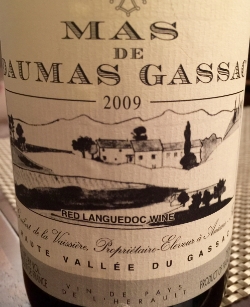
This wine makes me mad. It really ticks me off. It's balanced, elegant, complex, interesting and outrageously good to drink. What really gets me is that it's from a warm climate, downright Mediterranean, with hot sunny days - just like the the Napa Valley. This leads to the question, what the hell is wrong with the Napa Valley and why can't we make wines like this?
Yes there are those few that do, but they are lone voices. We all know Corison, Dunn, Stony Hill and a few other regal producers who get nods from the more enlightened media. Yet when it come to points it's excess that still wins the day.
The wine that angered me so much? The 2009 Mas de Daumas Gassac a stunning wine from a place famous for its sunshine.
What's your excuse Napa Valley? Just because you can doesn't mean you should.


Cabernet Sauvignon on Thanksgiving
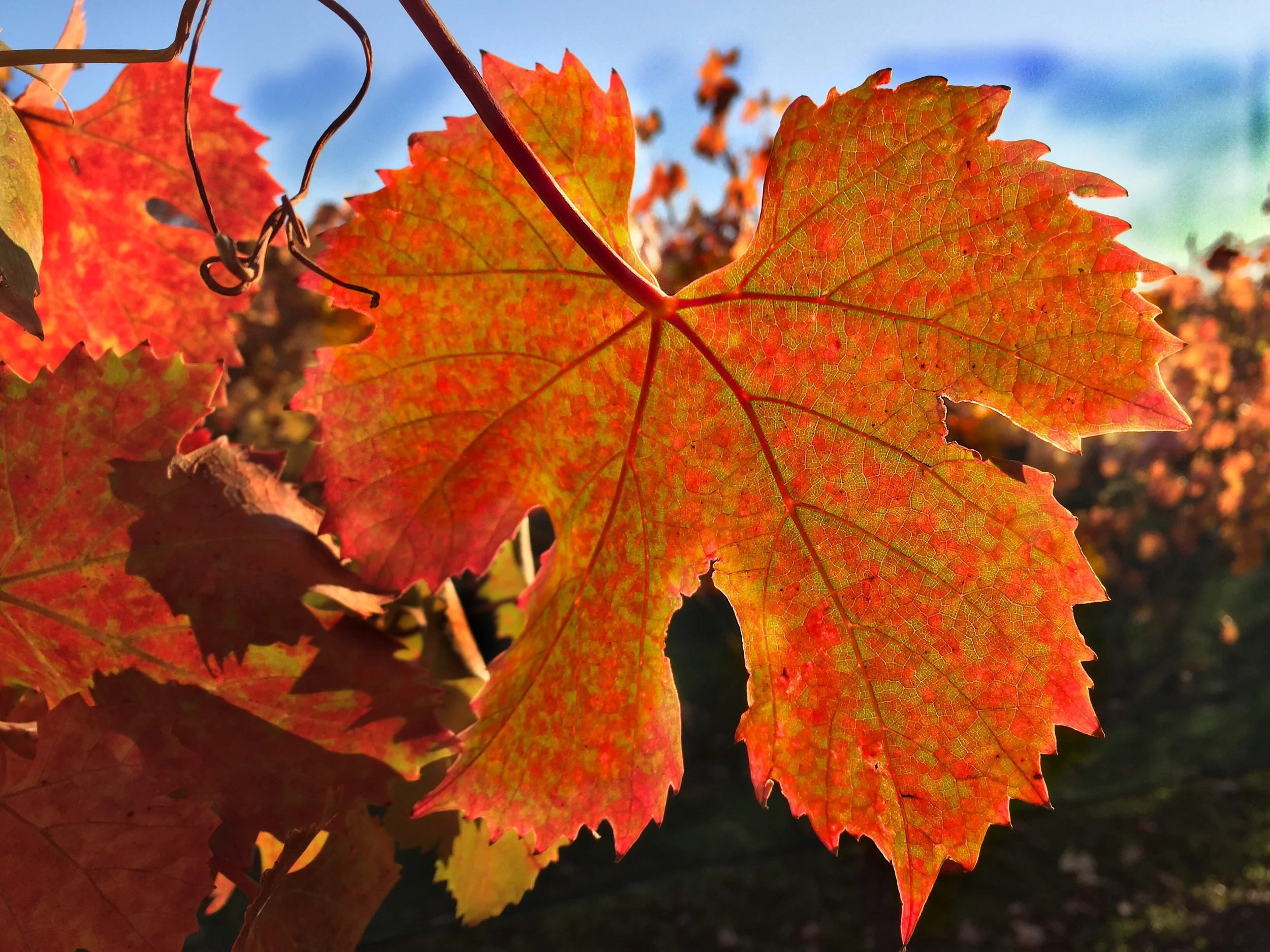
Cabernet Sauvignon leaf on Thanksgiving Day in Yountville Napa Valley
Fall Napa Valley

Napa Valley Cabernet Sauvignon vineyard just before Thanksgiving Yountville AVA
Ram Horn Vineyard Syrah Harvest, Mendocino
Uploaded by Craig Camp on 2015-11-15.
A true family endevour, the Poor Ranch in Mendocino is home to some wondeful old vines. The third generation is now working on the land and a fourth is one the way. The vineyard has always been farmed organically, in fact, this was the way vineyards used to be farmed and they just kept doing the way they had always farmed the land. They kind of laugh when people talk about the "new California" style of agriculture. True natural winegrowing by people that know no other way
Fall Napa Valley
It finally feels like fall in the Napa Valley. Some actual rainstorms and cool dew on the leaves in the morning. All the grapevines changing colors are beautiful with each variety having its own distinct hue.
Let's Play Two
The Dodgers and the Mets were in game five of the division championships and it occurred to me that the winner would be facing the Cubs in the NLCS. As a long time White Sox fan I'd spent the better part of the last three decades hating the Cubs. Normally I'd just assume I'd be pulling for whoever they ended up playing.
However, now I've been on the west coast for so long I've truly become a San Francisco Giants fan. To be a Giants fan means having a deep contempt for the Dodgers. So the idea of a potential Cubs and Dodgers NLCS made me face my true baseball fan soul.
What I discovered is that Tony Bennett has won out over Frank Sinatra and my roots are now truly more on the west coast than the midwest, where I grew up. The true measure of this was revealed to me when I realized in a showdown between the Dodgers and the Cubs I'd have to pull for the Cubs. Mind you I might not have been pulling very hard for them, but anything is better than the Dodgers getting to the World Series.
I guess we’re defined equally by not only the team we root for, but by the team we decide to see as evil incarnate.
There are several things that have made the Giants number one in my heart over the White Sox. Without a doubt winning three World Series in six years didn't hurt, but the fact that the White Sox, as they play in the American League, have a DH and the Giants don't has really changed the way I like to watch baseball played. The game is just better without the DH.
The Cubs, Dodgers and Yankees are rich teams in big markets. The (L.A.) Dodgers and Yankees have thrown their money at the game always feeling that anything less than a World Series Championship is failure. The Cubs, on the other hand, have been satisfied to just take the money from their fans and delivered mediocrity knowing they would still pack their quaint ballpark just by coming close to the playoffs every few years. Success at Wrigley Field has been measured by accountants not championships. It’s hard to like a team that has treated its long suffering fans so callously. Just think if they win the World Series this year they can ride that gravy train for another century. If is often joked about the Cubs that any team can have a bad century. But in fact the Cubs have had a tremendous century, they just haven’t won any championships. The lovable losers have been taking it to the bank for a long time now.
It was this attitude that eventually drove my loyalties from Wrigley Field to Comiskey Park and there they’ll stay in Chicago. I was drawn to the White Sox as, like me, they had to win to succeed. I felt closer to a team that had to produce results than one who was living on a type of inheritance and was milking it for all it was worth. It took a lot to drive me away from the team of my youth and the first place I ever saw a major league baseball game, but the Cubs did it.
My mother loves the Cubs and so if they do win I will be very happy for her and the other Cub fans so desperately praying for their beloved Cubbies to finally break the fabled curse. The same goes for the players who will be the real champions if they can pull it off. However, the ownership of this fabled franchise should not be let off the hook. They could have pulled this off much sooner with the resources at their command. The reason the Cubs have not won the World Series since 1908 is not due to the players or fans, but due to the callous economic interests of the various owners over the years.
I was lucky to visit Cooperstown and the Baseball Hall of Fame this summer. It was an amazing experience for someone who loves baseball and nothing moved me more than the plaque honoring Ernie Banks. Behind me in my office sits a framed scorecard my dad kept when he took me to a game in Wrigley Field on August 24th, 1962, the day after my ninth birthday. Warren Spahn pitched for the Milwaukee Braves and Hank Aaron hit a home run. A young player named Lou Brock was playing center field for the Cubs. Billy Williams was in right and Santo was on third. The Cubs lost. On the front of that scorecard are the autographs of Don Landrum, Ken Hubbs and the incomparable Ernie Banks all scored for me by my dad.
So for my mom, dad, Ernie and that beautiful game in 1962 I will root for the Cubs to make it this time in spite of the suits who have run the franchise so cynically for the last century. Terrible owners have given Chicago the Black Sox and a hundred years of frustration for generations of faithful Cub fans. It’s time to think about the game, not them.
“Let’s play two,” said Ernie, the most beautiful quote in baseball. For the next two weeks, I’ll be a Cubs fan.