Punched Down

Punching down Troon Tempranillo in the rain under our old oak tree.
There are thirty one-ton fermenters spread out before me under the oak tree behind the winery. They all need punch downs and I'm the only one there to do them. It’s raining and at this moment there is nothing romantic about winemaking, fortunately I know that once these wines are in the bottle there will be more than enough romance to make me face this line up of fermenters tomorrow, and the day after tomorrow…
Now it's night and most of me hurts and I'm exhausted, but tomorrow I will be up and ready to go as I know that my life with these wines will make the effort more than worthwhile.
But why is there just me a 63 year old available for punch downs this morning? Welcome to the Applegate Valley where there's not an intern in sight. Welcome to winemaking on the frontier. The Applegate Valley is an exciting, but emerging fine wine region and the niceties of established regions like the Willamette Valley or Napa Valley just don’t exist.
As tiring and challenging as it is, the lack of accoutrements is also liberating. You are forced into choices that make you rediscover how natural the winemaking process truly is and that so many of the interventions used almost without thought in more established regions are unnecessary.
You soon come to understand that these interventions are not only unnecessary, but detrimental as they strip wines of real character leaving pretty, fruity wines with indistinguishable personalities. When I first saw an optical sorter in the Napa Valley I was blown away. Out of one end came perfect grapes, looking exactly like blueberries, and on the side it discharged everything deemed less than perfect. My initial excitement slowly dissolved as I tasted the wines in barrel then bottle. What I thought was perfect fruit yielded wines that were one-dimensional. Those perfect grape blueberries ended up making a wine that tasted a lot like it actually came from blueberries. The strange thing about those perfect grapes is that they only look perfect. If they were truly perfect winemakers would not be forced to add acids, water and use enzymes and other additions to put back in what the optical sorter took out.
At Troon there are no optical sorters in sight, nor in all of Southern Oregon as far as I know. All of our sorting is done during the pick in the vineyard. Instead of making wine with blueberries, we make wine with the grapes that nature gives us. That means along with those perfect grapes some are a little more ripe and some a little less. In the fermenter, together with the indigenous yeasts of the Applegate Valley, this varied fruit creates wine that is anything but one-dimensional. The grapes that are a little less ripe contribute vivacious natural acidity and those a shade overripe contribute body and richness - no additions required. Oh yes, and often we include stems in the ferment. In the tank it may not be pretty, but together they make wines that are alive.
Wines that live make me feel more alive.
Feeling Connected

The Troon Vineyard crew picking the grapes they grew. This is Vermentino bound for Troon Black Label Vermentino after a year in barrel.
There's not much to it. You pick the grapes, crush them by foot, de-stem if needed and dump them in a fermenter. The fermenter, a one-ton macro-bin sits under the old oak tree behind the winery. After a few days the fermentation begins. Just like that.
It seems so simple, so natural as we use no yeast, sulfur or acid additions as was the norm at wineries in my past. These interventions are not required by Mother Nature. Then it's hands-on punch downs every day and soon your hands are stained burgundy red. There is something different about this kind of winemaking. You are mentally and physically part of the wine. This is not a process, it's a philosophy, a way of life. You and the wine are connected.
At Troon the same crew, the same people, tend the vines, harvest the grapes and make the wines. No sorting table is needed at harvest because the pickers are the same people that farmed each vine throughout the vintage. They only pick the perfect bunches, because these grapes are their grapes. They are harvesting a full year of work with each bunch cut from the vine.
After years in the Napa Valley I was shocked at the deliberate pace of the pickers during harvest here at Troon in the Applegate Valley. In Napa the picking crews are well-oiled machines and picking is at super-human speeds, which makes the pickers seem more mechanical than human as they surgically remove fruit from vine. Here in Oregon the picking pace is slower, but not any less work. Yet by dialing back the speed of picking the harvest seems to be the work of people, not machines. A picker that knows each row and vine treats the fruits of their year long labors with the respect that only sweat equity can understand. Their work needs no second guessing on a sorting table.
The simple elegance of the process and the personal hands-on experience of growing and making wine this way cannot help but make you feel more connected. You are connected to the land, the vines, the wines, the people who make them and to the people who will drink them. Feeling this connection is the most rewarding feeling I've ever had in thirty-five years in the wine business.
Wine should be a connection. It should connect the drinker with the land and people that brought the vineyard to life in a bottle of wine. This harvest I'm feeling very connected.
Oregon Applegate Valley 2016 Harvest
Perfectly ripe Troon Vineyard Estate Vermentino ready to be harvested tomorrow morning.


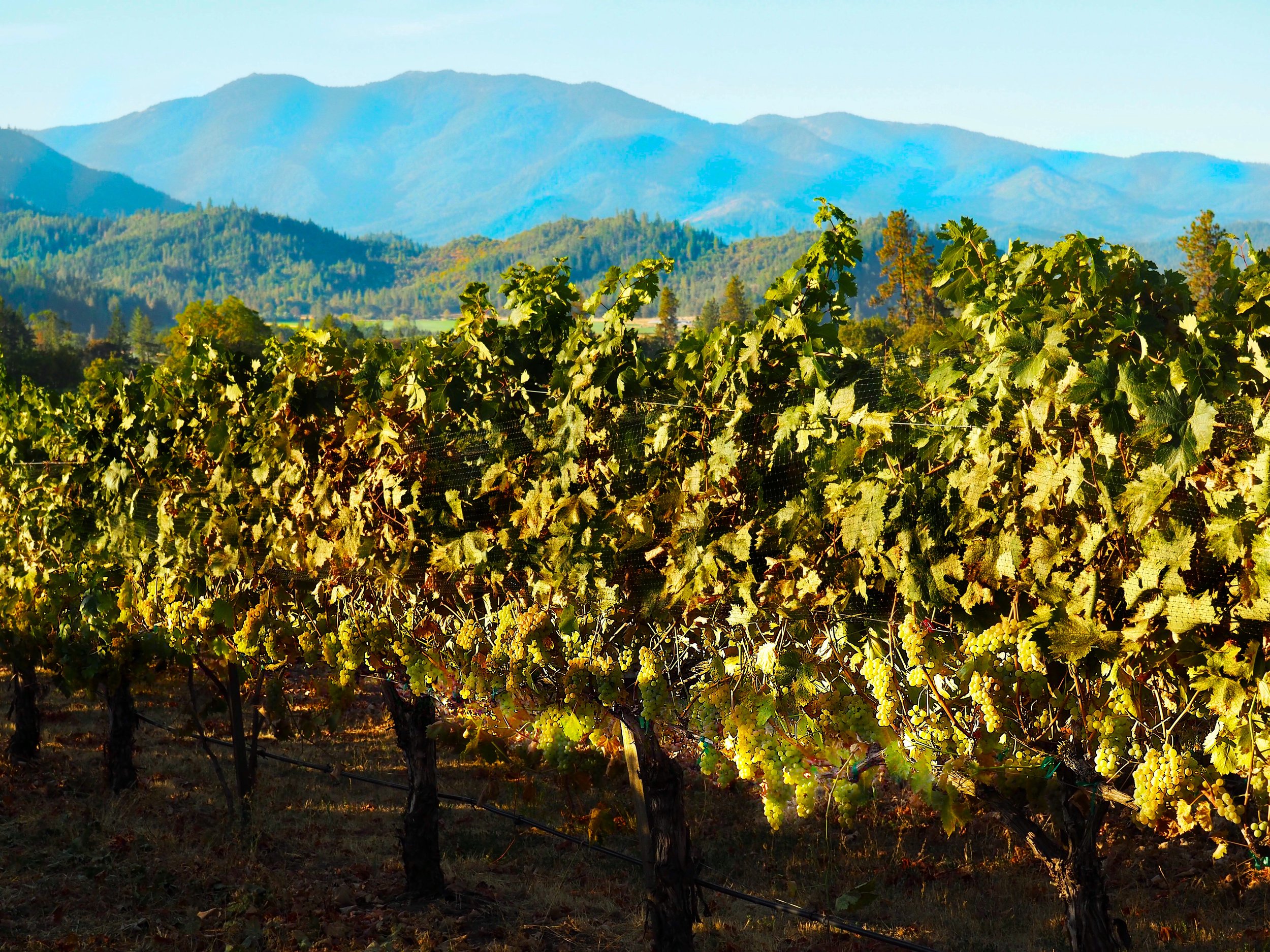
Troon Estate Vermentino framed by the Siskiyou Mountains
Varietal Vigilantes
In the United States we tend to think of wines being driven by a single variety. That there is somehow something purer about being made from one type of vine. The varietal vigilantes are always asking, “is this 100%?” Due to the heavy emphasis on varietal labeling they don’t realize is that historically wines made from a single variety were the exception, not the rule.
Some of the greatest names in the world of wine: Bordeaux, Châteauneuf du Pape, Côte Rôtie, Chianti, Rioja, Porto and Champagne are, and have always been blends of varieties. There are classic marriages like: cabernet sauvignon, cabernet franc and merlot; marsanne and roussanne, syrah and viognier that have defined their wine regions. Without a doubt there are great mono-variety wines like Burgundy and Barolo, but many a classic wine region discovered over the centuries that blending produced not only the best wines for them, but a more consistently good wine vintage-to-vintage.
I believe that the Applegate Valley is one of those regions where blending creates the most complete and complex wines. In almost all of our wines at Troon Vineyard you’ll find more than one variety in the blend. We think deeply in making these choices looking for varieties that together create wines with greater nuance and personality than they could on their own. My goal in blending is to make the wines come alive and to craft wines that could only come from the Applegate Valley as making a wine of place is at the center of everything for me.
Blending is one thing, but I believe you need to go farther and actually co-ferment the varieties that you believe make will make your best blends. When you blend finished wines you can make wonderful wines, but when you can ferment the different varieties together they meld in a new an magical way that simple blending cannot reproduced. When fermenting together Mother Nature’s natural chemistry is amplified and a whole new wine emerges from the fermenter. When co-ferments are combined with natural yeasts and natural malolactic fermentations a unique purity of place and variety is expressed in your wine.
One of the better examples of this magic is our Troon Vineyard Longue Carabine, conceived by winemaker Steve Hall, which is created by blending several different co-fermented lots. The characteristics of each variety in the 2014 blend (38.5% vermentino, 33% viognier, 33% marsanne, 1.5% roussanne) shows their distinctive highlights in the expansive aromatics and rich texture. Longue Carabine is a one-of-a-kind wine totally unique to the Applegate Valley, Troon Vineyard and Oregon.
Being able to create wines like this is one of the inspirations that led me from Napa to the Applegate Valley in southern Oregon. The freedom to constantly experiment and push your wines forward is truly exciting - and truly fun!
2014 Troon Blue Label Longue Carabine, Applegate Valley
Giving Thanks: Napa Cab, Willamette Pinot
November in Oregon's Willamette Valley
Just in time for Thanksgiving I’m excited to share my new Cornerstone Oregon releases with you. Certainly there is no better match for the traditional cuisine of this American holiday than wines from America’s premiere pinot noir and chardonnay region: Oregon. With the 2014 vintage I passed my first decade making wine in Oregon and I am more convinced than ever that it is here in the United States that pinot and chardonnay can best show their true personality.
For this reason at Cornerstone Cellars we do not make any chardonnay or pinot in California as, while there are a few examples of wines that are true to these varieties, the vast majority of wines produced in California from pinot and chardonnay speak far more of winemaking than terroir. I believe in pinot and chardonnay grown in the Willamette Valley just as fervently as I do in cabernets, merlot, syrah and sauvignon blanc grown in the Napa Valley.
Very soon Cornerstone Oregon will be at the same production level as Cornerstone Cellars in the Napa Valley (about 5,000 cases each) and so these wines are of the highest priority to me.
As from the beginning of Cornerstone Oregon in 2007, our wines are a collaboration between myself and my friend and the Northwest’s premiere winemaker, Tony Rynders. The style of Cornerstone Oregon reflects my over three decade immersion in the wines of Burgundy and Tony’s two decades in the Northwest, which includes stints as the red wine winemaker at Hogue and a decade as winemaker at Domaine Serene. The wines of Cornerstone Oregon are a synthesis of our perspectives and together we are crafting wines with a classic structure intertwined with a vibrant New World personality. As always, all of the wines of Cornerstone Oregon are grown, produced and bottled in Oregon.
This Thanksgiving I am giving thanks for the privlege of making cabernet in the Napa Valley and pinot noir and chardonnay in the Willamette Valley. Certainly this is having the best of both worlds.
Isn't That the Point

It very strange how in winemaking you can end up at the same point in very, very different ways. "It is important to understand that a point is not a thing, but a place," notes the Math Open Reference. The point we are always trying to achieve is a pure expression of our three "V's": vintage, variety and vineyard.
To achieve this with varieties as transparent as chardonnay and pinot noir takes a clear vision of where you are going. To arrive at the same point in winemaking is not to make carbon copies vintage-to-vintage, but to arrive at the place you feel each vintage is taking you. Patient, careful winemaking allows wines of very different vintages to arrive at the place, the point, you are seeking as a winemaker. To arrive at this point you have to let the wine achieve its own natural balance for the year that created it. So in some years you have structured wines and in others a more natural richness and forward personality. Just because they are different does not mean they have not arrived at the exact point you are trying to achieve.
Two such vintages are 2011 and 2012 in Oregon's Willamette Valley. In 2011 rain and cool weather made fruit sorting an art form if you wanted to make exceptional wines. We rejected bin after bin and individually sorted and selected each bunch that made it into the fermenters. The end result speaks for itself in the beautifully lifted and structured 2011 Cornerstone Oregon Willamette Valley Pinot Noir, White Label. The wines from this year are naturally tight and are only now starting to reveal their delicate layers of complexity. As someone who cut their pinot noir teeth on Burgundy I particularly love this wine. Then there was the sunny, gentle 2012 vintage where there was hardly a thing to sort. In fact, the 2012 chardonnay fruit was the most beautiful and defect free I've ever seen in Oregon. The 2012 Cornerstone Oregon, Willamette Valley Chardonnay, White Label reflects this generous vintage, not by being soft, but with a rounded firmness that will develop for years to come. I think this is a perfect example of the extraordinary potential of chardonnay in Oregon and why I am convinced this is the best region for chardonnay in North America.
It is exciting to release such a distinct range of personalities with our Cornerstone Oregon releases this fall. For me such differences are the things that make wine so exciting and pleasurable. After all, isn't that the point.
Hard Chard
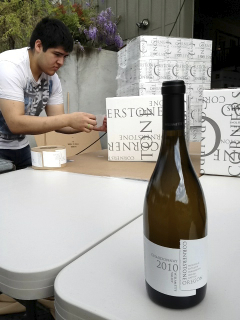
Firsts are always hard and hard this one certainly was, which always makes the experience even more delicious. In this case it also makes the wine more delicious. This September we’ll be able to share this experience with you.
It was with a surprising sense of satisfaction that I picked up the first bottle off the bottling line. It was, of all things a chardonnay. I confess I have little affection for most renditions of this variety in the New World. However, winemaker Tony Rynders changed my mind and I am sure this chardonnay will change yours.
The hard part I was referring to in this wine was a backbone. A concentrated minerality and racy acidity that will hurt the teeth of those that love oaky, sweet chardonnay. That is the way I decided to make it. I would never dream of making a spineless chardonnay. Cornerstone has never been about spineless wines and I have no place for them at my table.
So this September I will be extremely proud to introduce you to the 2010 Cornerstone Oregon, Willamette Valley Chardonnay. Less than two hundred cases were produced. It’s a lean, mean machine and I wish I could wait another year to release it as it certainly needs a few years in the bottle to show all has to give. I can only hope that some of you will lay some bottles away in your cellar.
How did it get here? Well, first of all there was a challenging vintage to deal with, but that’s something winegrowers in places like Oregon and Burgundy deal with seven vintages out of ten. There was a lot of mold when the fruit came in, but we hand-sorted like madmen and delivered only the clean bunches to the fermenter. Starting the fermentation in stainless steel tanks, the wine was racked into mature French Oak barrels to continue and finish fermentation. Those barrels were home to our chardonnay for the next fourteen months where it mellowed and broadened its flavors and, most of all, its complexity. Only 80% of the wine went through malolatic to preserve its perfect tightrope of acidity. In fact, nothing in the cellar was allowed to pilfer anything from the wine.
In a strange twist of conventional wisdom, our Cornerstone Oregon, Willamette Valley Chardonnay is a better oyster wine than our Cornerstone Cellars Napa Valley Sauvignon Blanc, which finds its soul mates in crab and lobster. What these two white wines have in common is they will both age beautifully. This is our goal. To let each wine express its true spirit and find the match at your table that nature intended. That nature is something you’ll find subtly expressed in all our vintages after 2008. This is just a start as we will push ourselves each vintage to ever higher expressions of vineyard, variety and vintage. I believe that the Napa Valley is a perfect place to grow sauvignon blanc and that the Willamette Valley is a perfect place to grow chardonnay. Our vision is to go where the variety loves to be, not to force the variety to love where we put down roots. After all, nothing is more important to a wine than the soil that gave life to the vines. That essence flows from the soil through the roots to be mixed with sunshine to create wine.
To understand my hesitance to make a chardonnay you have to understand my background. In the early eighties I was importing the wines of Domaine Comtes Lafon through Becky Wasserman, who I represented in the mid-west. At that time Dominque Lafon had yet to take over the estate from his father and was working for Becky. Over a two year period, on his many visits to Chicago and mine to Burgundy, I was privileged to drink a lot of great chardonnay (and a lot of other things) with Dominque. It is on this foundation my viewpoint on chardonnay is based. As a side note, just to highlight how different the wine world is today, in those days we had winemaker dinners promoting the wines of Comtes Lafon, which actually included their Le Montrachet. Times have changed, now you’re lucky and a lot poorer if you can get an allocation of Lafon. The point is, if your early reference point is Lafon Le Montrachet your future enjoyment of chardonnay may be impaired.
Certainly I am not trying to compare our Cornerstone Oregon, Willamette Valley Chardonnay to Lafon Le Montrachet, but I will say that if you love Premier Cru Chablis you will pleased by our 2010 Cornerstone Oregon, Willamette Valley Chardonnay. The reason I can say that with confidence is that I am pleased, which is something not easy to do.
I’m pleased to introduce you to something new from Cornerstone: Cornerstone Oregon, Willamette Valley Chardonnay. See you in September.
Cornerstone Oregon Harvest 2011

Dawn Harvest for Cornerstone Oregon in the Yamhill Carlton AVA. For more Oregon harvest photos vist the gallery here: http://bit.ly/toyBXW
Skating With The Love Puppets
 We're sometimes marionettes when it comes to food and wine matching, but Love Puppets and skate can cut those strings. Skate wing is one of my favorite fish dishes and meaty, rich fish like this sometimes go better with red than white wines. Especially the way I cooked it, quickly floured and sauteed, then served with a beurre rouge - in this case accented with some pancetta and capers. Easy and delicious.
What better to go with skate wing and a red wine sauce than Love Puppets. The Love Puppets here (I'm not sure what you were thinking of) is a lovely Oregon pinot noir from Brandborg Vineyards. The 2006 Brandborg Vineyards Love Puppets Pinot Noir catches all the romance that is pinot noir. Very spicy, brightly fruity and charming, but with just a touch of the earthy, wild mushrooms notes that always highlight the best pinots this is a wine you can drink now or over the next several years. The San Francisco Chronicle placed it in their top 100 wines of 2008 and I can see why. Besides that, it's a bargain at only $30.
 The real love puppets are the husband and wife team of Terry and Sue Brandborg who make this excellent pinot and a host of other wines from cool climate varieties in their decidedly very cool climate in the the Umpqua Valley in southern Oregon, which they are so successfully pioneering.
 All to often we seek romance in winemaking, but rarely find it in these days of corporate wine factories, but the Brandborgs are the real thing and you can taste their passion for both wine and each other in the wonderful wines of Brandborg Vineyards.
Technorati Tags: wine, Oregon, pinot noir, Umpqua, Brandborg

Oregon 2008 Updates

The growing sense of optimism over the 2008 vintage in Oregon has spilled over the edge of the fermenter into outright excitement. Veteran winemakers throughout the Willamette Valley are letting their enthusiasm for this vintage show now that almost all their fruit is harvested. Here are some comments on the 2008 vintage from some of Oregon’s most important winemakers.
Brian O’Donnell owner and winemaker of the one of Oregon’s finest estates Belle Pente describes 2008 this way, “In terms of my impression of the harvest, I’m really excited! We brought in 10 tons October 1st that is now done, and these are some of the most delicious young wines I’ve ever tasted! The chemistry on the stuff we picked later is a little bizarre, but with a few tweaks it should be fine….we’re planning to let fermentation run a little hotter than normal and do longer than normal post-fermentation maceration to try and “burn” some of the obvious fruitiness out of the wines to let the site characteristics show thru better. But frankly, I think we’ve got a tiger by the tail, and she’s wild and sassy and will take a lot of good (and lucky) winemaking decisions to get the best out of her.”
Few growers and winemakers have the depth of experience possessed by David Adelsheim one of the true founders and pioneers of the Oregon wine industry. About this vintage he comments, “Another weird year. Three weeks late, rain in July and August, and still we saw the beginnings of drought stress in some sites. We starting picking on Sep 29th and finished this past week on Oct 18th. A third of our Pinot noir was picked by Oct 3rd; during the next 10 days (which were damp) we picked only a few lots of white grapes; everything else was picked in the final six hectic days. And the quality is looking pretty grand. It will need to be – our crop levels were off by 30% compared to 2007”
Jerry Murray winemaker and vineyard manager of highly regarded Patton Valley Vineyards says of 2008, “The harvest has looked great. We pulled in the last of our fruit yesterday. Considering the way the season started out, late bud break and all, mother nature has given us exactly what we needed to not just to avoid a disaster but to really ripen fruit in a way that should make some amazing wines, true pinot. The chemistry of the grapes has been just about perfect, great acidity, moderate alcohol, great color and phenolic development. As a winemaker you hope for this sort of vintage every year but I would be surprised if you get more than a handful in a lifetime. All that is left is to see the quality through to bottle. It is very exciting.”

Top: Vines at the Belle Pente estate vineyard change color. Below: Harvest in Tony Soter’s Mineral Springs Vineyard
Wine Pics: Vintage Oregon 08

Barrel washing at Grand Cru

Pump over at Grand Cru

Washing bins at Soter Vineyards

Pinot harvest at Soter Vineyards
Oregon Winemakers Optimistic
 Experienced Oregon winemakers are quietly enthused about the potential of the 2008 vintage. Winemakers are rightfully conservative in their assessment of a vintage at this point in time because you never really can be sure about the quality of a wine until it’s actually wine. However, with experience winemakers obviously develop a pretty good idea of what to expect. Those expectations are starting to sound quite high for 2008.
Laurent Montalieu is one of the Willamette Valley’s most experienced winemakers. A veteran of Willakenzie Estate, today Montalieu owns Solena Cellars, the Northwest Wine Company and his newest venture, the ultra-premium custom crush winery Grand Cru Estates. Montalieu, pictured here (left) sampling a vineyard with winemaking consultant Tony Rynders, who is also winemaker at the new Grand Cru estates, has one of the widest experiences with the full range of Willamette Valley vineyards as his Northwest Wine Company deals with vineyards located throughout the Valley. Montalieu comments about this vintage, “The beautiful Indian summer has saved us one more time… essentially right now I am looking at hanging the balance of our fruit as late as possible….. if the fruit is not getting worse it has to be getting better…. So far the ferments have shown great purity of the aromatics and the extraction level will be quite structured .We are in for a treat of a vintage, remember 1999?”
Winemaker Scott Wright, owner of Scott Paul Cellars, also has a great depth of experience with Oregon vintages. Before founding his own winery, Scott was general manager of Domaine Drouhin Oregon. Wright says of the 2008 vintage so far, “We’ve been very happy with the quality of the fruit we’ve brought in so far – very clean and healthy, excellent flavors, really nice pH & acids – potential alcohols in the low 13s – exactly what we’re looking for. Yields have been on the low side – averaging about 1.5 tons per acre so far. We’ve got about 2/3 of our fruit in now, and will likely finish up today and tomorrow. The potential is there for a really nice vintage!”
Superstar winemaking consultant Tony Rynders (pictured above, right) had a decade knocking out one 90+ rated wine after another as winemaker at Domaine Serene before launching his own consulting company and taking on winemaking duties at Grand Cru Estates. On the 2008 vintage Rynders notes, “Harvest 2008 is well underway in the Willamette Valley. We have remained about 10 days behind in ripening based on the last ten years. But is actual fact, we are right at our long term average for harvest timing. After a little rain at the beginning of the month, we have had a nice stretch of weather for the last 12 days. Flavors have come on strong and the sugars are very reasonable. This latest weather development has been critical for flavor development and phenolic maturity. The cold soaks are showing beautiful color. The wines are going to be very pretty with excellent balance. We are about 60% complete with another 20% due in the next three days.”
You are hearing similar comments from winemakers throughout the Willamette Valley. The potential is there for a very special vintage in the classic Oregon style, which emphasizes balance, structure, aromatics and elegance with moderate alcohol levels. I’m looking forward to drinking these wines.
Pictured below, a picker in Tony Soter’s Mineral Springs Vineyard.

More Oregon Harvest Blogs
Winery blogs are helping bring the excitement of harvest to readers far from wine country. Here are two more from Oregon:
Brandborg Winery Blog http://brandborgwine.wordpress.com/
Terra Vina Winery Blog http://terravinawines.wordpress.com/
Oregon Harvest 2008

 Oregon's grape harvest continued today in perfect, cool weather. In Tony Soter's outstanding Mineral Springs Vineyard (pictured here) in the Yamhill Carlton AVA they decided to put in the extra time needed to harvest the entire vineyard today as the fruit was in perfect condition and rain is forecasted over the next several days. Most of this vineyard is planted in a unique clone of pinot noir discovered and then propagated by Soter from an old vineyard in California. It has no name at this time and Mineral Springs is the only vineyard anywhere planted with this clone. As it is yet formally named, I'll call it the Soter Clone. This combination of distinctive terroir with a unique massal clone makes this one of the most exciting vineyards in Oregon.

Oregon Vintage 2008 Kicks Into High Gear

Oregon’s 2008 grape harvest is now in full swing as growers try to beat the sure to come rains and the already arrived birds. The week started with about 30% of the fruit in the valley picked and by the end of this week a majority of the vineyards will be harvested. At this point, the birds may be the biggest threat as massive flocks can devastate a vineyard in a day. In my opinion, this will be a very good vintage for those that did not harvest too early as the grapes have been gaining flavor, if not much sugar, over the last week of lovely, dry and cool, but sunny weather. With showers due later in the week and the migratory birds already arrived, most growers are harvesting as fast as they can at this point. Pinot noir from good sites is coming in fully ripe with good flavors and lab statistics that promise some exciting wines. For the second year in a row, Mother Nature is forcing Oregon’s winemakers to back away from the excessive extract and alcohols too many had started to strive for as they sought high scores from wine writers. The 2008’s should show good balance in an elegant style with moderate alcohols, which, after all, is why people came to Oregon to grow pinot noir in the first place.
Pictured above, winemaking and vineyard consultant Tony Rynders, formerly of Domaine Serene, takes pinot noir samples for analysis from Elvenglade Vineyards near Gaston.