Personal Hygiene

It was so clean. The color was not just healthy, but a brilliant, radiant garnet. I was struck by its purity.
I'd spent most of the last several weeks drinking wines from west coast wine rebels. These are winemakers that distain convention and I admire their dedication to making natural wines. These winemakers see the over-oaked, over extracted wines of most New World winemakers as brutish bores. I agree with them.
Yet there is something to be said for purity, brilliance and, yes, simple personal wine hygiene. By hygiene I don't mean making wines sterile, boring carbon copies of the accepted commercial norm of industrial wine beverages. Certainly there is no need for any more of those. What I value is purity.
The wine mentioned above was a 2013 Domaine Bernard Baudry Chinon imported by Kermit Lynch. This is a wine stunning in its clarity and focus. After the wines from trendy California producers that I'd been drinking I was immediately struck by its brilliant, clean color. There was no browning, no haziness, just a perfectly clear and beautiful garnet wine.
What is important to note here is that Baudry is also a winemaker in the natural winemaking vein. This is a Kermit Lynch selection and Baudry uses natural yeasts and does not fine or filter. So why are his wines so brilliant and pure while so many wines from our winemakers following the same winemaking concepts are cloudy and brown? Beyond appearance there was the rest of the wine - a lively, complex clear expression of cabernet franc. A charming wine full of clarity of purpose and personality.
The winemaking techniques used to make a wine are not in themselves a justification for liking a wine. The commitment of the winemaker to natural techniques is a heavy burden to bear as it is not easy to make wines in this way. However, as much as that commitment is to be respected it does not free the producer from making wines that purely speak of the vineyards and varieties that they sprang from. Wines full of faults including excessive brett, V.A., protein hazes (and others) and oxidation hide terroir and varietal character every bit as effectively as the bag of tricks used by companies like Enologix. In both cases it is the winemaking not the vineyard that defines the wine.
We always seem to be caught up on extremes. On one end of the spectrum are the 100 point wine fanatics easily suckered in by the manipulations of Enologix and others. On the other are the natural wine terrorists who value doing nothing to a wine more than they value how it actually tastes. As usual the sweet spot is in-between these two extremes. That’s where wines like the Baudry Chinon come in as it’s a wine made naturally, but also professionally with great competence and care. It is a pure expression of that variety and that vineyard in that vintage. For me, nothing is more exciting in a wine.
I don’t like to drink spoofulated wines, but I also don’t enjoy muddy, faulted wines, which are the exact opposites. Spoofulated has long described manipulated wines, perhaps we need a new term for under-manipulated wines. Any ideas?
The Hoax
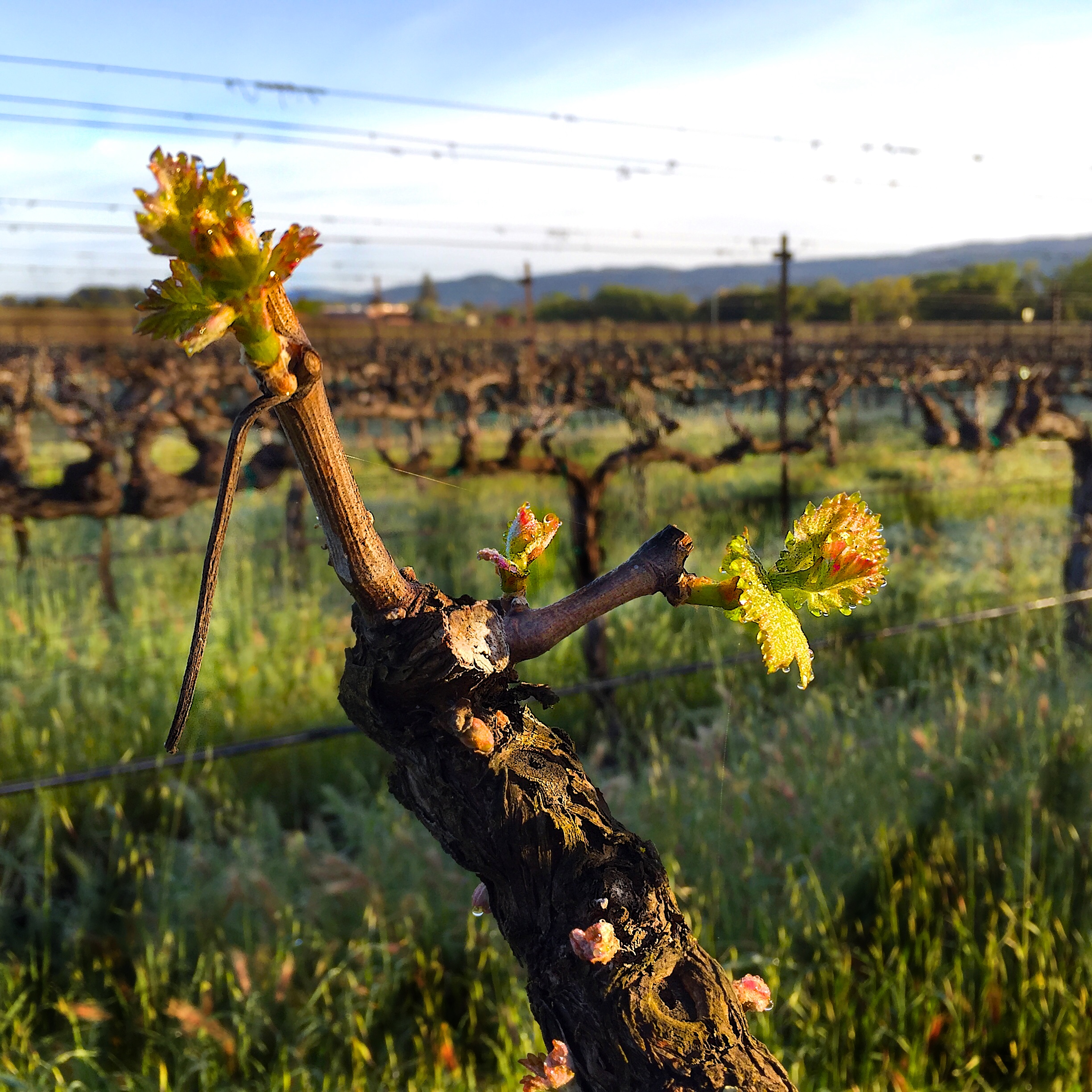
Cabernet Sauvignon bud break in the "cooler" Yountville AVA on 3/26/16
The Napa Valley is well into bud break for cabernet, yes late breaking cabernet, early varieties like chardonnay and pinot burst weeks ago. Even in the north Willamette Valley bud break is on with chardonnay. There is a new "normal" now when it comes to bud break on the west coast. In the Napa Valley, this year is a bit later than last year, even though it’s weeks ahead of years past hardly anyone notices as it just doesn’t seem so late anymore.
It's a good thing this climate change is a hoax, otherwise California might really have something to worry about. After all, harvesting cabernet before the end of September is much more convenient for the winery crew as they can trick and treat with their kids unlike earlier generations of winemakers who were just too busy at the end of October.
Anyone who grows things knows for a fact that the climate is changing. Perhaps if we actually do something about it now, in the future, winemakers will be missing Halloween with their kids once again. That's too bad for the kids, but very good for our planet and for our wines.
Dancing With Wine
"Wine Dance" by artist Janet Ekholm www.janetekholm.com
I love these "new California" wines. Many a night they grace my table and make my meal and my life better. Yet as full of pleasure as they are, they seem rarely profound. The same goes for many so called "natural" wines coming out of Europe these days. Delicious, full of pleasure, exciting, but not profound. Their experience is more in their juicy fresh flavors than their soaring soul. Not that there's anything wrong with that.
Perhaps it was because my palate was hammered on the anvil of the classics that I cannot find profundity here. One of the advantages of being a certain age is that when I was young and just getting into wine in the 1970s, great wines were just minor extravagances no more dear than the price of a dinner at a good restaurant; Lafite, Gaja and Lafon were all under $50. They've put on a few zeros since then.
Today's anvil, that everyone is pounding on, is confusingly called "natural wine". It's an odd phrase as wine, if left totally to its own devices, is just a stopping point on the way to becoming vinegar. While in the past bigger was better, now it seems that being different is, on that merit alone, now better. As usual we replace one oversimplification with another.
For example, much has been said about indigenous yeast fermentation although the science these days points toward the idea that such a concept isn't really possible. Obviously there is still much we do not know about how nature gives us wine. Yet, common sense tells me there must be some difference in regions where indigenous fermentation existed for hundreds of years before yeast were even discovered, much less produced industrially. In these areas natural selection would have refined the yeast population as it is clear from recent research that although we like to think of indigenous ferments as benefiting from a myriad of yeasts to build complexity, in the end one strain wins out and runs the show anyway. But what about the new world where densely packed wineries have been using aggressive commercial yeast strains for decades? It's fair to assume that those strains are now dominate in so called indigenous populations of compact areas like the Napa Valley.
However, this does not preclude that in many cases an indigenous fermentation may produce a more interesting wine than one from cultured yeast. It is also clear that the opposite can produce the same results. In other words anyone who says they know the answer is full of something or other. You can only do what you as a winemaker believe will craft wine to your own taste. Your vision and palate is all you should rely on as it is well proven that no matter the road you choose, if you have skill, great fruit, passion, focus and dedication to what you believe, you will make wines that will turn heads. Maybe not the heads of critics, but those of people who love wine.
Diversity is to be celebrated, but not for the fact that just being different is enough. As exciting as it may be to find an old vineyard in California from lesser known varieties like barbera or fruliano we must remember we do not drink in a vacuum. Yes that juicy barbera from Lodi may be tasty, but it's good to remember that in Italy old barbera vineyards are not a rarity. Forced to pick between a "new California " barbera or an old vine Barbera d'Asti, I know where I'll put my money. Some of this rush towards the obscure is driven by writers who always need something new to write about so diversity in itself becomes glorified as writers also have to find a way to stand out from the pack.
There is also the dirty little secret of many of these "new" wines everywhere in the world. Too many are marred by winemaking faults, which some confuse with terroir. The most common problem I run into is reduction, but the list is long. While not obsessed with squeaky clean wines, I just can't tolerate faults that obliterate sense of place and variety.
That being said I am an unabashed fan of many of these new wines, but that does not preclude loving the classics and once in awhile finding that wine that goes beyond delicious into profundity. Not every variety planted can be profound, but many can be delicious, which come to think of it, is a pretty good thing.
Winemaking is often called art, but to me it is more artisan. Like a fine piece of furniture crafted by a master craftsman or a master chef turning out a classic meal, these are things we live with and that make our lives better. For me this is the most wonderful part of wine. It has a unique ability to bring us together, to slow us down and make us smile. These are the highest callings a wine can aspire to achieve. Anything beyond that is too subjective to quantify.
Is it a wine's job to be profound or to bring pleasure, happiness and health to us? A simply delicious wine with friends, family and food is one the great synergies of existence. Perhaps profound is for museums (aka three star restaurants) and simply delicious is for living.
Delicious wine makes me happy. I can live with that.
The One Per Cent
It took forty-seven percent to make a difference for Mitt Romney. For us it's the one percent. No, we're not joining Boycott Wall Street. Percentages for us are all about blending and every percent matters.
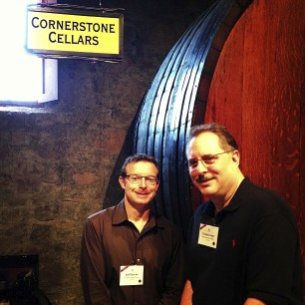
Winemaker Jeff Keene and I show what a percent can mean at Premier Napa Valley Auction 2013
Jeff Keene and I were working on our final blends for our 2011 reds a few weeks ago and it never ceases to amaze the nuance and complexity that can be gained by the smallest changes. It is on the blending table that the soul of the wine comes together. It requires intense concentration and attention to the smallest detail to bring a wine to the perfect point.
There are many ways to blend: different varieties and different vineyards, same variety different vineyards and every permutation you can think of. Yet it's not how you blend, but why you blend that's the most important thing. Different varieties react very differently to blending. Take varieties like pinot noir and nebbiolo and blend them with other varieties you quickly lose their distinctive character. The only real blending choice is to make a single vineyard or multi-vineyard wine. Then there is cabernet sauvignon, merlot and cabernet franc, varieties with assertive character that relish the flourishes added by blending their three spirits.
You don’t start off from scratch, you have a general idea where the wines will take you when you put the first rough blends together. Then you begin to work the permutations. A little more of that; a little less of that and the wine edges closer and closer to what you envision for the wines of this harvest. Finally you’re almost there, but there seems to be something missing. It’s tough to describe or put your finger on, but you know there is more to find, more for the wine to give. It is at this point you discover how important just one percent can be as suddenly the wine comes totally alive from just that small touch of the right variety or vineyard.
This time it was our 2011 Cornerstone Cellars Howell Mountain Cabernet Sauvignon, but it happens with every wine. We were so close with a blend of cabernet sauvignon and merlot, but Jeff and I just felt something was missing. This time the one percent truly made the difference and when we added a tiny dollop of cabernet franc the wine suddenly became brighter, more lifted and, frankly, perfect. It’s our willingness to reach for our vision of perfection that makes the wines of Cornerstone Cellars something truly special. There are many wonderful wines in the world, but sometimes by reaching for just one percent more moves you from wonderful to something memorable.
Cheating On Your Wife
 I had lied to my wife. Every guy in the room had. This was not the kind of thing you could safely share with a spouse. We gathered in the room with an exaggerated good-old-boy bachelor party kind of conviviality. The level of anticipation was high, perhaps too high. It was still afternoon and it felt a bit strange to be doing this in the light of day.
Everyone finally arrived and one-by-one we passed our wad of cash to the host with a sense of excitement and a tinge of guilt for the pleasures to come. After all, wasn't this money supposed to be going into the college fund or buying that new dresser? This was more money than I could easily afford on my rookie reporter's salary at the newspaper and I could only hope my wife would never find out. Our host took the cash and disappeared into another room. A second later, radiating sensuality, they swept into the room and were even more beautiful than we had hoped for in our dreams the night before. There were eight of them, one more exotic than the next. Each was wrapped in a skin tight sheath of aluminum foil just begging to be torn off and marked with a letter so each of us could choose their favorite. An electric energy coursed through me as I unpacked the toys I had brought for the festivities: eight glasses and a notebook. Once again I thought of my wife and how ticked off she we going to be if she found out I had spent our hard earned money on, of all things, wine.
This group of liars was cheating on their wives with our mistress - wine. She was stealing our money and time with our spouses, but we could not resist her charms. We had long passed the flirting stage and this was to be our most amorous liaison yet as we were going to taste Grand Cru Burgundy. None of us had ever spent that much money on wine before. We were at the stage where we had learned more about wine from books than with our tongues and were easily influenced by reputation and label. More than once I had convinced myself to like a wine because someone famous said I should. With this innocence and ignorance we began tasting the eight bottles of Burgundy that our host had tightly wrapped in gleaming aluminum foil as we were doing a “blind” tasting. However, this was not really “blind” as we knew that each wine was an expensive and famous Burgundy. We were prepared to be seduced. Each of the tasters had eight glasses and the table was a crowed forest of stemware. After each of the wines had been poured silence settled on the once boisterous group. Each of us focused our entire concentration each wine as we sipped, swirled, spat and furiously took notes. For the next hour the only sound was the occasional moan or sigh when our mistress hit just the right spot.
I can still remember some of my notes now, which went something like this:
A. Light color, weedy earthy aromas...
B. Light color, earthy, dried leather and cheese...
C. Light color, vegital, smoked bacon. plastic...
So it went for the next hour. When everyone finished it was time to compare notes and come up with a group rationalization for why these wines were not the other-worldly experience we had anticipated. They were strange and not very satisfying. We soon came to the conclusion that problem could not be these famous wines, but that it must be us. Our palates were not well honed enough to understand the complexities of these great and famous wines. Those odd aromas and flavors must be that magical ingredient terroir that the French use to describe the unique personalities of each vineyard that make each single-vineyard wine distinct. Those leather, cheese and bacon smells had to be terroir. Now it was our duty to keep learning and tasting until we could come to understand and appreciate them.
As I look back on this event over thirty years ago, I have learned to understand and appreciate the true glories of Burgundy, none of which could be described as weedy, cheesy or sweaty. I have also learned that those wines that made me feel inadequate in that tasting three decades ago would have better been poured down the drain. Those wines were faulted - full of brett and VA. We were just too young and too intimated by the names and prices of those wines to know the difference. Fortunately I soon learned the difference between terroir and wine faults. Wine faults are a major concern of mine as time and time again I run into wines that are loaded with faults that go undetected in many large tastings. All to often I lift a glass to my nose from an almost empty bottle to find it severely faulted with TCA (corkiness), brett or a range of other faults. At the recent Wine Bloggers Conference there was a lot of debate about ethics, but none about knowledge and tasting technique. If wine bloggers want to be taken seriously, it's far more important that they can spot brett and other faults than if they take samples from producers for free or not.
These memories were jogged by a bottle of 2004 Thomas Dundee Hills Pinot Noir that I pulled from my cellar to share with my good friend, winemaker Donald Patz. Always looking to bring something that he probably hasn't tasted (no easy task) I grabbed a bottle of this hard to get Oregon cult wine. Upon pulling the cork we were treated to a perfect example of brett. Needless to say, it was a great disappointment and we left the bottle, still mostly full, on the table when we left the restaurant. Thirty years ago we may have forced ourselves to accept such wines, but today there are no excuses. Winemakers have the finest laboratories available to them and far more knowledge than the winemakers of the past. Brett needs to be recognized and recognized for what it is - a fault that obliterates varietal character and terroir - which are the two most important things for me in a wine.
Not long after that tasting of three decades ago I entered the wine business. We were importing the Italian wines of Neil Empson and doing tasting event after tasting event. Neil and I would open hundreds of bottles over several days. Every time Neil found a corky bottle, which was often in those days, he'd shove the wine and the cork under my nose. Soon I got it and ever since have been hyper-aware of that musty TCA smell. We should all do what Neil did and every time we find a faulted bottle we need to shove it under someone’s nose. While winemakers have no business making faulted wines, we (especially wine writers) have no business missing those faults.
Alcopop
Wine world outraged at Channel 4 'Dispatches' doc - decanter.com
Winemakers were apparently offended by this television report referring to industrial produced wines as "alcopop". Producers like Blossom Hill, Jacob's Creek and Yvon Mau all had their feelings hurt. The thing is that the report was correct. Producers like these are producing a beverage using a recipe designed to produce a specific, repeatable result. The results and the philosophy applied are no different than those used in the production of Coca Cola. To complete the analogy, many of the executives that run these companies and market their wines move freely from beverage company to beverage company moving between companies like Coca Cola, Red Bull and Mondavi with no problem as the production and marketing issues are the same. There's a lot more alcopop being sold in the world than wine.
Powered by ScribeFire.
Worth Reading: Reconsidering Sulfites from The San Francisco Chronicle
“Long viewed as a necessary, if unromantic, tool by winemakers, and either ignored or completely misunderstood by consumers, the role of sulfur in wine has become a hot topic. From health issues (see”Debunking myths,” Page F4) to sulfur as a winemaking tool at a time when there’s a push within the industry for wines made with minimal intervention, sulfur dioxide is in the spotlight like never before.”
A Deepening Hatred
 There are certain wines you just treasure. You go to your cellar to get the bottle with a sense of pleasure and anticipation. Often these bottles are rare. You have just a few bottles, or, even more exciting, it's your last bottle.
Most wines that give me such feelings are red, but in this case it was a bottle of white wine. I was only able to get a few bottles of the current releases from Domaine Alice & Olivier De Moor's wonderful domaine in Chablis. The star of the group was the 2005 Chablis Bel Air et Clardy, of which I got only two bottles in my allocation from Chambers St Wine Merchants. The first was exceptional. Tight and firm with a delicious minerality and never-ending finish, it was everything you could hope for in a chardonnay.
Now I know I should have waited. I should have let it age a few more years, but the crab legs were just too perfect and too fresh and I could not resist. Off I went to get the bottle with the excitement I mentioned above. I pulled the cork, poured the wine and raised the glass to my nose. It was so corked I almost gagged. No little corkiness here, but a glass full of smelly, offensive junk.
I am developing a deepening hatred of corks. Enough is enough.
Spoofulated: Wine Blogging Wednesday
 It’s Wine Blogging Wednesday and hosts Erin and Michelle of The Grape Juice Blog have chosen the letter “S”, with a tip of the hat to Sesame Street, as the topic of the day. Immediately I thought of one of today’s hottest wine topics: Spoofulation.
Alice Feiring rages against the machine. Natural wines are the only wines. The problem is, of course, is that no one agrees on what natural wines are. There are natural, organic, biodynamic and sustainable growers and winemakers, but not one definition of what is natural wine exits. Except, of course, for Alice’s and she is sure she is right. The term that has arisen to describe over-manipulated wines is spoofulation, but is spoofulation the opposite of Alice’s version of natural wines? I don’t think so. There are many wines that would not meet Alice’s requirements that are clearly not spoofulated.
 What is spoofulation? That now ingrained term, to me, more than anything else, refers to wines of excess: excessive concentration, excessive oak, excessive alcohol and minimal terroir and varietal character. Spoofulated wines are wines that could come from anywhere and any variety. By my definition that does not mean that un-spoofulated wines have to be “natural” or “organic” or “biodynamic”, but without a doubt it appears to help. The reason I say they don’t have to be any of those things is because I have tasted many wines over the decades that not only did not employ these disciplines. but never heard of them. There are many wines from the 60’s that are pretty damn good and I assure you they never thought of such things. They worked with what they had and what they knew and used things in their vineyards that would cause outrage today.
Spoofulation, much like the Supreme Court’s definition of pornography, is something I know when I taste it. Spoofulated wines throw balance over the side in a headlong pursuit of points. It is an approach I can understand as wine producers have to make a living like any other farmer. Points from the Pontiffs sell wines to hoards of consumers who drink wine more often without food than with it. The point of spoofulated wines is to grab enough attention in a ten second taste to get a good review and to prevent the consumer from having any more thoughts about the wine, so they can return to their conversation. Spoofulation cannot be defined as “big wines” or “high alcohol wines” or anything other than wines that erase any individual character in pursuit of the lowest common denominator. Spoofulation is to wine what religion was to Karl Marx.
Spoofulation is so much a part of today’s wine vocabulary that a debate has begun on the etymology of the term. Joe Dressner, the importer, whose portfolio is spoofulated wine-free, recently reported on the birth of the term spoofulation on his blog, The Wine Importer, where he recounts the debate over how the word was coined by Harmon Skurnik of the extraordinary importer and distributor Michael Skurnik Wines in New York and Michael Wheeler, formerly of Michael Skurnik Wines and now of that extraordinary importer and distributor in New York, Polaner Selections. Please be prepared to keep your tongue firmly in your cheek as you read this post.
In the last few years we have welcomed a new word beginning with the letter “S” into our wine vocabulary. Now we have to work on defining it.
| Share this post : |  |  |  |  |  |  |  |  |  |
Corks Screwed
 Screwcaps are best: Decanter verdict - decanter.com
The normally conservative Decanter has jumped into the closure controversy with both feet. In an upcoming article “50 Reasons to Love Screwcaps” some of Decanter’s big guns, including Steven Spurrier have thrown their unequivocal support behind screwcaps. Spurrier says, “the Stelvin is one of the best things to have happened to wine in my lifetime.” If you follow the link above you’ll find not all Decanter readers agree.
In a recent post I commented on the new book by George Taber, Put A Cork In It, which I feel is the best research out there on the topic of wine closures. Taber’s conclusion was more-or-less it depends on the wine going into the bottle and that each of the closures currently in general use have their issues and unknowns. Everyone seems to agree that for wines destined to be consumed young and fresh that screwcaps are the best, which is a position that I fully concur with. As this category of wine probably accounts for over 95% of the wine made in the world it would seem to make this debate somewhat moot. Such wines should be in screwcaps.
However, for that five or so percent of wines from vineyards and winemakers that are made for aging the answer is not so clear. I have a feeling that eventually alternative closures will overtake this category too as industry leaders like Plumpjack prove their reliability and their capability for wines aged under screwcap to mature into wines as great as those aged under cork.
I admit I love screwcaps and have found the wines finished with them brighter and fresher than most cork finished wines. This is amplified with high acid white wines and riesling in particular seems to thrive under them. The big issue with screwcaps remains the potential of reduction developing in wines sealed with them, but winemakers have quickly dealt with this issue and should know how to prevent it. Of course, knowledge is not always used equally by all wineries, but you can apply this same argument to those using corks.
I can understand why a great Bordeaux chateau or Napa Valley Cabernet Sauvignon producer may want to wait before making the leap, but if you’re making Beaujolais Villages, Montepulciano d’Abruzzo, Albarino, California Sauvignon Blanc or any other wine likely to be consumed within a year or two of bottling it’s time to get your cork out of your neck.
Old vs. New: Is there a difference?
 Pamela at Enobytes graciously invited me to moderate a discussion on their Enobytes Forum on New World vs. Old World Wines: is there really a difference. To help fuel the discussion, I posted this comment:
In my experience there is a significant difference between European (Old World) and New World wines. I do not believe the reason for this is a superior terroir, but a way of thinking. Europeans cannot separate wine and food. I have never met a serious European winemaker whose vision of their wine is tied not only to the table, but to their local cuisine. They also describe the wine in those terms. If you use America as an example of the New World philosophy I think you will see our wines are conceived very differently and and consumed differently and these differences cause them to be made differently.
Let's look at consumption first as consumers fuel the fire so to speak. European consumers do not drink still wines as cocktails, before dinner they enjoy a whole range of aperitifs (including a lot of sparkling wine), but they don't sit around and gulp pinot grigio or merlot. One quick look at an upscale American bar and you'll see a very different picture as a majority of the customers are drinking wine as a cocktail, not as a companion to food. Oddly enough in recent years this includes red wines and a more unlikely cocktail I cannot imagine! This means that European winemakers can make their wines knowing they will be enjoyed with food, but that American winemakers must take into account that their wines will be served with conversation instead of cuisine. The very thing that makes European wines so wonderful with food: acidity, dryness and structure makes them difficult cocktails.
So New World winemakers are met with more than one dilemma. First they must make wine that can work as a cocktail. Secondly, it is more important to their commercial success that their wines taste great when compared to other wines instead of how well they work with food. Success is tied to top ratings by critics using the 100 point scale who taste wines against each other in a context more like an endurance sport. I can't think of something more radically the opposite of what wine enjoyment should be than tasting dozens (hundreds for some tasters) of wines blind in rapid fire succession and then ranking them.
I think it is this combination of the pressure to get points and to please consumers that drink wine without food that causes the major differences you see in New World wines and Old World wines. If you go back to California wines of three decades ago they were not so different from Old World wines. Over the years the demands of the market have forced producers from those more elegant styles of years past and replaced with with the fruit bombs that seem that seem so over-the-top to those who prefer more balanced wines crafted for the table instead of those formulated for competitions. Certainly there have been many Old World wines guilty of these excesses too as they courted the American market, but fortunately that attack is clearly in retreat.
There is no doubt that some European producers, notably in Spain and southern Italy have gone down this "International Style" of winemaking route. Considering the amount of wine they need to sell, their making what seemed like the best commercial decision at the time is understandable. One commenter noted that he was finding it hard to distinguish between a zinfandel and primitivo and I think that points out why what seems to be a good commercial decision is a bad one. If primitivo tastes more or less like zinfandel, why bother to import it? It seems to me that primitivo would be better off if it tried to have a distinct style. Sicily, a place with wonderfully distinct wines has tried to turn itself into another Australia (often using Australian trained winemakers) and has destroyed its market in the USA. Why drink a nero d' avola from Sicily when a shiraz from Australia tastes just like it for several dollars less a bottle? Some European producers have achieved short term success using this strategy, but I think in the long term as they become just another big, fruity red wine they will lose their markets to cheaper competitors.
There are many American producers that make wines that would be difficult to identify as being New World in blind tastings, but the majority have chosen a more commercially viable direction and are making the wines that the market and the press like. There is nothing wrong with this as a winery is an agricultural business that has to make a profit. Only when consumer preferences change, either here or in Europe, will it become harder and harder to tell the difference between Old and New World wines.
| Share this post : | | | | | | | | | |
Natural Spoofulation
 The passionate Alice Feiring and her new book, The Battle for Wine and Love, have fanned the flames of the natural winemaking debate. In particular she has bruised the feelings of the California wine industry, to which she has not been very complimentary. This has resulted in some lively back and forth on the side of the Californians in The Los Angeles Times, hardly a surprising forum for the pro-California view. I applaud Alice’s spirited attack on industrial wines and support of wines with personality and a sense of place. Her intensity has helped keep the debate a debate.
Extreme positions help sell books and it looks like Alice has done a good job in riling up the Californians and keeping her book in the headlines. I’m sure if the truth came out Alice, like me, has a long list of California wines she loves.
It’s becoming the spoofulators vs. the natural movement and the main spoofulators seem to be in California. Yet this raises the question of what’s really natural or not and at what point the line is crossed from one to the other. It’s not as clear as it may seem. At some point it is just as bad to do too little to the wine as it is to do too much. Bad wine is bad wine, natural or not.
Let’s take a look at the revered (I agree) wines of Josko Gravner in northeastern Italy on the border with Slovenia. Gravner ferments and ages his white wines on the skins and seeds for six or seven months in terra cotta amphorae coated with beeswax. This has a somewhat dramatic (to say the least) impact on the flavor and color of his wines. Is this natural winemaking or a kind of natural spoofulation? The wines of Gravner are extreme wines manipulated to that style by the hand of the winemaker. Are the techniques of Clark Smith more intrusive than this? I’m not sure this is a question that has been answered.
There are a few buzzwords out there that seem to define the natural wine forces: biodynamic, indigenous yeasts, little or no sulfur and never, never any machines. Yet there are a whole array of interventions other than these that winemakers impose on their wines either because they dream of crafting great art like Gravner or because they are commercial winemakers that must put out a good tasting stable wine year-after-year to keep their jobs. It seems a bit preposterous to return to primitive methods of winemaking that more-often-than-not have the potential to produce faulted wines. Not all progress is inherently bad and any good winemaker will do everything needed to improve their wines. Many winemakers resolve this conflict between their desire to be part of the natural movement and the realities of putting better wine in the bottle by forgetting to talk about certain things when they talk to the press.
Great wines are made, they don’t just happen. That’s why they call them winemakers. There is an incredible array of tools and knowledge available to today’s winemakers. To not make use of any of these tools and techniques does not make any sense. However, what you do with these many new tools is all important. You can’t make wine without manipulation, but without a doubt you can’t make great wine with with over-manipulation. I believe in terroir. I have tasted it in wines way to often to have any doubt. As long as a winemakers manipulations are designed to enhance that terroir I don’t have any problems with them.
| Share this post : | | | | | | | | |
Take Five White Rabbit
The guy next to me kept screaming “White Rabbit!” at the top of his lungs for the better part of two hours. It was a Jefferson Airplane concert in 1971 and the band, despite a change of personnel could not escape their hits. No matter how well they played that guy would only be happy if they played White Rabbit.
Last week, while attending a performance of the Dave Brubeck Quartet, a true jazz legend and creator of West Coast Jazz, the guy in front of me screamed “Take Five!”. It seems no matter how many decades pass that fans are more interested in hearing your hits instead of your music. In Brubeck’s case he has progressed far beyond his Take Five days and created am amazingly diverse body of work. Yet, even with all he’s done since Take Five was recorded in 1959 I’m willing to bet that the majority of concert goers were there to hear Take Five, which is probably the only jazz composition most could name from memory. Of course, I’m sure few of them knew that the piece they were screaming to hear was not written by Brubeck, but by the late, great Paul Desmond, who played saxophone for The Dave Brubeck Quartet when they recorded Take Five.
Winemakers face the a similar dilemma. Once you get a big score, your big hit, you can feel locked into that style. It takes great courage to evolve your style in a way you believe in instead of just playing the same old hit over and over again. What most consumers don’t understand is that a winemaker can be relatively unhappy with a wine even though it gets a high score. As difficult as it is to believe, behind closed doors winemakers are often amazed at a high score they’ve received. What happens if you get a 93 from Robert Parker on a wine you’re not particularly pleased with? Do you keep making that wine or follow your own vision?
Brubeck seems to have resolved this dilemma perfectly as when he did finally play Take Five for the crowd, it was not the Take Five of 1959, but a piece that reflected the talents of the current Dave Brubeck Quartet. While it started with the famous chords and catchy quintuple time, it soon evolved, in the great tradition of jazz, into a distinctive exciting performance with a personality all its own.
Great winemaking should take its cue from the improvisational spirit of jazz as each vintage is a singular performance that deserves its own riffs.
Technorati Tags: wine, jazz, Brubeck, Take Five
| Share this post : | | | | | | | | | |
Alcohol Is Not The Demon
 There have been major rants and counter-rants (their words not mine) lately about high alcohol wines by Alder Yarrow at Vinography and Thor Iverson at oenoLogic, there's lots of good thinking, interesting reading and great debate in these two posts. However, I think they miss the major point on this issue.
Nobody who has tasted a lot of wine can deny that they've tasted many wines with high alcohol that worked. Wines that despite their potent alcohol were balanced, interesting to drink, complex and great with food. There is also the reality that not all varieties are created equal when it comes to gracefully carrying high alcohol levels. For example the elegant pinot noir is often overwhelmed by alcohol levels that zinfandel and syrah lightly carry.
The issue should not be the alcohol level of the wine, but if the wine tastes balanced and still reflects the 3 V's of great wine: variety, vineyard and vintage. It is here that higher alcohol wines often fail, but the reason is not the alcohol level itself.
The faults often blamed on high alcohol come not from alcohol itself, but the fact that the grapes were harvested super-ripe, which is just another word for overripe. These overripe grapes, which are the fashion as one of the routes to pointy wines, obliterate the three V's as varietal character disappears as does the personalities of vineyard and vintage. A byproduct of these overripe grapes is high alcohol, which is created by combining exaggerated sugar levels with super-efficient cultured yeasts that can keep eating sugar and excreting more alcohol no matter the alcohol level in the fermenter. In the old days all the yeasts would have died, but today's macho yeasts can handle 16%+ with no problem. The result of all this is a wine with huge fruit flavors of indeterminate origin, 4.0 pH, 15% alcohol and 90+ points. Of course, it has only a generic personality as it could come from anywhere as can easily be seen in wines from Spain, Australia and California that are totally interchangeable and indistinguishable. After all, what is an appropriate alcohol level for a stateless wine with no varietal character?
The first issue should be if the wine has any personality at all before we get to the alcohol level. Once that issue has been resolved we can think about wether the alcohol level is appropriate. Appropriate alcohol levels also should vary by vintage and a winemaker that makes natural wines will have alcohol levels that change year-to-year. My experience is that even in hotter vintages that produce higher alcohol levels well made wines will achieve a balance that works, although it may take some time to attain equilibrium. No, wines from a hot vintage may not be the best a producer makes, but they can be excellent wines. The key issue for the winemaker is to harvest ripe, but not overripe grapes each year if they wish to produce distinctive wines. Ripe grapes produce wines with alcohol levels that will find a natural balance in the wine of that year, but wines from overripe grapes produce not only out of balance alcohol levels, but cannot achieve any kind of natural balance as every aspect of the wine becomes distorted and exaggerated.
It's overripe grapes, not demon alcohol, that are the villains in this debate.
Debating Points: Spoofulation
 I find George Will particularly irritating. The conservative columnist and television commentator is just too smart and well-spoken. All too often in face-to-face debates he shreds the argument of the liberal commentator across the table from him with his swifter wit and broader knowledge. It ticks me off no end.
In the debate about so called “natural” winemaking we have the same situation. Clark Smith, winemaker, super-consultant and king of spoofulated wines as the owner of Vinovation, is becoming as irritating to me as Will and for the same reasons. Smith, who makes his own wines besides consulting and “correcting” wines for hundreds of wineries, just has too much knowledge and experience for it to be a fair fight when it comes to debating winemaking ethics with people who have never made wines themselves. All to often these people are known as wine writers. It does surprise me how many writers who have don’t have enology degrees and whose experience working harvests is more akin to adventure vacations than real winemaking come to consider themselves winemaking experts. After all, does a trip to a dude ranch make you a cowboy?
Smith uses his superior knowledge and experience to effectively dismantle the “natural” winemaking debating team’s positions (which I mostly agree with) as he did in a recent article published on Appellation America’s website called Spoofulated or Artisanal, which is well worth reading. Spoofulated, for those unfamiliar with the term that debuted on the Wine Therapy Forum and became part of wine lingo, refers to manipulated wines, which are often made in a style that appeals to Robert Parker and The Wine Spectator. It is a word used as an insult by those seeking a more terroir-driven winemaking experience as spoofulated wines all-to-often taste more-or-less the same.
Is spoofulation always evil? I don’t think so. Commercial wines, which are produced for consumers not seeking nuance or complexity, but just a “winey” tasting beverage are better wines than ever due to these techniques. For all to long these inexpensive wines produced in huge quantities were thin and faulted. However, now those seeking nothing more can easily buy clean, fruity wines that neither require nor invite thought or contemplation. It is a fact of the market that the vast majority of consumers are perfectly satisfied with such wines and want nothing more. Clark Smith and his methods are a positive boon to such consumers.
It’s when wines pretend to more lofty goals that Clark Smith and I part company. I’ll draw an arbitrary line at the $10 a bottle point. That’s starting to get expensive and I think the consumer has a right to expect that wines with different labels will actually be different wines. The main problem with spoofulated wines is that they all taste the same. The differences get manipulated out as the wine is more-and-more manipulated. The fact that there are so many expensive New World wines that exhibit the bright simple ripe flavors of the commercial wines mentioned above is a real problem that is starting to destroy the reputation of places like the Napa Valley. Consumers that are willing to spend a significant amount of money for these wines are starting to realize how boring they are.
On the other end of the argument are writers who are “natural” wine fundamentalists who seem to believe the high point in winemaking knowledge was achieved by the Romans and any technique or knowledge achieved after Nero are unnatural manipulations that destroy a wines terroir. Of course such extremists only display their limited winemaking knowledge and a lack of sophistication as they (instead of the wines) are manipulated by winemakers who tell them only what they want to hear. While there are many winemakers who believe in and practice minimalist, natural winemaking, there are few to none willing to let several tons of fruit in a fermenter with problems become garbage without taking actions that don’t always meet these ideals. These are stories that journalists are unlikely to hear or understand if they did. Contrary to some writers opinions, winemakers sometimes actually have to make wine.
Spoofulators like Clark Smith and biodynamic guru Nicolas Joly actually have more in common than partisans on either side of the debate understand. Both are passionate, brilliant winemakers who are driven to pursue their vision of what makes a wine great. To make a truly great wine you need to ignore the ranting of journalists and the whims of consumers and make the wine you believe in. This is something that winemakers like Smith and Joly share.
As always, those that oversimplify issues are usually blinded to the finer points of the debate.